Decades of measles records reveal how births, school-season transmission, and changing population susceptibility combined to shape recurring epidemics, offering fresh clues about what signals could precede the next outbreak.
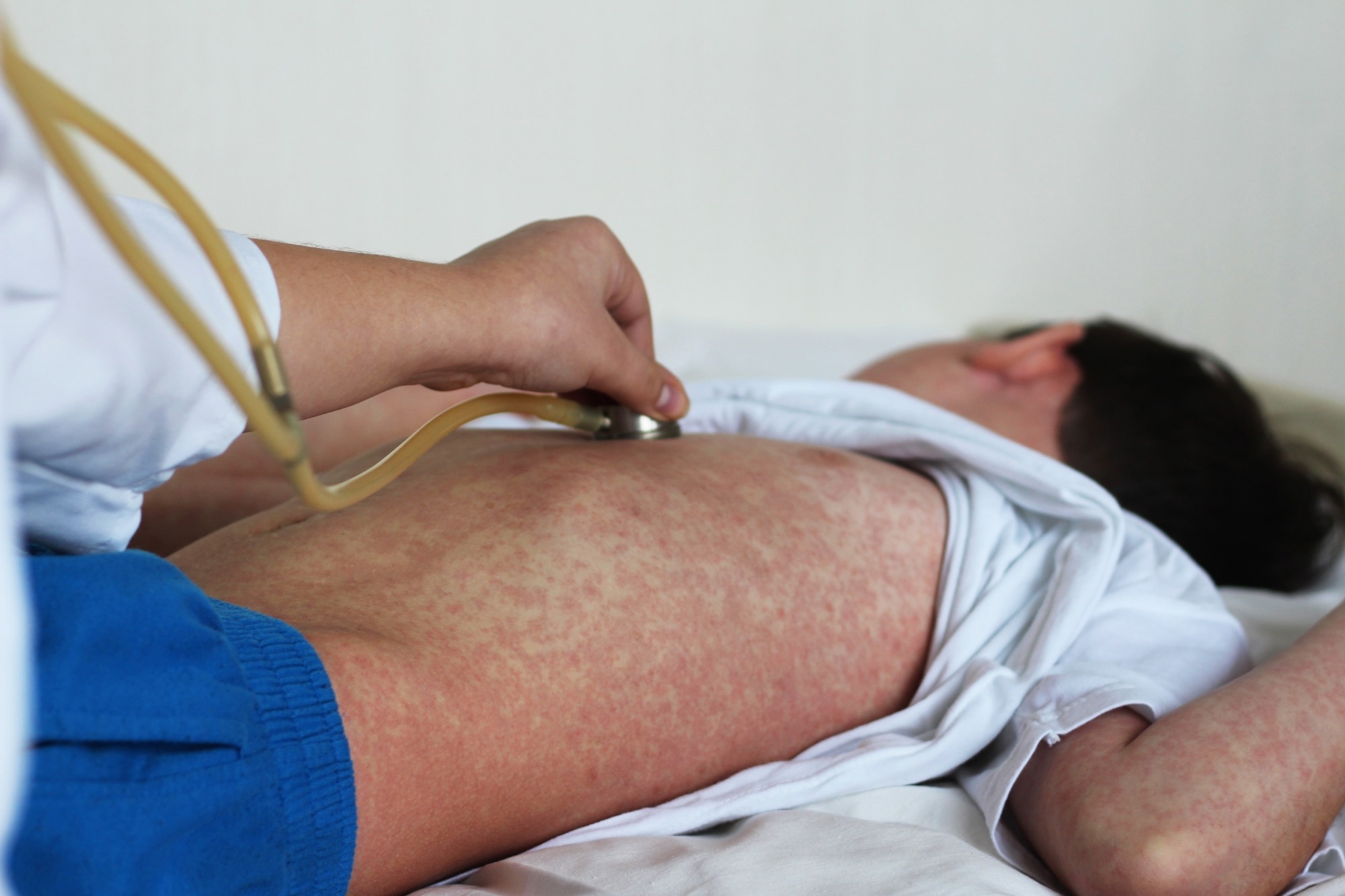
Study: Predicting measles outbreak magnitude via modeled population susceptibility evidence from pre-vaccination data. Image Credit: fotohay / Shutterstock
In a recent study published in the journal Scientific Reports, researchers applied and evaluated a discrete-time mechanistic epidemiological model to reconstruct population susceptibility and assess its ability to predict the magnitude of recurrent measles epidemics. The model was fitted to historical weekly surveillance records and demographic data from England and Wales, including the five largest English cities, during the pre-vaccination era (1948 to 1968).
The analysis found that the reconstructed pool of susceptible individuals at the start of each year (S0) was strongly associated with the observed epidemic attack rate (AR) in the following year. For England and Wales, reconstructed S0 showed a very strong relationship with the observed attack rate in the following year. These findings suggest that combining routine birth registrations with disease surveillance could support one-year-ahead forecasting of outbreak magnitude in comparable settings.
Background
Measles is an acute, highly contagious disease caused by the measles virus (MeV). Previous research has established that natural MeV infections typically confer lifelong immunity, indicating that sustaining high and equitable population-level immunity is necessary for disease control.
Historical records show that prior to the introduction of the national vaccination program in the United Kingdom (UK) in 1968, measles was an almost universal childhood disease, causing an estimated 135 million cases and over 6 million deaths globally every year, with nearly all children infected by age 15.
This pre-vaccination era was characterized by irregular, often biennial epidemics, with seasonal changes in contact among schoolchildren and the ongoing recruitment of susceptible newborns shaping transmission patterns. Linking mathematical models to real-world surveillance data in ways that capture epidemic patterns and support practical forecasting remains challenging.
About the study
Researchers examined annual measles transmission using a discrete-time age-of-infection model and assessed whether reconstructed susceptibility could predict the magnitude of subsequent epidemics.
The study dataset was derived from historical weekly case reports from the British Office of Population Census and Surveys (OPCS). Demographic data included birth records and annual population estimates for England and Wales, as well as for five major cities: London, Birmingham, Liverpool, Manchester, and Leeds.
The model operated on a daily time step, using a literature-based generation-time distribution with a maximum infectious period of 21 days and school-holiday calendar terms to capture shifts in contact rates.
Five parameterization schemes were compared. Model fit and parsimony were assessed using the Akaike Information Criterion (AIC) and Bayesian Information Criterion (BIC). Parameterization 3 had the lowest BIC across all six regions and the lowest AIC in five of them. This specification used shared estimates for the basic reproduction number (R0), holiday transmission reduction (δ), and reporting dispersion (κ), while allowing initial population susceptibility (S0) and initial infections (I0) to vary each year.
Study findings
Parameterization 3 showed strong agreement between modeled and observed annual attack rates across all six investigated regions. Under this specification, R0 estimates fell within the range reported in earlier studies, and mean initial susceptibility was about 4% to 5% of the population across the six regions.
Reconstructed S0 was inferred from surveillance case counts and demographic data rather than measured directly, leaving it sensitive to reporting bias, demographic uncertainty, and model assumptions. Agreement between fitted and reconstructed susceptibility also varied by region, with clearer discrepancies in Liverpool, Manchester, and Leeds.
A central result was that the reconstructed S0, derived from birth counts and case notifications, was strongly associated with the subsequent year's observed attack rate. The relationship was strongest for England and Wales and remained evident across all five cities, though its strength varied by location.
The model also estimated regional differences in observation variability and indicated that transmission fell by about 20% to 33% during school vacation periods.
Conclusions
The present study suggests that the replenishment of susceptible individuals through births, together with seasonal changes in school contacts, helps shape the timing and size of measles epidemics. It also indicates that reconstructing annual susceptibility from standard public health data can act as a surveillance-based predictor of subsequent outbreak magnitude within the historical data examined.
The study was limited by its deterministic model, incomplete and potentially time-varying historical reporting, annual re-estimation of initial susceptibility and infections, and reliance on literature-based values for some parameters. The model also lacked an explicit age structure and detailed social mixing, and its absolute fit was poorer than that of several existing models applied to the same or overlapping data.
The analysis shows how historical surveillance and demographic records can be used to study how susceptible populations accumulate between outbreaks. The authors note that further methodological development would be needed to extend the approach to contemporary surveillance settings, including under-vaccinated populations.
Journal reference:
- Dor, E., Yaari, R., & Huppert, A. (2026). Predicting measles outbreak magnitude via modeled population susceptibility evidence from pre-vaccination data. Scientific Reports. DOI: 10.1038/s41598-026-61920-w, https://www.nature.com/articles/s41598-026-61920-w
 Cross-reactive T cells target measles and dangerous Nipah viruses