From menstrual pain to ovarian aging, researchers are investigating how compounds in strawberries interact with the biological processes involved in women's reproductive health.
Strawberries and Their Bioactive Compounds in Women’s Reproductive Health and Related Diseases: A Narrative Review of Preclinical and Clinical Evidence. Image Credit: Volodymyr TVERDOKHLIB / Shutterstock
In a recent narrative review published in the journal Nutrients, researchers in the Department of Gynecology and Obstetrics at Johns Hopkins Medicine, USA, assessed evidence on the potential role of strawberries and their bioactive constituents in female reproductive health and disease.
Altered extracellular matrix (ECM) remodeling, oxidative stress, metabolic abnormalities, mitochondrial dysfunction, inflammation, and hormonal dysregulation influence female reproductive health and disease. Some of these pathways are implicated in common gynecological disorders, such as endometriosis, polycystic ovary syndrome (PCOS), and uterine fibroids.
Treatment for reproductive disorders includes pharmacological interventions, hormone therapy, and surgery. These approaches may have adverse effects, raise long-term safety concerns, or, in some cases, affect reproductive function or fertility. These limitations have prompted investigations into potential dietary interventions that may influence the implicated biological pathways.
Strawberries are well known for their abundant bioactive phytochemicals and nutritional value. Bioactive compounds in strawberries have shown biological activity in experimental studies, suggesting potential benefits for reproductive health.
This review summarizes available evidence on the potential role of strawberries and their bioactive constituents in female reproductive health and disease.
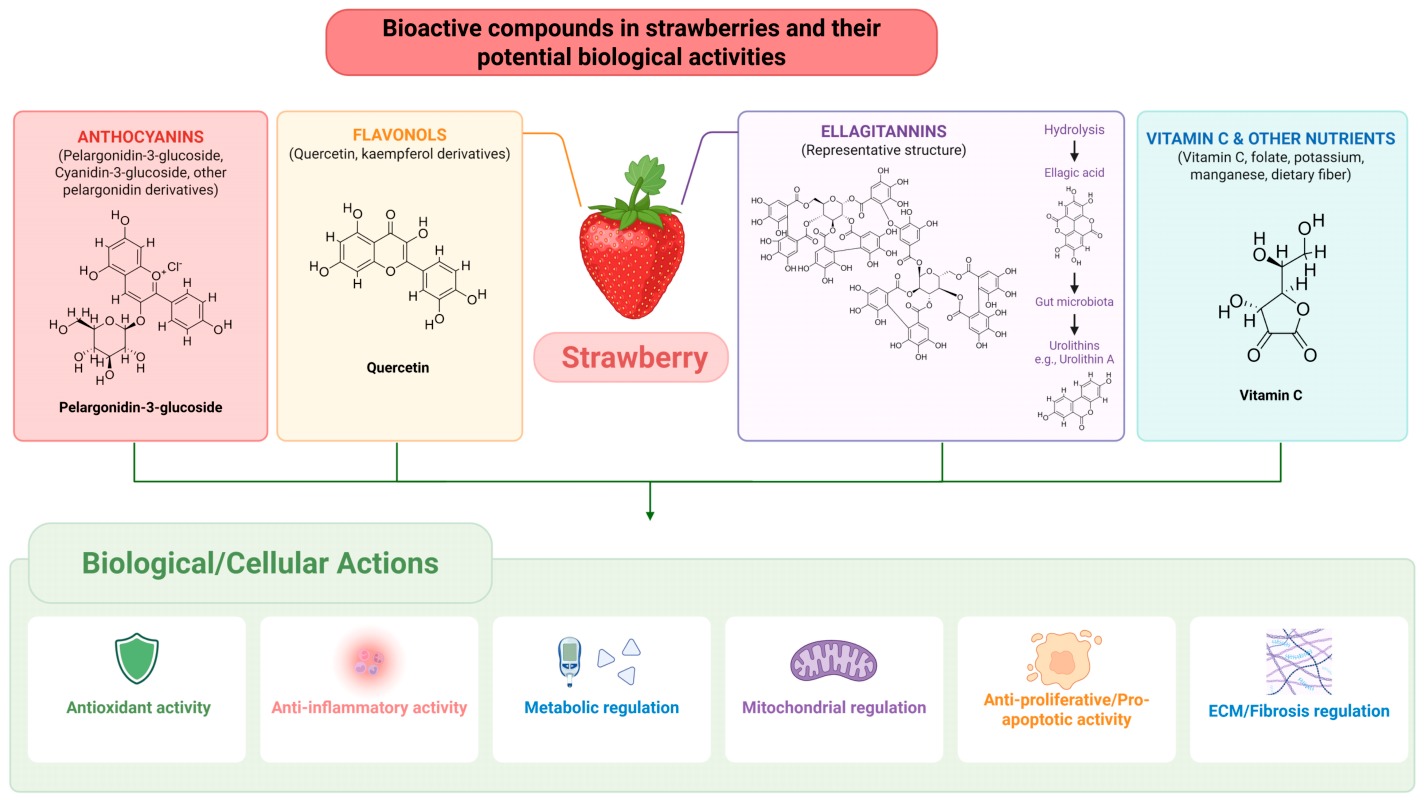
Major bioactive compounds in strawberries and their potential biological and cellular effects. Strawberries contain diverse bioactive constituents, including anthocyanins, flavonols, ellagitannins, vitamin C, and other nutrients. These compounds may contribute to multiple biological and cellular actions, including antioxidant and anti-inflammatory effects, metabolic and mitochondrial regulation, anti-proliferative/pro-apoptotic activity, and modulation of ECM and fibrotic pathways.
Strawberries and reproductive health
Strawberries contain a range of bioactive compounds, such as anthocyanins, flavonoids, phenolic acids, and ellagitannins. These compounds have shown anti-fibrotic, anti-proliferative, antioxidant, and anti-inflammatory effects in experimental models and may affect biological pathways relevant to female reproductive health, including inflammation, cellular aging, oxidative stress, and metabolic dysfunction.
Preclinical studies indicate that certain bioactive compounds in strawberries may influence oocyte maturation. For instance, cyanidin supplementation during bovine oocyte maturation improved embryonic development and blastocyst quality and reduced apoptosis and oxidative stress. Supplementation with ellagic acid, an ellagitannin metabolite, during porcine oocyte maturation in vitro reduced oxidative stress and improved blastocyst development.
Urolithin A, a metabolite of ellagitannins produced by the gut microbiota, was found to protect porcine oocytes from oxidative damage. In experiments involving neonatal mouse ovaries, it reduced chemotherapy-induced follicle apoptosis and premature follicle activation. Urolithin A treatment increased reproductive lifespan in Caenorhabditis elegans and maintained oocyte quality with age.
In laying chickens, ellagic acid supplementation has been shown to increase ovarian weight, antioxidant defenses, and the number of small yellow follicles; complementary in vitro analyses revealed improved mitochondrial function, reduced oxidative stress, and attenuated granulosa cell aging. A bovine study found changes in antioxidant-related gene expression without improvements in embryo development. These findings do not establish fertility benefits from eating strawberries.
Clinical research has also examined strawberry consumption in postmenopausal women, focusing on cardiovascular rather than reproductive outcomes. In a trial among postmenopausal women, freeze-dried strawberry powder was associated with reductions in blood pressure and arterial stiffness from baseline, but no significant differences between treatment groups were detected, and menopausal symptoms were not assessed.
Strawberries and reproductive diseases
A study showed that strawberry extracts decreased cell viability and glycolysis, modulated pathways involved in ECM production and fibrosis, and increased reactive oxygen species (ROS) and apoptosis in human uterine fibroid cells in vitro.
A subsequent study found contrasting responses in normal myometrial cells, with increased viability and reduced ROS, compared with decreased viability and increased ROS in fibroid cells.
A randomized controlled pilot trial involving 64 women with primary dysmenorrhea found a significant reduction in menstrual pain and a higher perceived health status in the group assigned to consume 250 g of fresh strawberries daily for a month compared to controls. The small, open-label trial relied on self-reported outcomes and had no placebo control.
Experiments involving ellagic acid and urolithins affected endometriosis-related cell behaviors, but no studies have established benefits from eating strawberries for endometriosis, adenomyosis, or benign ovarian cysts.
Another randomized controlled trial involving 60 women with PCOS found that eight weeks of supplementation with 200 mg daily of purified ellagic acid reduced insulin resistance, fasting glucose, inflammatory markers, blood lipids, and selected hormone levels compared with placebo. The trial did not test strawberries or establish improvements in ovulation or fertility.
A methanolic strawberry extract induced apoptosis and reduced cell viability in the T47D human breast cancer cell line. In a mouse model of breast adenocarcinoma, oral administration of the extract inhibited tumor progression and improved survival.
A screening study of polyphenol-rich extracts from different berries in human cervical cancer cells identified strawberry extract as one of the most effective, demonstrating anti-proliferative activity. Phenolic extracts from methyl jasmonate-treated strawberries increased apoptosis and reduced cell viability in cervical cancer cells.
Research into the potential role of strawberries in ovarian cancer remains limited. A study examining the cytotoxic and antioxidant activities of extracts from different berries in a human ovarian cancer cell line found that the cytotoxic effects varied by fraction. The methylene chloride fraction of strawberry extract had the highest radical-scavenging activity, whereas the n-butanol fraction had the highest cytotoxic activity. These cancer findings come from laboratory and animal studies, not clinical trials in patients.
Concluding remarks
Experimental studies have reported anti-inflammatory, pro-apoptotic, antioxidant, and anti-fibrotic effects of strawberry preparations. Preclinical studies examined select strawberry compounds in models of PCOS, reproductive cancers, and ovarian function, but clinical evidence remains scarce.
A small trial reported less menstrual pain after fresh strawberry consumption, but findings involving concentrated extracts or isolated compounds cannot be assumed to apply to eating the fruit.
Overall, strawberries represent a potential dietary source of bioactive compounds relevant to female health, but benefits for reproductive conditions have yet to be established.
Source:
Journal reference:
- Taha M, Ferdous Riya T, Shen C, Segars JH, Islam MS (2026). Strawberries and Their Bioactive Compounds in Women’s Reproductive Health and Related Diseases: A Narrative Review of Preclinical and Clinical Evidence. Nutrients, 18(22), 3786. DOI: 10.3390/nu18223786, https://www.mdpi.com/2072-6643/18/22/3786
 Exercise may improve mood and memory, and researchers say doctors should prescribe it