From muscle-derived signals to changes in memory and mood, researchers examine the science linking exercise to brain function and what it could mean for patients facing mental and physical health challenges.

Viewpoint: Exercise is critical for brain health. Image Credit: dan quiet life / Shutterstock
In a recent Viewpoint published in the journal Brain Health, the authors discussed how exercise may improve brain health and summarized the evidence for exercise and mental health, cognition, and clinical practice.
Background
Brain health encompasses cognitive, emotional, behavioral, and social functioning throughout life. These domains are influenced by vascular and metabolic health, inflammation, sleep, physical capacity, and social connection. Physical activity is often presented as general lifestyle advice, but research suggests it may also help prevent, treat, and support recovery from brain-related conditions. Exercise can complement established mental-health interventions.
Biological pathways linking exercise and brain function
Brain function depends partly on vascular integrity, metabolic regulation, inflammatory balance, and neuroplasticity. One proposed explanation is the muscle–brain axis. Exercise can influence these systems by improving cardiorespiratory and cerebrovascular function, modulating immune activity, and changing neurotrophic factors involved in synaptic plasticity and learning. During skeletal muscle contraction, muscle tissue releases myokines and other signaling molecules that interact with metabolic, inflammatory, neuroendocrine, and neurotrophic pathways relevant to mood and cognition. Other proposed pathways include improved sleep and circadian regulation, lower vascular and metabolic risk, and psychological effects involving self-efficacy, social connection, and behavioral activation.
In a randomized trial involving older adults, aerobic exercise increased anterior hippocampal volume and improved memory. Broader research also links physical activity with cognitive performance and executive function, but some findings are observational and cannot establish causation.
Exercise mimetics are experimental pharmacological or biological agents that may reproduce selected molecular effects of exercise and could eventually complement depression treatment for people unable to participate in sufficient physical activity. They remain investigational and should not replace safe, accessible physical activity.
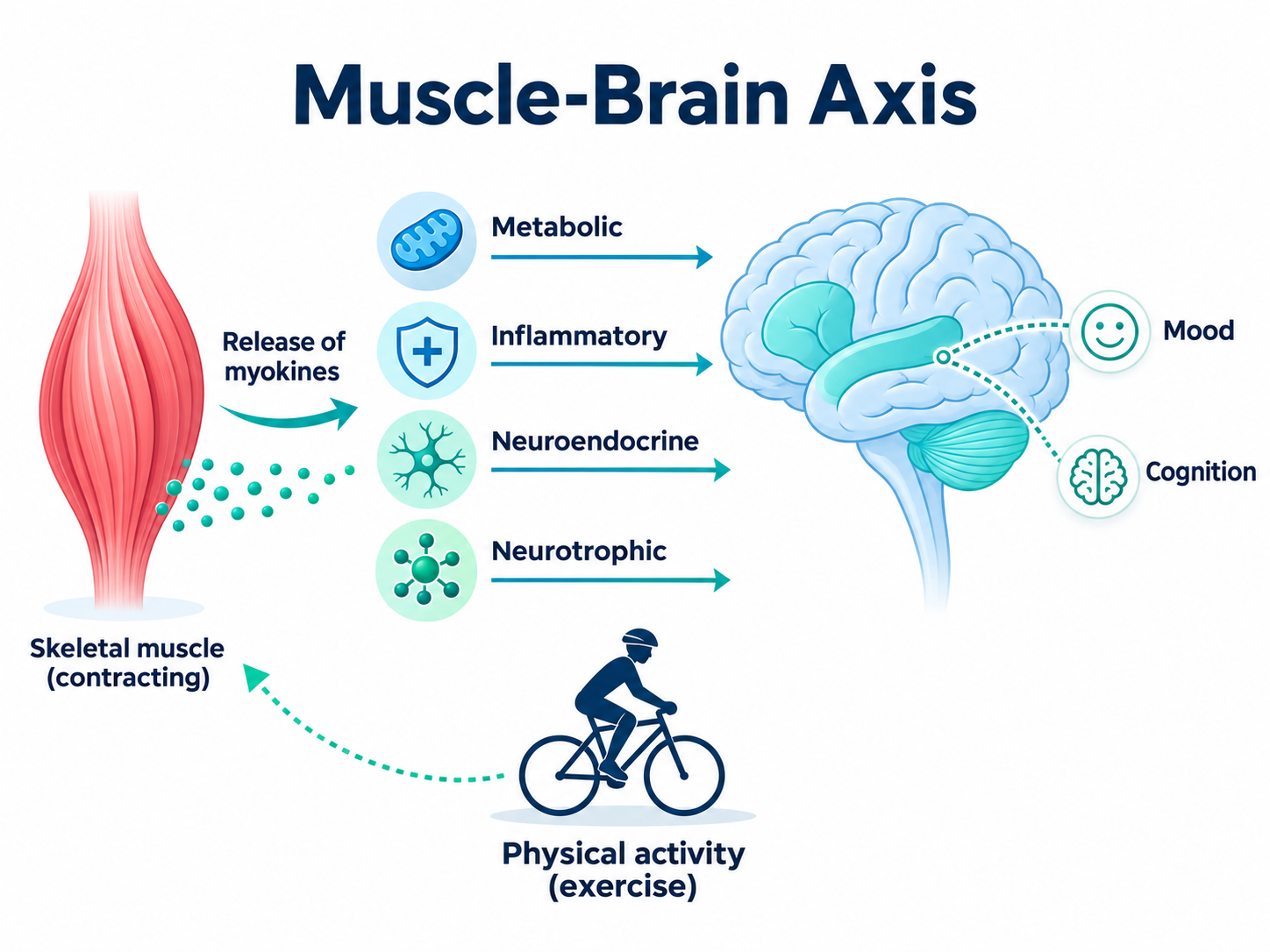
The muscle-brain axis, one of several proposed pathways linking exercise to brain health. Contracting skeletal muscle releases myokines that act through metabolic, inflammatory, neuroendocrine, and neurotrophic pathways relevant to mood and cognition. Figure created with the assistance of ChatGPT/OpenAI
Evidence for mental health benefits
Randomized controlled trials (RCTs) and meta-analyses suggest that physical activity programs decrease depressive symptoms, anxiety symptoms, and psychological distress, with some evidence of benefits for suicide-related outcomes. The 2024 network meta-analysis of RCTs reported decreases in depressive symptoms with walking, jogging, yoga, and strength training. Effects were generally greater with higher exercise intensity. Prospective cohort studies have reported that higher physical activity is associated with a lower risk of developing depression. Dose-response analyses suggest associations even below public health recommendations, at approximately 75 minutes of moderate-intensity activity per week. Still, observational findings do not prove that exercise alone prevents depression.
Cognition, aging, and severe mental illness
Physical activity has been associated with a lower risk of cognitive impairment, all-cause dementia, and Alzheimer’s disease. The World Health Organization (WHO) includes physical activity in its recommendations for reducing the risk of cognitive decline and dementia. The evidence is primarily observational and cannot establish that physical activity reduces the risk of cognitive impairment, dementia, or Alzheimer’s disease.
Exercise may also benefit people with schizophrenia, who experience high levels of sedentary behavior, cardiometabolic disease, and premature mortality. Meta-analytic evidence suggests that aerobic exercise may improve global cognition, with possible benefits in working memory, attention, and social cognition. These outcomes matter because cognitive difficulties can affect everyday functioning, while available pharmacological treatments have limited effects on cognition. Still, the evidence is based on a limited number of trials with modest sample sizes, and larger studies are needed. Exercise may help address psychiatric symptoms, cognition, and physical health concurrently.
Prescribing exercise in clinical practice
Exercise prescriptions should specify activity type, frequency, intensity, duration, safety considerations, barriers, and follow-up. The WHO recommends 150 to 300 minutes of weekly moderate-intensity aerobic activity or 75 to 150 minutes of weekly vigorous-intensity activity, and muscle-strengthening activities on at least two days of the week. Brisk walking is moderate-intensity activity, while running and fast cycling are examples of vigorous activity. Recommendations must be individualized based on each person’s baseline fitness, symptom severity, existing medical conditions, personal preference,e and access.
Safety assessment is important for people who are frail or have unstable cardiac or respiratory symptoms, recent fainting or falls, acute infection, uncontrolled pain, or other medical instability. Some individuals may require medical assessment, physiotherapy input, supervised exercise, or temporary deferral before increasing activity. For most patients, a graded approach is appropriate, beginning with low-risk activities and gradually increasing duration or intensity. Activity should be developed and monitored over time, and the exercise prescription should be revised if patients experience pain, dizziness, chest symptoms, marked breathlessness, or functional decline.
Access and implementation
Depression, anxiety, psychosis, chronic pain, disability, poverty, caregiving responsibilities, and unsafe environments can make regular activity difficult. Collaborative, gradual goals and follow-up may be effective. Possible starting points include a brief 5-minute walk or chair-based activity. Other options include a physiotherapy referral, supervised group exercise, or movement integrated into a routine. Healthcare staff may assess physical activity levels and refer patients to appropriate community exercise programs.
Access must be addressed along with exercise prescribing. Without support, recommendations can increase inequalities. Funded community exercise programs, transportation support, physiotherapy referrals, supervised groups, and partnerships with recreation centers may help people facing financial, physical, and social barriers.
Conclusion
Exercise should be prescribed as a structured component of brain-health care rather than treated solely as general lifestyle advice. Research suggests that exercise can improve mood and cognition and support cardiometabolic health, sleep, functioning, and quality of life. Clinicians should prescribe safe, individualized activities and address barriers to participation. Further adequately powered research is required, particularly to establish the cognitive benefits of exercise in people with schizophrenia.
 Short bursts of exercise may improve fitness and blood sugar in sedentary adults