A recent study, published in a peer-reviewed medical journal, found femtosecond laser imaging assesses lung tumor margins six times faster than the current standard, allowing surgeons to make life-saving decisions on how much tissue to remove while the patient is still in surgery. According to femtosecond laser manufacturer LITILIT, the study points to a number of applications for femtosecond lasers in medicine, from eye surgery to cancer diagnostics.
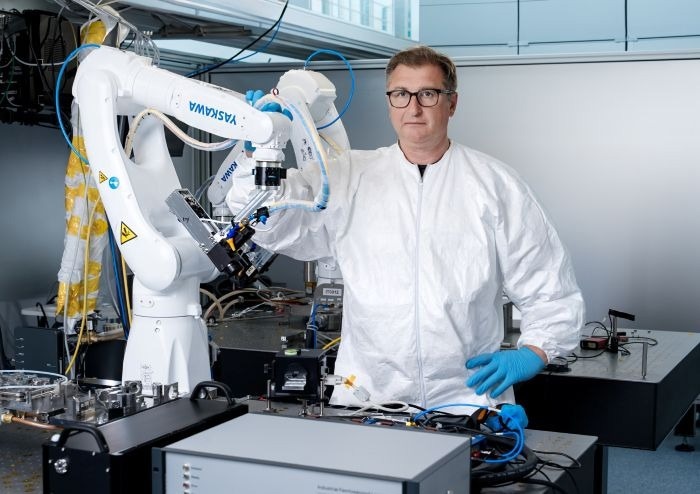 Nikolajus Gavrilinas, Co-Founder and CEO of LITILIT. Image Credit: LITILIT
The study found that femtosecond laser imaging cut the time to assess tumor margins from 36 minutes to under 6, matching the accuracy of the standard method while giving surgeons an answer in time to act on it.
Other potential medical applications of femtosecond lasers currently in development include dentistry, where femtosecond pulses can cut enamel and dentin with less microcracking than a drill, glaucoma treatment, where an image-guided femtosecond laser creates drainage channels to relieve eye pressure, and more.
According to Nikolajus Gavrilinas, CEO and co-founder of femtosecond laser company LITILIT, femtosecond lasers are used in such medical applications because they fire extremely short pulses, short enough to shape or read tissue while minimizing heat transfer to surrounding tissue. The same quality makes them indispensable in complex eye surgeries.
“When you are working with human vision, there is simply no room for error. Precision, stability and control are not optional – they are absolute requirements. This is why femtosecond lasers have become so important in procedures such as LASIK, SMILE and cataract surgery. When a person’s sight is at stake, there can be no compromise on the precision and reliability of the technology,” he says.
Gavrilinas notes that at the current pace of adoption, it might be difficult to produce femtosecond lasers at the scale that industries need in the future. Aside from medicine, femtosecond lasers are used in manufacturing semiconductors, consumer electronics, and equipment for data centers, among other fast-developing fields, meaning the industry could face a bottleneck.
Typically, manufacturing femtosecond lasers is a complex process that requires highly trained specialists, We built our lasers on a patented architecture with a purpose-built design and a high level of automation that allows us to manufacture them at the scale that medical and other industries need. We also made our lasers smaller than the industry standard, allowing to fit into an operating room or a factory more easily.”
Nikolajus Gavrilinas, CEO and Co-Founder, LITILIT
To solve the scalability gap, LITILIT is currently developing a large-scale femtosecond factory in Vilnius that is set to open in October. The facility is designed to scale production to approximately 3,000 femtosecond lasers annually, one of the highest capacities in the world. Later, the company plans to replicate this factory model in other parts of the world.
The company builds lasers based on a few patented inventions (patent 1, patent 2), made by LITILIT co-founders Kęstutis Regelskis, Nerijus Rusteika, and Gavrilinas, in close collaboration with the Center for Physical Sciences and Technology (FTMC) in Vilnius.
 Simple urine test can accurately diagnose and track bladder cancer