Controlled laboratory environments play a critical role in biological, clinical, pharmaceutical, and research settings to safeguard product quality, ensure operator safety, and protect the surrounding environment.
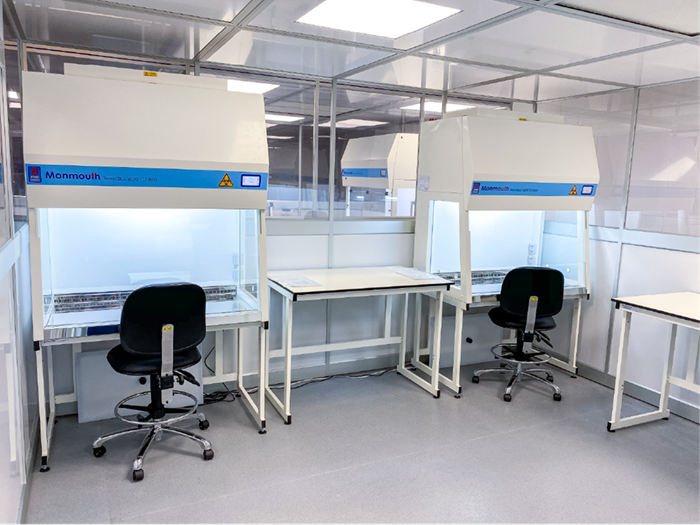
Image Credit: Monmouth Scientific
Two commonly employed systems for achieving these goals are Biological Safety Cabinets (BSCs) and Laminar Flow Cabinets (LFCs). While these cabinets may appear similar and both rely on HEPA filtration, they are designed for distinctly different purposes.
Technical insights: Understanding protection, airflow, and application requirements
At a fundamental level, BSCs are designed to protect laboratory personnel and the environment, while LFCs are engineered to preserve product integrity. Recognizing this distinction is essential for selecting appropriate equipment for specific laboratory tasks and for maintaining compliance with biosafety requirements.
Incorrect use of either system can increase the likelihood of sample contamination, operator exposure, or failure to meet regulatory standards, particularly when working with biological or potentially hazardous substances.
For this reason, it is critical to understand how airflow functions in each cabinet, what each system is designed to achieve, and the circumstances under which each should be used.
With this understanding, laboratories can implement effective safety controls, operate with greater confidence, and protect both personnel and research outcomes.
Biological Safety Cabinets
A Biological Safety Cabinet (BSC) is a primary containment device that protects the user, the sample, and the surrounding environment from exposure to hazardous biological materials.
These cabinets are widely used in microbiology, clinical diagnostics, pharmaceutical research, and other laboratory environments that handle infectious or potentially infectious agents, including cell cultures, viral vectors, and clinical specimens.1
BSCs use a precisely engineered airflow pattern that draws air inward through the front opening and directs it downward across the work surface.
This airflow configuration reduces the release of aerosols generated during laboratory procedures and limits contamination of both the operator and the laboratory space, thereby supporting the safe handling of high-risk biological materials.1
Biological Safety Cabinets are categorized into Class I, Class II, and Class III units, with Class II cabinets being the most commonly used.
Class II BSCs provide combined protection for personnel, products, and the environment, making them suitable for work conducted at Biosafety Levels 1 through 3, depending on the specific cabinet type and facility design.2
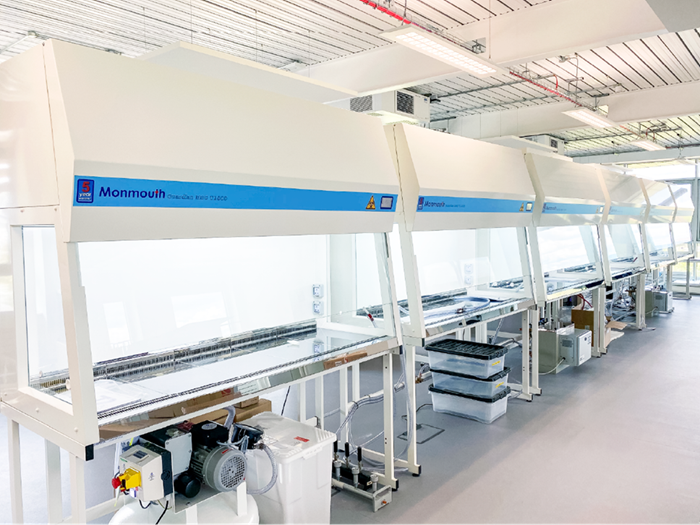
Image Credit: Monmouth Scientific
Laminar Flow Cabinets
A Laminar Flow Cabinet (LFC), often called a clean bench, is designed to protect samples from particulate contamination by delivering HEPA-filtered air in a consistent horizontal or vertical flow across the work surface. This airflow creates a clean zone over the working area for sensitive materials.3
Unlike Class II BSCs, LFCs provide protection only for the product and offer no safeguards for the operator or the surrounding room. This limitation is due to the outward airflow pattern, which directs air from the cabinet toward the user or into the laboratory environment.
If aerosols or contaminants are produced during work, they may be released directly into the laboratory, creating a potential health hazard, particularly when biological agents are present. As a result, laminar flow cabinets are not appropriate for handling hazardous biological materials.4
Laminar flow cabinets are commonly used in non-hazardous applications such as sterile media preparation, electronics assembly, optical component production, and pharmaceutical processes where product cleanliness is the primary concern and personnel or environmental protection is not required.
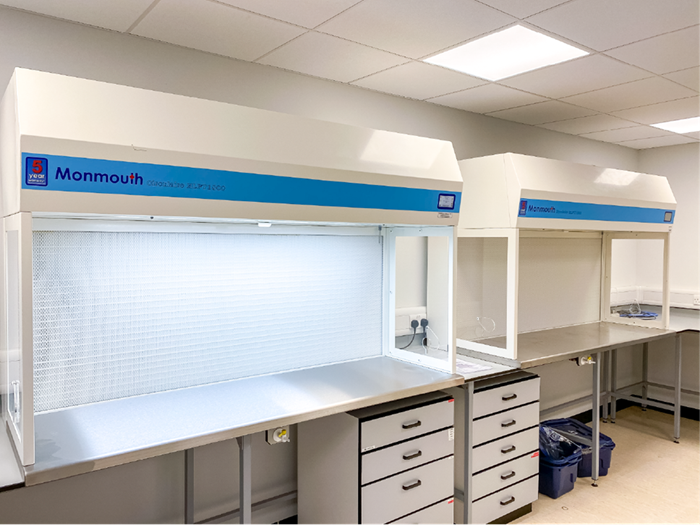
Image Credit: Monmouth Scientific
Key operational differences: Airflow and filtration
The most significant operational difference between BSCs and LFCs is airflow configuration. Biological Safety Cabinets protect personnel through inward airflow, safeguard samples using downward HEPA-filtered air, and protect the laboratory environment through HEPA-filtered exhaust air.1,2
These features make BSCs suitable for biocontainment applications, including work with infectious agents, cell cultures, viral vectors, and procedures that generate aerosols.
Laminar Flow Cabinets, on the other hand, use unidirectional HEPA-filtered airflow across the work surface but release exhaust air directly into the laboratory without containment. This design provides no protection beyond maintaining sample cleanliness.4
Consequently, LFCs should only be used for non-hazardous tasks and are not appropriate for infectious materials or aerosol-generating procedures, as they do not protect personnel or the environment.
Research has shown that factors such as airflow velocity, cabinet loading, and user technique significantly affect the containment performance of BSCs, highlighting the importance of selecting and operating the correct cabinet when working with biological hazards.5
Application-driven selection
Selecting between a BSC and an LFC should be based on a formal risk assessment and a clear understanding of the laboratory process involved.
- A Biological Safety Cabinet should be used when working with pathogenic microorganisms, clinical samples, genetically modified organisms, or any material that presents a biological risk to personnel or the environment.1, 2
- A Laminar Flow Cabinet should be selected for work involving sterile, non-hazardous materials where maintaining product cleanliness is the sole requirement.3
Regulatory agencies and biosafety guidelines consistently state that laminar flow cabinets are not acceptable substitutes for biological safety cabinets in applications that require containment.1
Conclusion
Although Biological Safety Cabinets and Laminar Flow Cabinets may look similar, their purposes, safety functions, and intended uses differ significantly. BSCs are designed to protect personnel and the environment from biological hazards, while laminar flow cabinets are intended to maintain product sterility.
A clear understanding of these differences allows laboratories to make informed equipment decisions, maintain regulatory compliance, and support safe and effective operations.
Using the incorrect cabinet can increase exposure risks, compromise biosafety measures, and result in regulatory penalties, particularly in environments that handle hazardous materials. When containment is necessary, a Biological Safety Cabinet is the appropriate choice.
Acknowledgements
This article was produced using materials originally authored by Michael Skidmore from Monmouth Scientific Limited
References
- Kruse, R.H., Puckett, W.H., and Richardson, J.H. (1991). Biological safety cabinetry. Clinical Microbiology Reviews, 4(2), pp.207–241. DOI: 10.1128/cmr.4.2.207. https://journals.asm.org/doi/10.1128/cmr.4.2.207.
- CDC (2024). Biosafety in Microbiological and Biomedical Laboratories (BMBL) 6th Edition. (online) CDC Laboratories. Available at: https://www.cdc.gov/labs/bmbl/index.html.
- Nagaraju, P.T. and Indhu, V. (2015) Laminar airflow hood: Working principle and applications. International Journal of Pharmacy and Pharmaceutical Sciences, 7(2), pp. 373–377.
- Whyte, W. (2010) Cleanroom technology: fundamentals of design, testing and operation. Chichester: John Wiley & Sons. Available at: https://download.e-bookshelf.de/download/0000/5962/27/L-X-0000596227-0001311514.XHTML/index.xhtml
- Peng, G., et al. (2025). Research and Prospects of Airtightness of Biological Laboratory Enclosures: Influencing Factors and Evaluation Methods. Buildings, 15(13), p.2314. DOI: 10.3390/buildings15132314. https://www.mdpi.com/2075-5309/15/13/2314.
About Monmouth Scientific
At Monmouth Scientific, environmentally responsible recirculating technology is central to its expertise.
Monmouth's specialized Fume Cupboard, Laminar Flow, Biological Safety, Powder Containment, and ISO Class Cleanroom solutions provide the best protection and performance for your personnel.
A UK Market Leader in Clean Air Solutions and at the forefront of the industry, Monmouth employs cutting-edge technologies and innovative engineering to ensure that its solutions consume minimal energy while delivering optimal performance.
As experts in clean environments and laboratory personnel safety, the team continues to proudly pioneer innovative new technologies to guarantee the highest levels of safety for a diverse client base, including;
- Laboratory
- Research
- Pharmaceutical
- Electronics
- Aerospace
Sponsored Content Policy: News-Medical.net publishes articles and related content that may be derived from sources where we have existing commercial relationships, provided such content adds value to the core editorial ethos of News-Medical.net, which is to educate and inform site visitors interested in medical research, science, medical devices, and treatments.