High-pressure homogenizers, such as NanoGenizer, prepare nanomaterials by producing high flow velocities through a small opening via an internal fixed geometry specifically designed to operate at ultra-high pressures (up to 60,000 psi).
During homogenization, alterations in physical, chemical, and structural properties occur, which result in a homogeneous suspension at the nanoscale. The pressure of a traditional homogenizer is typically within a range limited to 15,000 psi, while a high-pressure homogenizer can reach up to 30,000 psi, and ultra-high-pressure homogenizers achieve 60,000 psi.
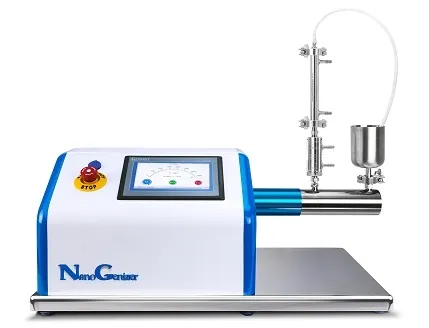
High-pressure homogenizer. Image Credit: Genizer
Introduction
High-pressure homogenizers can be found in the biological, pharmaceutical, food, and chemical industries, among many others. Their application extends to products and purposes as varied as cell disruption, conductive coatings, dairy products, dyes, fat emulsions, food homogenization, fine chemicals, graphene, carbon nanotube infusion solutions, lipid microspheres, microemulsions, nano-oxide dispersion, nanosuspensions, liposome preparation, vaccines, and many more.
The global market for high-pressure homogenizers is rising, especially in the nanotechnology market. To prepare nanoemulsions for the pharmaceutical industry, high-pressure homogenizers such as the NanoGenizer are crucial. With pressure consistently exceeding 20,000 psi and high-quality diamond interaction chambers, these instruments can achieve a uniform, pharmaceutical-grade nanoparticle size distribution.
Key principles
A key feature of a high-pressure homogenizer is the homogenization unit, which comprises a diamond interaction chamber and a high-pressure pump unit. Within the diamond interaction chamber, there is a specially designed fixed geometry.
The piston in the high-pressure pump unit drives the samples through the interaction chamber at supersonic speed with each stroke. In the chamber, materials experience mechanical forces, including high shearing, high-frequency oscillation, cavitation, convective impact, and proportional thermal effects, simultaneously.
The materials may undergo changes in the physical, chemical, and particle structures as a result of the physiochemical effects. This produces uniform, smaller nanoparticle sizes, achieving homogenization.
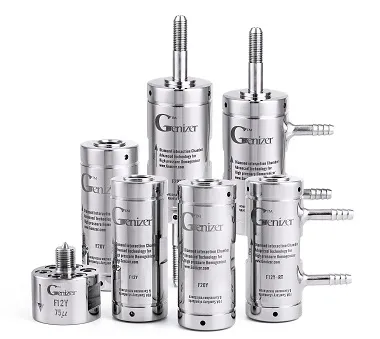
Interaction chambers in a homogenization unit. Image Credit: Genizer
At the core of the interaction chamber is the high-pressure homogenizer. Its sophisticated internal geometric structure is the driving factor determining the overall efficiency of the homogenization process. The intensifier pump applies the required pressure for materials to transit the interaction chamber at high speeds. The strength and stability of the pressure are critical for producing high-quality nanomaterials.
High-pressure homogenizer applications
The high-pressure homogenizer is one of the most advanced pieces of equipment for preparing nanomaterials using top-down nanotechnology. High-pressure homogenizers and their interaction chambers serve a vast range of purposes across nanomaterial production and nanotechnology.
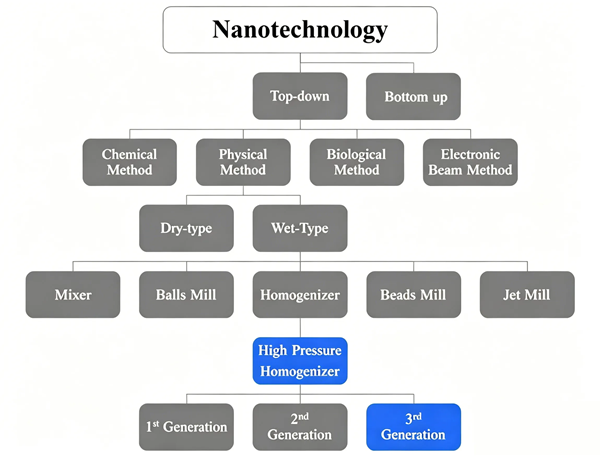
Classification of nanotechnology applications. Image Credit: Genizer
Applications include:
- Homogeneous dispersion of products in the cosmetics, fine chemical, and other industries to boost product functionality, increase value, and ensure stability across processes
- Homogenization and emulsification in the food and beverage industry to enhance taste, improve stability and appearance, and encapsulate nutrients in food products
- Preparation of fat emulsions, liposomes, microemulsions, nanosuspensions, and nanoparticles in the pharmaceutical industry
- Dispersion and exfoliation of conductive paste, resistance paste, graphene, carbon nanotubes, and nano-oxides
- Cell disruption, microcapsules, and vaccine adjuvants in biotechnology products
Types of high-pressure homogenizers: By energy source
Electric
Electric homogenizers are driven by an electric motor. This category of homogenizer can be categorized into two subtypes: direct drive and intensifier.
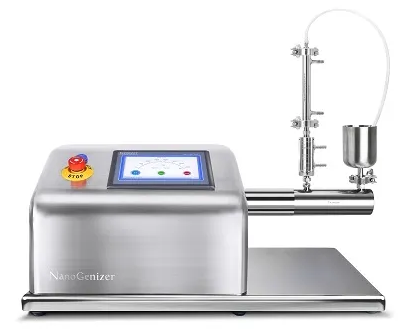
Electric high-pressure homogenizer with intensifier. Image Credit: Genizer
Direct-drive type: The motor drives the crankshaft, moving the plunger back and forth to directly pressurize the material. Multiple plungers operate in tandem to maintain constant pressure and a high flow rate; large quantities of material are required to sustain this pressure.
A multi-stage gear-reduction mechanism drives the crankshaft, powering the motor. This makes the equipment bulky. Crankshaft-based homogenizers are, therefore, best suited for large-scale production in low-pressure applications.
Intensifier type: In intensifier-type high-pressure homogenizers, the material is pressurized and driven through the interaction chamber via the motor. The intensifier system can deliver higher pressures, therefore boosting the performance of the homogenization process.
The flow rate of the intensifier-type homogenizer is lower than that of the homogenizer with a crankshaft. This means fewer materials are required while achieving greater pressures. This kind of homogenizer can be used for laboratory applications with small sample amounts, and for production applications that demand high pressure.
When fitted with the diamond interaction chamber, the instrument qualifies as a high-end homogenizer. This type is used extensively in laboratories implementing biological, pharmaceutical, and nanotechnology processes. While conventional intensifiers are hydraulic, a new type has emerged with an electric cylinder and linear actuator to boost performance.
Hand driven
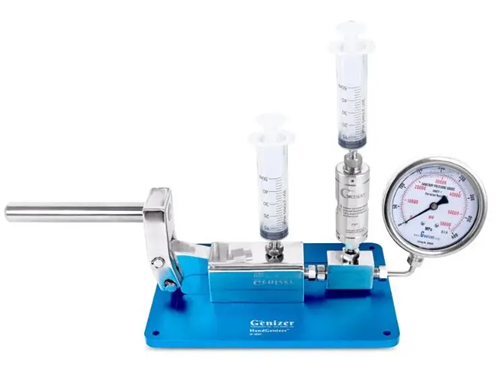
Hand-driven high-pressure homogenizer (HandGenizer). Image Credit: Genizer
HandGenizer: Hand-driven homogenizers use manual power to pressurize the materials. With a relatively low flow rate, the main benefits of the HandGenizer are its portability and ease of assembly and disassembly. It is well-suited for small-scale applications, as only small amounts of material are required. This kind of device can support the research and development needs of most biopharmaceutical laboratories.
Air driven
The air-driven homogenizer transforms compressed gas into hydraulic pressure. Therefore, a nitrogen cylinder or an air compressor is required to support this system. This kind of homogenizer consumes large amounts of gas and produces high noise levels.
Moreover, its maximum homogenization pressure is typically low. However, since there is no need for a separate intensifier pump structure, its volume is small, and it is ideal for sites carrying compressed nitrogen.
Types of high-pressure homogenizers: By principle and structure of the interaction chamber
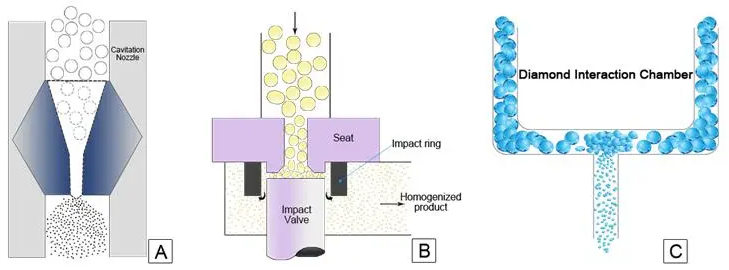
Three working principles of high-pressure homogenization. Image Credit: Genizer
First generation: Impact type
Cavitation nozzles: The primary function of this nozzle is cavitation, which separates the emulsion, thereby leading to an increase in particle size. When the homogenizer pressure is applied, the material flows into the small aperture of the cavitation nozzle at several times the speed of sound.
The interaction of the particles and the metal valve parts creates intense friction and collisions. This friction affects the equipment’s durability and service life, and the collisions cause metallic particles to fall into the final products.
Impact valve: The impact valve and impact ring structure use tungsten alloy materials to prevent local wear and moderately prolong the homogenization chamber’s service life. The impact valve’s role relates to impact and cavitation.
However, its core operating principle is the collision between the materials in the suspension and a high-hardness metal (such as a tungsten alloy). As a result, the impact valve fails to solve the problem of metallic particle residue. By the early 20th century, the majority of high-pressure homogenizers had already started introducing impact valve components.
Second generation: Interaction type
Y-type interaction chamber: The Y-type interaction chamber, widely regarded as one of the most powerful homogenization chambers available, has been adopted by several manufacturers across the US. The flow stream is split into two channels, which are redirected over the same plane at right angles before converging into a single flow stream.
The increased pressure in these systems accelerates the crossover of the two flows, leading to higher shear, turbulence, and cavitation over the single outbound flow stream. With the novel Y-type structure, the materials move and collide at high speeds in the high-pressure solution, a process that significantly improves the chamber's service life compared to more conventional designs. The use of diamond material further eliminates the risk of metal particle residue formation.
The Y-type interaction chamber is used extensively for the preparation of pharmaceutical emulsions because it significantly reduces cavitation and provides exceptional control over particle size and PDI (polydispersity index).
Genizer and Microfluidics Corp. are the principal manufacturers of the diamond interaction chamber. Today, the Y-type diamond interaction chamber is predominantly employed in high-end nanotechnology applications and is used in 90 % of the US pharmaceutical industry.
Genizer’s temperature-controlled interaction chamber mitigates temperature surges while sustaining working pressures of up to 60,000 psi.
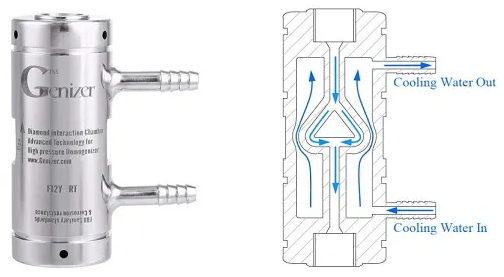
Interaction chamber with cooling jacket. Image Credit: Genizer
Low emulsification efficiency and metallic particle residue are two problems associated with homogenization chambers designed with the impact principle. During the pharmaceutical injection phase, residual inert metallic particles are generated when particles collide with internal metal components.
These metallic particles may accumulate and produce larger particles. In pharmaceutical applications, this is a major issue because large particles can impede capillary blood flow, causing mechanical damage to tissues in the human body and leading to acute or chronic inflammation.
The interaction chamber addresses the problems associated with particle residue and demulsification. However, the chamber’s internal configuration makes it more prone to flow blockage than impact homogenizers when processing high-viscosity materials.
Types of high-pressure homogenizers: Pressurization principle
Ultra-high-pressure homogenizers require considerable amounts of thrust to drive the piston in the cylinder to reach high pressure levels. The rotating motor must be able to reduce speed while increasing torque, converting linear motion to achieve the linear reciprocating motion with high thrust. The pressurization principle operates distinctly across direct-drive type and intensifier-type homogenizer configurations.
Direct-drive type: The crankshaft is driven by a motor to move the plunger back and forth, applying direct pressure to the material. A series of plungers delivers constant pressure, with an increased flow rate associated with this homogenizer type. However, minimum material requirements are also high, as is the amount of residual material.
The motor-driven crankshaft requires a multi-stage gear reduction mechanism, limiting the efficiency capabilities of these homogenizers while also taking up more space due to larger unit dimensions. However, this homogenizer type is well-suited for the food and chemical industries, as well as other applications that do not necessitate the use of high pressures.
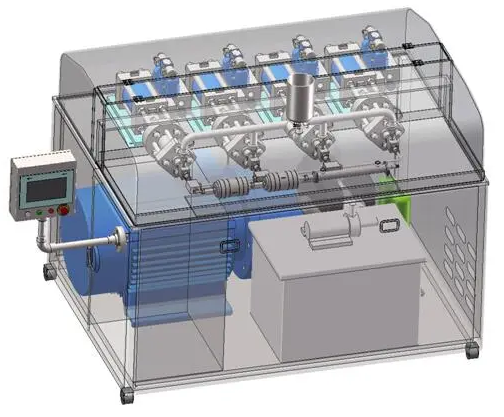
Structural diagram of a hydraulic type-quad pump with constant pressure. Image Credit: Genizer
Intensifier type: The intensifier-type homogenizer represents the recent developments made in ultra-high-pressure technology. This system pressurizes the material through a hydraulic system, which involves a motor driving the oil pump. The pressure delivered by the hydraulic system is greater than that of direct-drive homogenizers, while the volume and minimum material requirements are much smaller.
The intensifier-type homogenizer is well-suited for use in both laboratory and production applications with high pressure. Hydraulic homogenizers do come with higher initial costs, but the hydraulic intensifier has a longer service life and reduced maintenance thanks to its low-frequency, high-thrust piston movement.
Using parallel four-cylinder technology, stable pressure can be achieved without an accumulator, allowing the system to reach ultra-high pressure of up to 45,000 psi.
In previous decades, most high-pressure homogenizers fell into the direct-drive category, but this type has clear disadvantages. Its reduced service life and wearing parts lead to more frequent maintenance and greater costs, especially for pressure-bearing parts when the pressure is above 100 MPa.
Hydraulic homogenizers have higher manufacturing costs but offer a longer service life and lower maintenance costs over the long term.
How to select a high-pressure homogenizer
Selecting a high-pressure generator
Intensifier-based cylinders are considered superior to direct-drive assemblies.
At equivalent flow rates, increased pressure generates lower frequencies, limits pressure fluctuations, improves product quality, and exhibits greater equipment durability. At 30,000 psi, Genizer's laboratory high-pressure homogenizer, NanoGenizer, achieves fluctuation levels below 10 Hz, compared to 60 Hz in conventional homogenizers.
High-pressure piston materials can be classified into three categories: ceramics, tungsten carbide, and hardened stainless steel. Ceramics are associated with increased costs but greater quality and durability, while hardened stainless steel is the most economical but lower in quality.
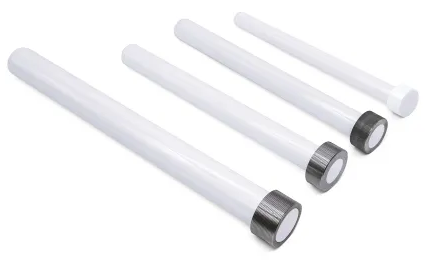
Ceramic piston. Image Credit: Genizer
Selecting homogenization parts
Homogenization chambers play a crucial role in obtaining the best results for the overall process. Different inner constructions of homogenization chambers, as the core component of homogenizers, mean that results and applications vary from industry to industry.
Homogenization chamber performance comparison. Source: Genizer
| Properties |
Description |
First-generation Figure A & Figure B Impact type |
Second-generation Figure C Interaction type |
| Efficiency |
Performance |
Moderate |
Good |
| Multi channel |
Scale-up guarantee |
Moderate |
Good |
| Multi stage |
Enhance performance |
Dual stage |
Single stage |
| Adjustable |
Optimize performance |
Adjustable |
Fixed |
| Cooling |
Biological applications |
None |
Yes |
When choosing a suitable homogenizer, performance and cost need to be considered. Generally, first-generation homogenization chambers are more cost-effective, but their overall performance during homogenization may be lower than that of second-generation instruments.
Second-generation homogenization chambers produce superior products but are more expensive. They are also more likely to cause blockages when processing materials with high concentration and viscosity than first-generation machines. The interaction chamber is equipped with a cooling system developed by Genizer and can be employed for thermally unstable biological and pharmaceutical products.
Maximum homogenizing pressure
Generally, higher pressure during homogenization leads to improved quality. This is due to increased uniformity in particle size if the homogenizer’s pressure is higher, which means processors are able to create the nanomaterial with greater efficiency.
Greater homogenizing pressure also expands the range of samples that can be processed. Emulsions, for instance, usually require a homogenizing pressure of 20,000 psi to achieve a particle size of 100 nm, whereas suspensions typically require a minimum of 45,000 psi to reach the nanoscale.
It should also be noted that the results of the homogenization process will be impacted by increased temperatures. The greater the pressure, the greater the temperature. Consequently, 30,000 psi is deemed the maximum pressure for high-pressure homogenization without a cooling system.
Beyond 30,000 psi, high temperatures do not lead to higher pressures during homogenization. The ultra-high-pressure diamond interaction chamber addresses this, as it was developed with a cooling system that effectively reduces the concentration of large particles and resolves the problems associated with emulsion stability and high temperatures. Therefore, machines fitted with this type of chamber can easily reach pressures up to 60,000 psi.
Product uniformity
Ensuring particle uniformity across particle size distribution is crucial during the production process. If particle sizes range from nanometers to microns, the batch is not acceptable, especially if there particles larger than 5 um in a pharmaceutical emulsion.
USP (US Pharmacopeia) sets pharmaceutical emulsion standards in relation to the particle size distribution. Interaction chambers enable increased uniformity across particle size distribution in contrast to impact valve homogenizers.
The future of high-pressure homogenizers
In 2010, the FDA announced a recall of 11 batches of clevidipine butyrate injection emulsion across the United States, as the emulsion was suspected to contain inert metallic particles. The accumulation of particles causes an agglomeration of larger particles, which, in theory, could lead to clogging in blood capillaries, causing damage to the body or triggering other acute or chronic inflammation.
Therefore, impact-valve homogenization chambers are not recommended in the pharmaceutical industry. These models are now deemed unsuitable for the mass production of pharmaceutical emulsion injections.
Ultra-high-pressure machines demonstrate greater durability in the interaction mechanism when equipped with temperature control. With the demand for nanomaterials increasing, interaction chambers will be deployed more extensively in nanotechnology fields, such as pharmaceuticals, semiconductors, and microelectronics, as higher pressures and improved performance are key parameters for effective nanodispersion.
The homogenizer has undergone numerous changes since its inception at the turn of the 20th century. It has moved from low (10,000 psi) to high (20,000 psi), and ultra-high-pressure (60,000 psi) designs; the homogenizing valve, interaction chambers, and temperature-controlled chambers have been introduced; and direct-drive, intensifier, and multi-pump constant-pressure types have been developed.
With the development of high-thrust linear actuator systems, ultra-high-pressure homogenizers will soon be fitted with high-thrust, low-speed linear motors.
As pressure increases, temperature control will present a significant technical challenge, and therefore, a temperature-controlled ultra-high-pressure durable interaction chamber should be prioritized for future development.
About Genizer
Genizer™, located at Technology Link in Greater Los Angeles, is dedicated to advancing nanotechnology for homogenizers.
The company provides high-pressure homogenizers, liposome extruders, sanitary heat exchangers, diamond interaction chambers, and high-pressure gauges compatible with other brands of high-pressure homogenizers, pumps, and microfluidizers.
Sponsored Content Policy: News-Medical.net publishes articles and related content that may be derived from sources where we have existing commercial relationships, provided such content adds value to the core editorial ethos of News-Medical.net, which is to educate and inform site visitors interested in medical research, science, medical devices, and treatments.