For research use only. Not for use in diagnostic procedures.
This is an Application Brief and does not contain a detailed Experimental section.
Steroid hormones underpin a wide range of biochemical processes, including immune functions, metabolism, inflammation, salt and water balance, sexual characteristic development, and the ability to withstand illness and injury.
Enzymes that form part of the steroid biosynthesis pathway are central to these metabolic processes, meaning their dysfunction can be examined in clinical research by investigating steroid hormones in the pathway.
Steroid measurement via immunoassay is prone to analytical interference, however, due to the cross-reactivity of assay antibodies with structurally related steroid hormones and synthetic derivatives.
Liquid Chromatography-Tandem Mass Spectrometry (LC-MS/MS) offers a solution to this issue, offering analytically sensitive, precise, and accurate measurements of steroid hormones.
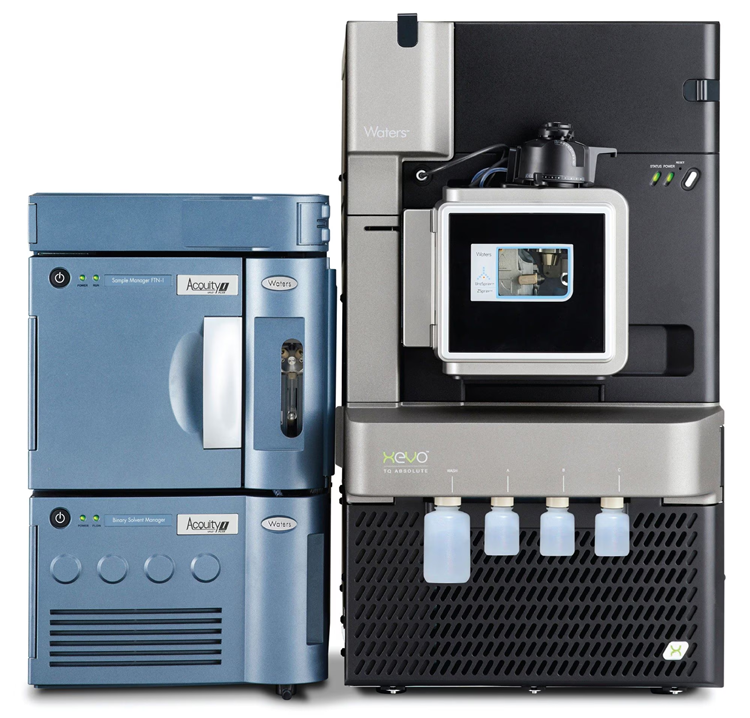
Figure 1. ACQUITY™ UPLC I-Class FL IVD and Xevo TQ Absolute IVD Mass Spectrometer. Image Credit: Waters Advanced Diagnostics
The Xevo TQ Absolute IVD mass spectrometer features StepWave™ XS ion transfer optics and an Xtended Dynamic Range (XDR), offering improved robustness, analytical sensitivity, and reliability over six orders of linear dynamic range.
Combining this powerful instrument with a simple sample preparation method using the MassTrak™ Endocrine Steroid Calibrator and Quality Control Sets, and with Oasis™ MAX µElution™ technology and UPLC separation of steroid hormones, results in an extremely selective and analytically sensitive method that reliably analyzes steroid hormones for clinical research.
The study presented here investigated a number of steroid hormones:
- Androstenedione
- Dehydroepiandrosterone (DHEA)
- 17-hydroxyprogesterone (17-OHP)
- Progesterone
- Dihydrotestosterone (DHT)
- Testosterone
Experimental
Sample preparation and UPLC-MS/MS analysis
A Hamilton STAR liquid handling robot was used for sample extraction. An internal standard was added to 100 μL of MassTrak Endocrine Steroid Calibrators, QCs, and samples, with the samples then precipitated using water and methanol, and mixed following each reagent addition.
An Oasis MAX μElution Plate (p/n: 186001829) was conditioned and equilibrated during the centrifugation of samples, with an aliquot of each pre-treated sample loaded into individual wells before being slowly pulled through the plate.
Consecutive washes were performed in order to reduce potential ionic interference. These washes were done with formic acid in 15 % acetonitrile(aq) and ammonia in 15 % acetonitrile(aq). Analytes were eluted with 60 % acetonitrile (aq) before adding water.
The samples were subsequently injected onto an ACQUITY UPLC I-Class FL System and Xevo TQ Absolute IVD Mass Spectrometer, using a water/methanol/ammonium fluoride gradient and a Waters™ CORTECS™ UPLC C18 Column.
Figure 2 shows Multiple Reaction Monitoring (MRM) transitions, quantifier (quan), and qualifier (qual) for the detection of all analytes.
Results and discussion
Chromatographic separation was achieved for all isobaric steroid hormones. An injection-to-injection time of around seven minutes was also achieved. Figure 2 shows a typical chromatogram.
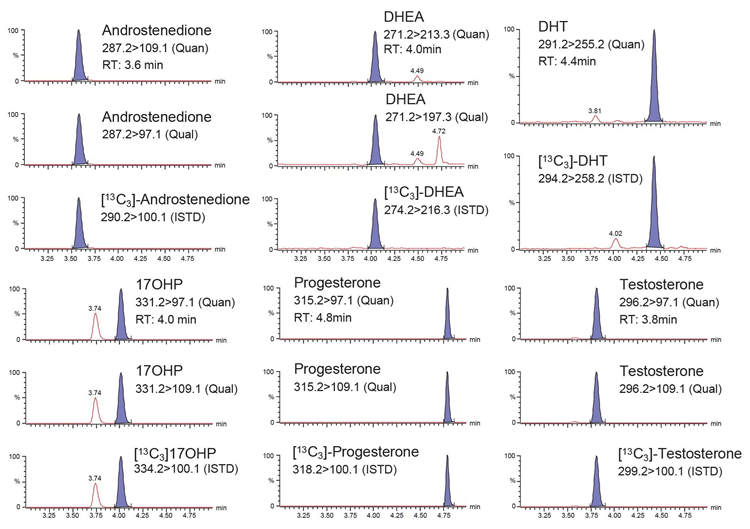
Figure 2. Typical Chromatograms of the Steroid Hormones Panel. Image Credit: Waters Advanced Diagnostics
Calibration curves were linear over the defined calibration ranges (Table 1). All five occasions demonstrated correlation coefficients of >0.99 and %bias of within ±15 % (±20 % for Calibrator 1) for all analytes. Figure 3 shows an example calibration curve.
Table 1. Calibration Ranges for the Steroid Hormones Panel. Source: Waters Advanced Diagnostics
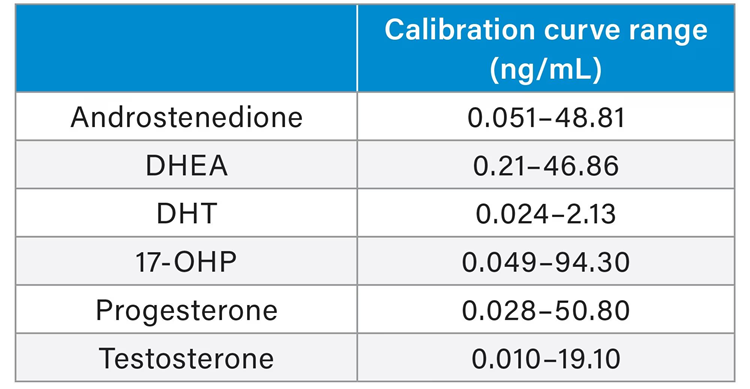
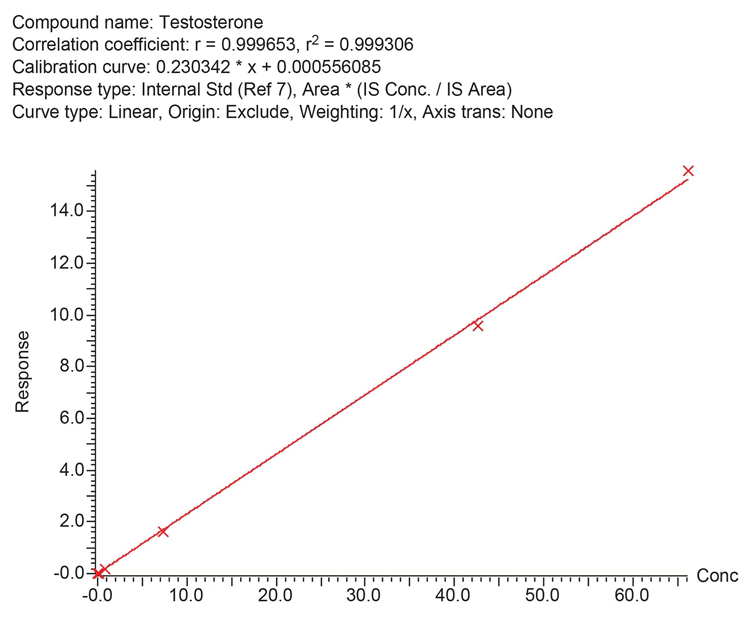
Figure 3. Example Calibration Line for Testosterone. Image Credit: Waters Advanced Diagnostics
Precision performance was evaluated by extracting and analyzing five replicates of the low, mid, and high MassTrak Endocrine QC Set on each of five occasions. Within-run and total precision were determined to be ≤6.8 % CV for all steroid hormones at all concentration levels (Table 2).
Table 2. Precision Performance Summary of Steroid Hormones Extracted and Analyzed on the ACQUITY UPLC I-Class FL and Xevo TQ Absolute IVD. Source: Waters Advanced Diagnostics

Analytical Sensitivity was evaluated by diluting the Calibrator 2 solution with Golden West Biologicals’ MSG4000 stripped serum in order to create low-level pool samples.
A total of 10 replicates of each sample were extracted and analyzed on four occasions to calculate %CVs (Table 3). It was possible to obtain %CVs of ≤20 % at:
- 20.8 pg/mL for androstenedione
- 17.9 pg/mL for 17-OHP
- 11.9 pg/mL for progesterone
- 3.3 pg/mL for testosterone
Figure 4 also shows typical chromatograms for each analyte at these concentrations.
Table 3. Analytical Sensitivity Levels of Four Steroid Hormones from the Panel. Source: Waters Advanced Diagnostics
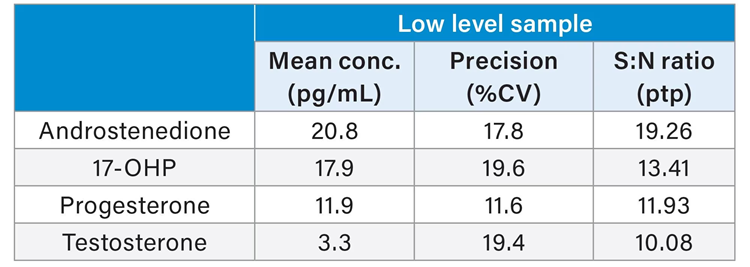
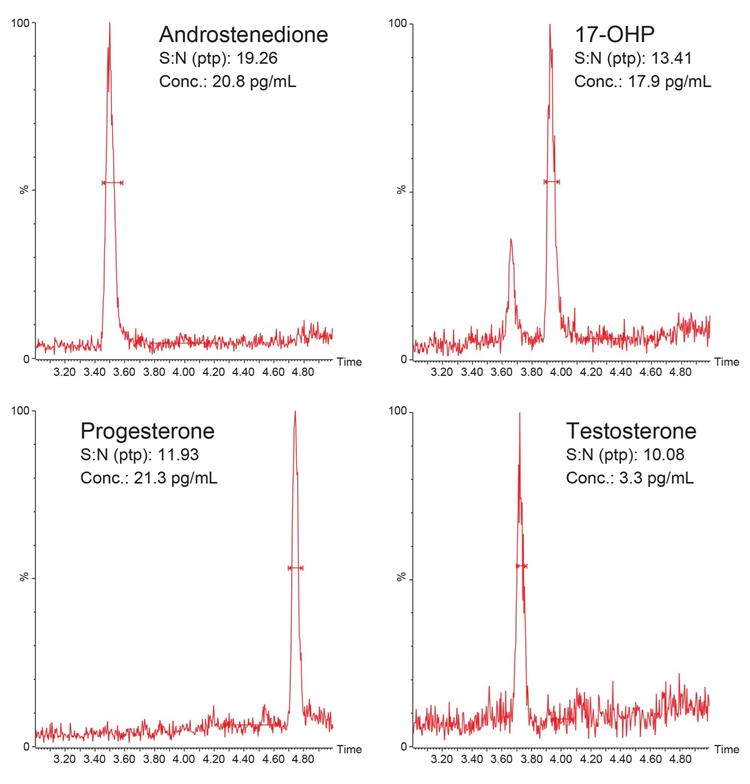
Figure 4. Example Chromatograms for Four Steroid Hormones from the Panel. Image Credit: Waters Advanced Diagnostics
For Research Use Only. Not for use in diagnostic procedures.
Conclusion
The Xevo TQ Absolute IVD demonstrated excellent quantitative performance and analytical sensitivity when used to analyze a steroid hormone panel in a clinical research setting. The method described offered a range of impressive performance characteristics, including:
- Calibration curves with correlation coefficients (r2) of >0.99 for all steroid hormones and for all runs.
- Total and within-run precision results of ≤6.8 % CV.
- Analytical sensitivity concentrations of 20.8 pg/mL for androstenedione, 17.9 pg/mL for 17-OHP, 11.9 pg/mL for progesterone, and 3.3 pg/mL for testosterone.
- A %CV of <20 % and S: N (ptp) of >10:1 from just 100 µL of serum.
Acknowledgments
Produced from materials originally authored by Robert Wardle, Dominic Foley, and Gareth Hammond from Waters Corporation.
About Waters Advanced Diagnostics
At Waters, we recognize the critical role hospital laboratories play in delivering timely, accurate diagnostics that drive patient care. Our solutions are built to support your lab’s evolving needs - whether you’re expanding test menus, improving turnaround times, or meeting rigorous regulatory standards.
Rooted in three foundational pillars, our approach is designed specifically for clinical lab environments like yours:
Flexibility – Integrate seamlessly into your existing systems and workflows.
Efficiency – Help your team deliver high-quality results faster and with fewer hands-on steps.
Trust – Proven technologies backed by decades of scientific innovation and global support.
From LC-MS/MS systems to automated sample preparation and data management tools, Waters offers comprehensive solutions that enable your lab to operate with confidence - today and in the future.
Sponsored Content Policy: News-Medical.net publishes articles and related content that may be derived from sources where we have existing commercial relationships, provided such content adds value to the core editorial ethos of News-Medical.net, which is to educate and inform site visitors interested in medical research, science, medical devices, and treatments.