Amyloid-beta (Aβ) peptides, which range in length from 36 to 43 amino acids, are the primary component of amyloid plaques found in the brains of individuals with neurodegenerative disorders.
These peptides are therefore of particular interest in clinical research and pharmacodynamic investigations of new therapeutics. Aβ peptide quantification in biological fluids has been historically dependent on ELISA and other immunoassays.1,2
These techniques can suffer from cross-reactivity; however, confidence in results is adversely affected by the risk of batch-to-batch variation of the methods. Furthermore, an individual ELISA method is also required for each peptide in assessments involving multiple biomarkers, increasing overall analysis cost and time.
These challenges can be overcome by using a single robust method that offers greater analytical selectivity.
Liquid Chromatography-Tandem Mass Spectrometry (LC-MS/MS) is a potentially useful technique for clinical research on Aβ peptides. For example, LC-MS/MS offers improved analytical selectivity alongside multi-analyte quantitative detection in a single run.
Using the surrogate matrix methodology enables measurement of Aβ peptide isoforms, achieving selectivity through a combination of chromatographic separation, Multiple Reaction Monitoring (MRM) mass spectrometry, and sample preparation.
This article demonstrates the ACQUITY™ Premier UPLC I-Class System with Xevo™ TQ Absolute Mass Spectrometer’s capabilities when employed in clinical research settings that work with the analytically sensitive and selective quantitation of multiple intact Aβ peptide isoforms (1-38, 1-40, 1-42).
These isoforms were extracted from 200 µL of artificial Cerebrospinal Fluid (aCSF) and are within the concentration range 0.1–10 ng/mL.
Sample preparation and LC-MS analysis
Previously used sample preparation and LC-MS analysis techniques were applied with minor changes to improve analyte retention.3
Calibration and Quality Control (QC) working solutions at each level were spiked into the blank aCSF with 0.4 % (w/v) Bovine Serum Albumin (BSA).
An internal standard working solution was then added to 200 µL of spiked samples. This was diluted with 200 µL of 5 M guanidine-HCl and 200 µL of 4 % (v/v) phosphoric acid.
Samples were incubated at room temperature for 1 hour before being loaded onto an Oasis™ MCX SPE µElution plate. This plate was washed and eluted using the previously described protocol (Figure 1).3 The eluate was then evaporated with nitrogen to dryness before being reconstituted with 50 µL of 20:80:1 (v:v:v) acetonitrile:water:ammonia.
The Aβ peptide isoforms were separated using an ACQUITY Premier UPLC I-Class FTN System and an ACQUITY UPLC BEH Peptide C18 300 Å, 2.1 x 150 mm, 1.7 µm column with a 0.3 % NH4OH/water/acetonitrile gradient from 10–55 % mobile phase B.
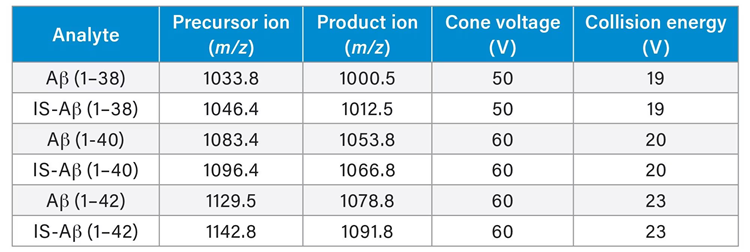
Analysis was completed using a Xevo TQ Absolute Mass Spectrometer. Table 1 shows the MRM transitions and precursor scan parameters used. Mobile phases were freshly prepared each day.
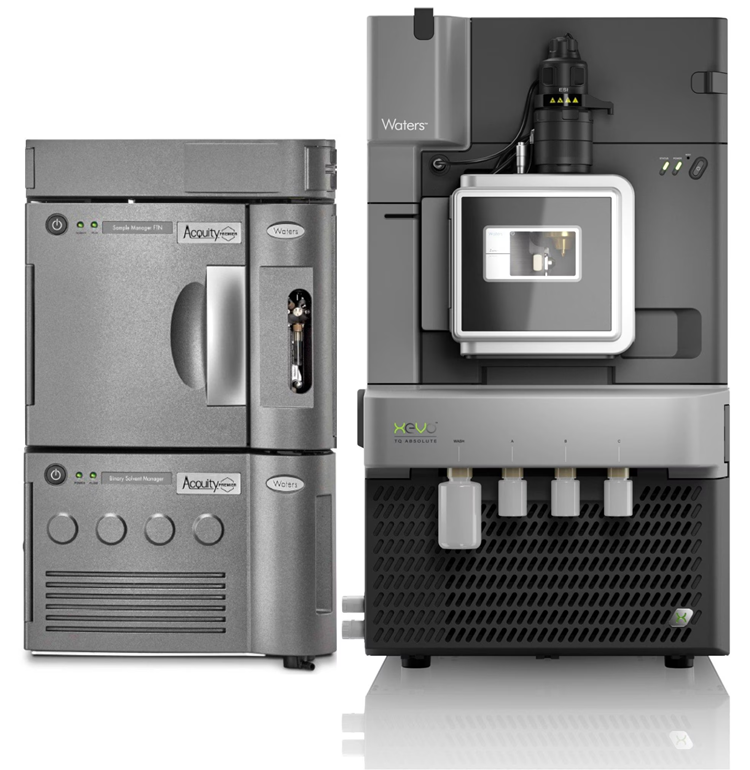
Figure 1. Waters ACQUITY™ Premier UPLC I-Class System with Xevo™ TQ Absolute Mass Spectrometer. Image Credit: Waters Advanced Diagnostics
Table 1. The MRM transitions used to analyze the intact Aβ peptide isoforms and their internal standards (IS). Source: Waters Advanced Diagnostics
Results and discussion
The analytical sensitivity of the lowest calibrator at 0.1 ng/mL was confirmed by S/N (PtP) > 10:1 for all Aβ peptide isoforms (1-38, 1-40, 1-42). This was the case across all five analytical runs (Figure 2).
Analytical sensitivity of the method
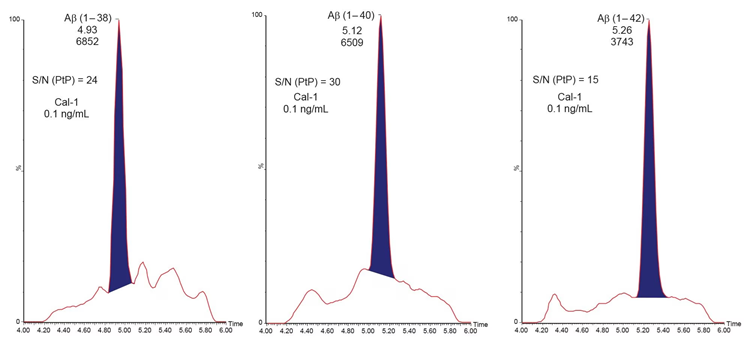
Figure 2. Analytical sensitivity of the method at 0.1 ng/mL for the Aβ peptide isoforms (1–38, 1–40, 1–42) using the ACQUITY™ Premier UPLC I-Class with Xevo™ TQ Absolute Mass Spectrometer (20 μL injection). Image Credit: Waters Advanced Diagnostics
Calibration lines over the five analytical runs were found to be linear with r2 > 0.999 for each peptide over the range 0.1–10 ng/mL.
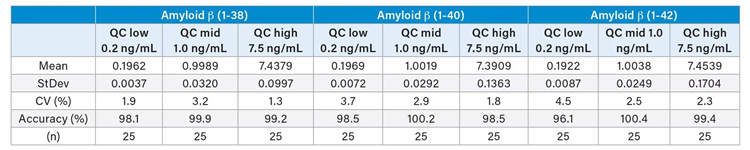
Evaluations of total precision and repeatability across the Aβ peptides were done on the Xevo™ TQ Absolute Mass Spectrometer using QCs at three concentrations: 0.2, 1.0, and 7.5 ng/mL. These were completed in five replicates across a total of five analytical runs (n = 25).
Total precision and repeatability were < 5 % CV, and QC accuracy relative to nominal concentrations ranged from 96.1-100.4 % across the Aβ peptide isoforms (Table 2).
Table 2. Total precision and repeatability performance for the Aβ peptide isoforms. Source: Waters Advanced Diagnostics
Conclusion
An LC-MS/MS method was developed for the analysis of Aβ peptide biomarkers in aCSF in a clinical research setting.
The ACQUITY Premier UPLC I-Class System and Xevo TQ Absolute Mass Spectrometer were shown to offer excellent analytical sensitivity, inter-day linearity, precision, and accuracy, providing confidence in the quantification results of Aβ peptide isoforms (1–38, 1–40, 1–42).
This is an Application Brief and does not contain a detailed Experimental section.
For research use only. Not for use in diagnostic procedures.
References and further reading
- Jensen, M., et al. (2000). Quantification of Alzheimer Amyloid β Peptides Ending at Residues 40 and 42 by Novel ELISA Systems. Molecular Medicine, 6(4), 291–302. DOI: 10.1007/bf03401938. https://link.springer.com/article/10.1007/BF03401938.
- Lachno, D. R., et al. (2015). Validation and Clinical Utility of ELISA Methods for Quantification of Amyloid-β Peptides in Cerebrospinal Fluid Specimens from Alzheimer’s Disease Studies. Journal of Alzheimer’s Disease, 45(2), 527–542. DOI: 10.3233/jad-141686. https://journals.sagepub.com/doi/abs/10.3233/JAD-141686.
- Salcedo, J., et al. Amyloid beta peptides quantification by SPE-LC-MS/MS with automated sample preparation for preclinical research and biomarker discovery. Waters Application Note, 720006517.
Acknowledgments
Produced from materials originally authored by Bilgin Vatansever and Lisa J. Calton from Waters Corporation.
About Waters Advanced Diagnostics
At Waters, we recognize the critical role hospital laboratories play in delivering timely, accurate diagnostics that drive patient care. Our solutions are built to support your lab’s evolving needs - whether you’re expanding test menus, improving turnaround times, or meeting rigorous regulatory standards.
Rooted in three foundational pillars, our approach is designed specifically for clinical lab environments like yours:
Flexibility – Integrate seamlessly into your existing systems and workflows.
Efficiency – Help your team deliver high-quality results faster and with fewer hands-on steps.
Trust – Proven technologies backed by decades of scientific innovation and global support.
From LC-MS/MS systems to automated sample preparation and data management tools, Waters offers comprehensive solutions that enable your lab to operate with confidence - today and in the future.
Sponsored Content Policy: News-Medical.net publishes articles and related content that may be derived from sources where we have existing commercial relationships, provided such content adds value to the core editorial ethos of News-Medical.net, which is to educate and inform site visitors interested in medical research, science, medical devices, and treatments.