Introduction
How are new foods created?
AI across the food development lifecycle
Population health and public health applications
Ethical, social, and practical challenges
Real-world examples and case studies
Safety profile and toxicology
Conclusions
References
Further reading
Artificial intelligence is reshaping the journey from ingredient discovery to personalized nutrition, revealing how data-driven food design could transform human health, sustainability, and the future of what we eat.
 Image Credit: Inkoly / Shutterstock.com
Introduction
The global human population is expected to reach 10 billion by 2050, which will lead to a 20% increase in food demand that will further strain the global food system. Traditional animal agriculture is a leading contributor of greenhouse gas (GHG) emissions and biodiversity loss; therefore, it is crucial to identify sustainable alternatives to sustain projected population growth without worsening climate change.
Artificial intelligence (AI) technologies are increasingly used across the food industry to support the transformation of existing food technologies and the development of new products. Recent research indicates that AI can accelerate ingredient discovery, optimize formulation design, and analyze large biochemical and nutritional datasets to identify novel bioactive compounds and sustainable food sources.2,10 This article discusses the strengths, limitations, and future potential of integrating AI into the food lifecycle.
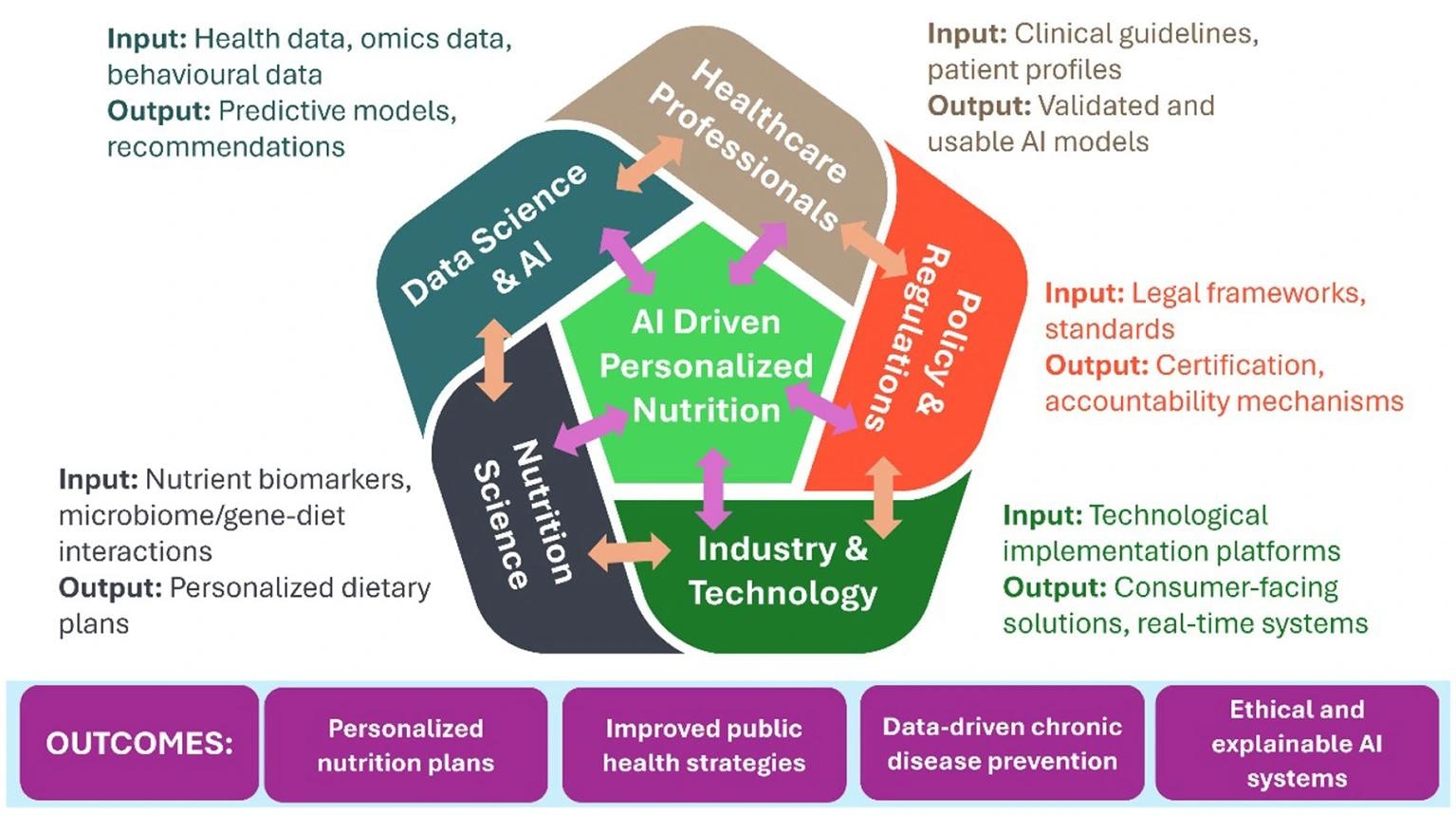
A conceptual framework illustrating interdisciplinary collaboration in AI-driven personalized nutrition. The model integrates contributions from data science, healthcare, nutrition, industry, and policy to produce ethically grounded, clinically valid, and context-sensitive dietary solutions. 2
How are new foods created?
Creating new food products is a time-consuming and expensive process that often requires collaboration between food scientists, engineers, culinary artists, and consumer research. The food development cycle begins with the selection of target meat and other key ingredients based on the desired structure and nutritional profile of the final product. Thereafter, various ratios of proteins, fats, binders, and other additives are evaluated for their effects on the food's taste, texture, and appearance.
Changing any of these parameters can lead to significant variations in the quality of the final product, thus necessitating a trial-and-error approach that is often inefficient and costly. Computational modeling and AI-driven formulation tools can reduce the number of physical experiments required by predicting ingredient interactions, sensory properties, and nutritional outcomes before prototypes are produced.2,10
Non-generative AI is the most common application of this technology in the food industry, particularly for optimizing specific properties such as nutritional value or environmental impact. Nevertheless, AI is also being applied to discover new protein sources from extensive datasets on various plants and to predict their taste, texture, and/or behavior when combined with different ingredient combinations.
For now, we should leverage AI as a partner to systematically improve solutions, reduce the number of trials, and accelerate the timeline from seed to plate.10
AI across the food development lifecycle
Current AI large-language models (LLMs) have been trained on sufficient data to accurately predict nutritional profiles from a list of weighted ingredients. Although there remains insufficient data on rheology, texture, and flavor, new training data is increasingly being generated to create foundational models to create future products.
Specifically, these data will enable AI technologies to better understand the relationships among ingredients, formulations, nutritional profiles, texture, flavor, and taste. For example, if a novel LLM is provided with a list of ingredients and the nutritional profiles of those ingredients, it could be used to estimate ingredient composition using optimization tools. Multivariable optimization expands upon this skill set by optimizing multiple characteristics, prioritizing features based on consumer preferences and product constraints.
In parallel, AI-powered recommender systems and digital nutrition platforms are being explored to guide healthier dietary choices by combining behavioral science, nutritional datasets, and personalized dietary recommendations.2,7
Building a more sustainable food system with AI | FT Food Revolution
Population health and public health applications
At the population level, AI is being utilized as a powerful diagnostic tool to address the dual burden of malnutrition and overconsumption of ultra-processed foods. ML classifiers, including the validated “FoodProX,” examine nutritional features as input to predict the degree of food processing, thereby allowing the model to classify the likely level of industrial food processing rather than directly measuring nutrient loss. This provides public health officials and consumers with objective data identifying healthier alternatives.5
AI algorithms are being used to map food deserts by analyzing satellite imagery and socio-economic data. These detailed maps enable the personalization of public health policies and dietary recommendations to specific communities or high-risk demographic groups.2
For example, among older adults at greater risk of malnutrition, AI-assisted nutrition-monitoring tools and predictive models are being developed to identify nutritional risk factors and support earlier dietary interventions. However, many of these systems remain in early research or prototype stages and require further real-world validation before widespread clinical adoption.1,9
Through a synergistic partnership with AI, we can build healthier and more sustainable food futures, faster, cheaper, and more efficiently.10
Ethical, social, and practical challenges
The World Health Organization (WHO) emphasizes the urgent need for robust AI governance frameworks that prevent algorithmic bias in health-related technologies and ensure transparency, accountability, and fairness in AI-driven decision-making.6
The lack of standardized AI-driven protocols and limited clinical validation in racially or socially diverse populations remains a major implementation challenge.2
International guidance also stresses the importance of explainable AI, transparent datasets, and multidisciplinary oversight to ensure that health-related AI systems remain trustworthy, unbiased, and socially responsible.6,8 Recent reviews posit that ensuring that AI tools are equitable and transparent through policy implementation and multidisciplinary collaboration is essential to establish public trust and the eventual acceptance of AI-designed foods.7
Real-world examples and case studies
One of the most cited examples of AI’s successful integration into industry is the food-tech firm Brightseed, which used its "Forager" AI to analyze over 700,000 compounds to identify hemp hulls as a rich natural source of two bioactive compounds that support gut barrier function.10
Moreover, the United States National Institutes of Health (NIH) has launched the Nutrition for Precision Health study, which aims to engage over 10,000 participants while prioritizing sample diversity to build algorithms that predict individual responses to dietary patterns.2
Clinical studies evaluating personalized nutrition programs have demonstrated improvements in several cardiometabolic indicators, including body weight, triglycerides, and diet quality, although some biomarkers such as LDL cholesterol may not show significant changes.3
Recently, the Food Plus application developed by Samsung has been developed to recognize over 40,000 food ingredients and provide personalized recipes with real-time adjustments to users across 104 countries.2
 Image Credit: elenabsl / Shutterstock.com
Safety profile and toxicology
AI-driven New Approach Methods (NAMs) are being explored to support food safety assessments by analyzing molecular structures, biochemical datasets, and toxicity databases to identify potential hazards earlier in the development process.8 These approaches aim to complement traditional toxicology methods and regulatory evaluation rather than replace them.
In clinical and public health contexts, ML models are also being investigated to screen for malnutrition risk in older adults by analyzing combinations of demographic, clinical, and nutritional indicators. While early studies show promising predictive performance, broader clinical validation is still needed.9
Conclusions
The present article highlights how AI-designed foods and precision nutrition platforms have the potential to transform human health by improving nutrient quality and food system sustainability. Continued interdisciplinary research among data scientists, clinicians, and food technologists will be the key to realizing a resilient and equitable nutritional future.
Future progress will depend on expanding high-quality datasets, validating AI systems across diverse populations, and implementing responsible governance frameworks to ensure that AI-enabled food innovation benefits global health without exacerbating existing inequalities.2,6,8
References
- Kalu, K., Ataguba, G., Onifade, O., et al. (2025). Application of Artificial Intelligence Technologies as an Intervention for Promoting Healthy Eating and Nutrition in Older Adults: A Systematic Literature Review. Nutrients 17(20); 3223. DOI: 10.3390/nu17203223. https://www.mdpi.com/2072-6643/17/20/3223
- Agrawal, K., Goktas, P., Kumar, N., & Leung, M.-F. (2025). Artificial intelligence in personalized nutrition and food manufacturing: a comprehensive review of methods, applications, and future directions. Frontiers in Nutrition 12. DOI: 10.3389/fnut.2025.1636980. https://www.frontiersin.org/journals/nutrition/articles/10.3389/fnut.2025.1636980/full
- Bermingham, K. M., Linenberg, I., Polidori, L., et al. (2024). Effects of a personalized nutrition program on cardiometabolic health: a randomized controlled trial. Nature Medicine 30(7); 1888-1897. DOI: 10.1038/s41591-024-02951-6. https://www.nature.com/articles/s41591-024-02951-6
- Shamanna, P., Joshi, S., Thajudeen, M., et al. (2024). Personalized nutrition in type 2 diabetes remission: application of digital twin technology for predictive glycemic control. Frontiers in Endocrinology 15. DOI: 10.3389/fendo.2024.1485464. https://www.frontiersin.org/journals/endocrinology/articles/10.3389/fendo.2024.1485464/full
- Menichetti, G., Ravandi, B., Mozaffarian, D., & Barabási, A.-L. (2023). Machine learning prediction of the degree of food processing. Nature Communications 14(1). DOI: 10.1038/s41467-023-37457-1. https://www.nature.com/articles/s41467-023-37457-1
- World Health Organization. (2025, March 25). Ethics and governance of artificial intelligence for health: Guidance on large multi-modal models. https://www.who.int/publications/i/item/9789240084759
- Starke, A. D., Dierkes, J., Lied, G. A., et al. (2025). Supporting healthier food choices through AI-tailored advice: A research agenda. PEC Innovation 6; 100372. DOI: 10.1016/j.pecinn.2025.100372. https://www.sciencedirect.com/science/article/pii/S2772628225000019
- Gant, T. W., Boxall, A., Burgwinkel, D., et al. (2026). Building trust in the integration of artificial intelligence into chemical risk assessment: findings from the 2024 ECETOC workshop. Archives of Toxicology. DOI: 10.1007/s00204-025-04286-8. https://link.springer.com/article/10.1007/s00204-025-04286-8
- Ghosh, J. (2024). Recognizing and Predicting the Risk of Malnutrition in the Elderly Using Artificial Intelligence: A Systematic Review. International Journal of Advancement in Life Sciences Research 7(03); 01-14. DOI: 10.31632/ijalsr.2024.v07i03.001. https://ijalsr.org/index.php/journal/article/view/287
- Kuhl, E. (2025). AI for food: accelerating and democratizing discovery and innovation. npj Science of Food 9(82). DOI: 10.1038/s41538-025-00441-8. https://www.nature.com/articles/s41538-025-00441-8.
Further Reading
Last Updated: Mar 10, 2026
 Artificial intelligence improves diagnostic accuracy in clinical breast pathology