Recalling similar memories triggers divergent brain activity, resulting in better memory performance
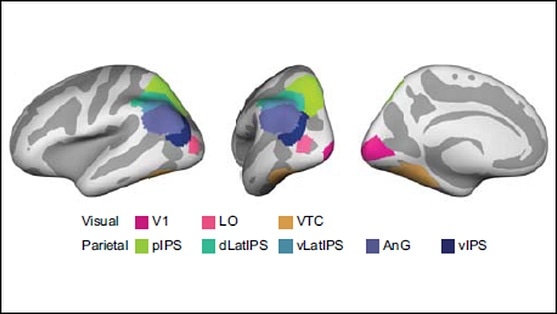
Image Credit: Society of Neuroscience
In order to remember similar events, the brain exaggerates the difference between them. This results in divergent brain activity patterns but better memory performance, according to new research published in JNeurosci.
Memory is subjective. Different people recall the same event in unique ways, and people exaggerate the difference between similar events in their own life. Yet this type of bias can be advantageous when it helps the brain distinguish between similar things and prevent confusion.
In a study by Zhao et al., participants memorized different sets of faces paired with colored objects. Some objects were identical except for slight color differences. At the start of training, the participants had a hard time distinguishing pairs when the objects were almost identical. However, after two days of practice and testing, performance improved. Participants were then shown a face and imagined the corresponding object while the researchers measured their brain activity with fMRI. Recalling two similar objects resulted in different activity patterns in the intraparietal sulcus, a brain area involved in the subjective aspect of memory. The more dissimilar the brain activity, the better the participants’ memory performance and the more they exaggerated the color difference in a post-scan test.
Source:
Journal reference:
Zhao, Y., et al. (2021) Adaptive Memory Distortions Are Predicted by Feature Representations in Parietal Cortex. Journal of Neuroscience. doi.org/10.1523/JNEUROSCI.2875-20.2021.
 Study reveals dynamic remodeling of genome architecture during brain aging