A new analysis suggests that cutting ultra-processed foods alone is not enough if higher-protein advice pushes Americans toward more meat, with plant-based protein emerging as the lower-impact option.
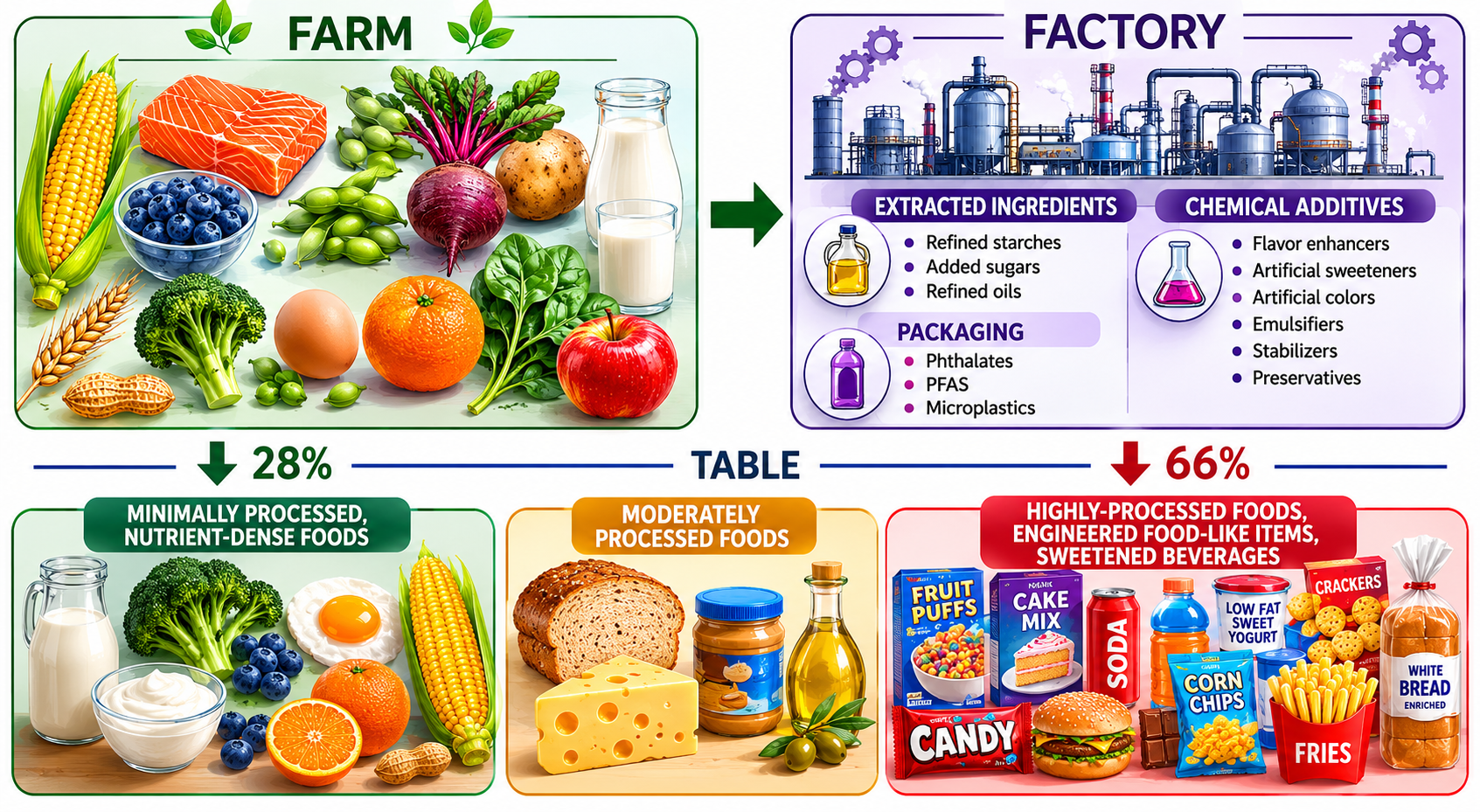
Highly processed and engineered foods and beverages make up the bulk of the U.S. diet. Highly processed foods and extracted ingredients account for about two-thirds of the energy consumed by U.S. youth and adolescents and 60% of the energy consumed by U.S. adults. Abbreviation: PFAS, per- and polyfluoroalkyl substances.
In a recent study published in the Proceedings of the National Academy of Sciences, researchers investigated the environmental impacts of adherence to the 2025–30 Dietary Guidelines for Americans (DGAs).
The Dietary Guidelines Advisory Committee convenes every 5 years to synthesize the latest evidence to advise the United States (US) government on healthy diets. This report shapes the development of DGAs, the foundation of US food policy.
The 2025–30 DGAs were released in early 2026 and advise avoiding “hyperprocessed” foods, also known as ultra-processed foods (UPFs), while recommending higher protein intake, chiefly from animal sources.
Since most protein currently consumed in the US is animal-based, a recommendation for higher overall protein intake might translate into increased meat intake. Moreover, the authors argue that branding the new guidelines as a return to real foods, excluding anything industrial or processed, implies consuming “natural” red meat, which many consumers may interpret as grass-fed beef. However, the authors note that a nationwide shift to grass-fed beef could support only about half of current US beef consumption, making current or higher intake levels infeasible.
DGA Diet Modeling And Metrics
In the present study, researchers evaluated the environmental impacts of adherence to the 2025–30 DGAs. Specifically, they assessed land use, nitrogen fertilizer use, freshwater use, and greenhouse gas (GHG) emissions for diets that adhere to these new DGAs compared with the current Mean American Diet (MAD). Land use, nitrogen fertilizer use, water use, and GHG impact coefficients were derived from a previously published Dietary Impacts on Environmental Measures (DIEM) dataset.
The team assessed different diets without UPFs with distinct protein intake levels. They constructed three isocaloric diets of 2,500 kcal with protein levels of 0.8, 1.2, and 1.6 g/kg body weight, respectively, and eliminated all UPFs. The protein intake range encompassed both the former protein intake recommendation (0.8 g/kg) and the upper limit in the new DGAs (1.6 g/kg).
In addition, the researchers constructed two high-protein diets (1.6 g/kg body weight) with plant or animal protein sources to evaluate the differences between plant- and animal-based foods. The protein intake level in the current MAD was 1.2 g/kg body weight, 50% more than the recommended level in previous DGAs. UPFs accounted for a substantial share of environmental impact, i.e., 40%–58%, in the current MAD.
Notably, land use, nitrogen fertilizer use, and GHG emissions from excluding UPFs in the current MAD were outweighed by the detrimental impact of increasing protein intake to 1.2–1.6 g/kg, by up to 32%. However, increasing protein intake and eliminating UPFs reduced freshwater use by 7%–19% compared to MAD. Moreover, the diet with animal-based protein had a greater environmental impact than that with plant-based protein.
Animal Protein Drives Environmental Costs
The findings indicate net environmental harm across most key metrics if the new DGAs are followed in ways that increase animal-based protein intake. In particular, the results underscore the considerable environmental costs of animal-based foods and UPFs, and the need to decrease them for sustainability.
Although eliminating all UPFs yielded substantial benefits, increasing protein intake offset most of those gains. Water use was the exception, declining relative to MAD, but the authors note that the benefit would be greater with lower protein intake and greater plant-sourced protein intake. The diet with high plant-based protein had a substantially lower environmental impact.
Removing UPFs from existing diets and replacing them with plant-based whole foods would have a considerable benefit for planetary and public health. However, replacing UPFs with animal-based foods would cause net environmental harm, with an uncertain impact on public health.
Overall, the authors argue that the 2025–30 DGAs must be revised to align them with established science and evidence, which requires prioritizing plant-based foods over animal foods.
Download your PDF copy by clicking here.
Journal reference:
- Shepon A, Makov T, Katz DL, Eshel G (2026). The 2025–2030 Dietary Guidelines for Americans are associated with higher land, water and nitrogen use, and greenhouse gas emissions. Proceedings of the National Academy of Sciences, 123(24), e2604814123. DOI: 10.1073/pnas.2604814123, https://www.pnas.org/doi/10.1073/pnas.2604814123
 Researchers find secret protein that drives cancer cell division