Cold exposure during early pregnancy altered breast milk bile acids and microbial metabolism, providing male rat offspring with lasting protection against impaired glucose control and liver fat accumulation.
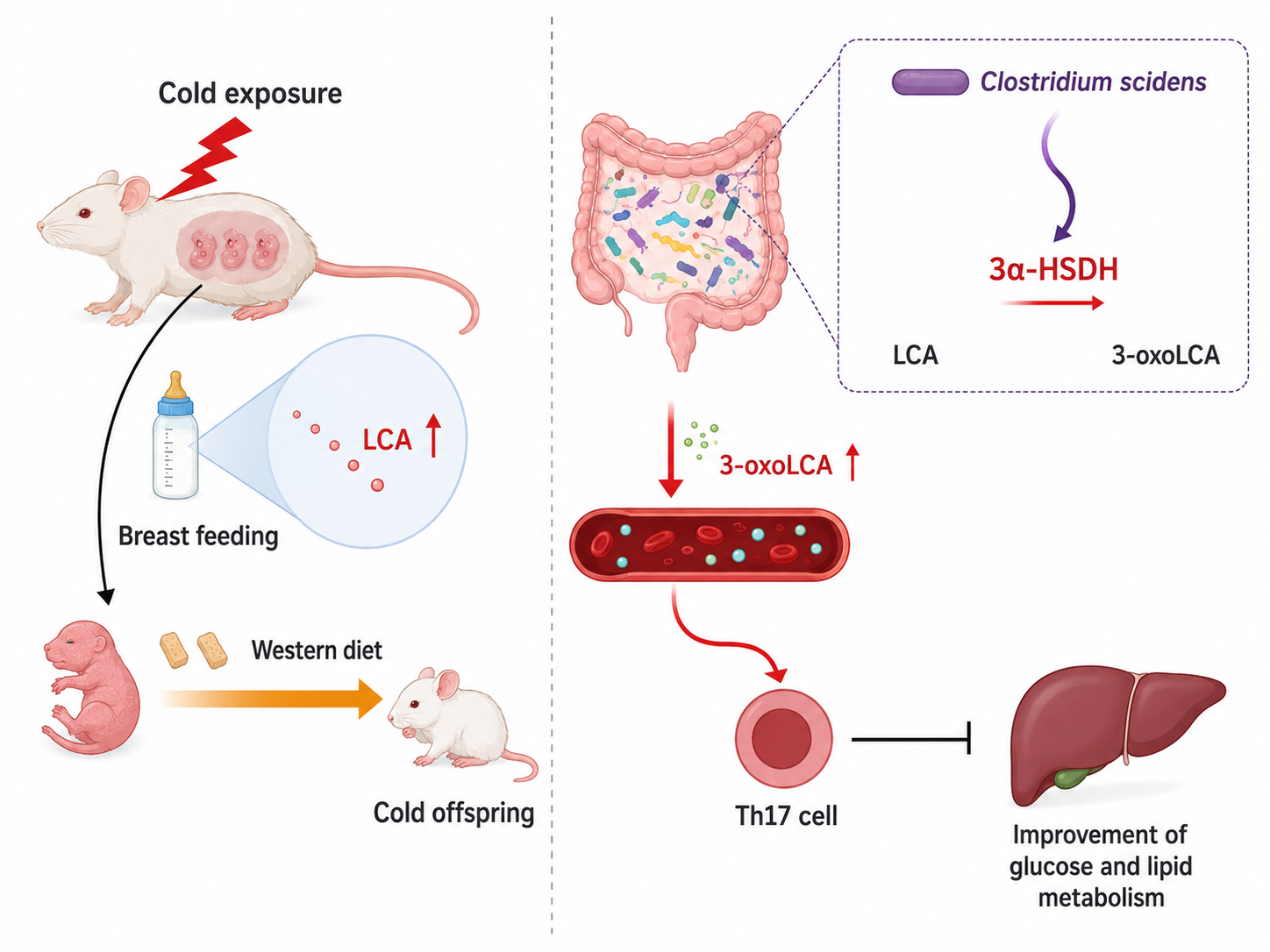
Maternal cold exposure reprograms offspring metabolism via a microbiota–bile acid–Th17 axis. Study: Maternal cold exposure improves offspring metabolic health via a milk lithocholic acid–microbiota–Th17 axis
In a recent study published in the journal npj Biofilms and Microbiomes, researchers evaluated whether maternal cold exposure during early pregnancy influenced long-term metabolic outcomes in offspring.
The study combined immunophenotyping, transcriptomic, metabolomic, and cross-fostering approaches and revealed that male offspring of cold-exposed dams demonstrated significantly improved glucose tolerance, insulin sensitivity, and hepatic lipid profiles when challenged with a Western diet. In a separate cohort maintained on standard chow, these metabolic benefits remained detectable at 18 months of age.
Importantly, the study found that these maternally conferred benefits persisted into late adulthood in male rats maintained on standard chow. Mechanistic evaluations indicated that the benefits were transmitted at least partly through postnatal factors associated with lactation, with lithocholic acid (LCA)-enriched breast milk identified as a potential mediator. These in vivo model findings were complemented by observational human analyses in which winter conception, used as a proxy for early-pregnancy cold exposure, was associated with a lower risk of metabolic dysfunction-associated steatotic liver disease (MASLD).
Background
Modern transitions to Western-inspired dietary patterns have been highlighted as major contributors to the rising global burden of metabolic conditions like obesity. Alarmingly, type 2 diabetes (T2D) and MASLD, conditions conventionally associated with adulthood, are increasingly being reported during childhood and early life, suggesting a transgenerational shift in metabolic risk.
The Developmental Origins of Health and Disease (DOHaD) framework aims to explain these observations by positing that environmental exposures during prenatal and perinatal windows can exert lasting effects on an individual's physiology. While negative factors such as pollutants or poor diets have been shown to predispose offspring to adult illness, beneficial maternal interventions, including exercise and dietary changes, may improve offspring's metabolic resilience.
Separately, studies in adults have shown that cold exposure activates thermogenic and lipid-metabolic pathways. However, whether maternal cold exposure could program lasting metabolic wellness in offspring remained unknown.
About the Study
The present study aimed to address this knowledge gap by experimentally exposing pregnant rats to either room temperature (25 ± 1°C) or cold conditions (4 ± 1°C) during the first 10 days of gestation. Their offspring were raised at room temperature until the end of weaning (21 days), after which dietary interventions were initiated.
The interventions comprised feeding experimental cohort pups a high-fat Western diet containing 60% of energy from fat, together with 10% weight/volume (w/v) fructose in their drinking water for 5 weeks. A separate cohort was maintained on standard chow until 18 months of age to assess late-adulthood outcomes.
To isolate the prenatal versus postnatal impacts of maternal exposure, cross-fostering experiments were conducted. Within 24 hours of birth, a subset of newborn pups was exchanged between cold-exposed and room-temperature mothers.
Long-term metabolic changes and their potential physiological mechanisms were assessed using next-generation molecular assays, particularly liquid chromatography-tandem mass spectrometry (LC-MS/MS) for metabolomic profiling of maternal breast milk and offspring plasma.
Furthermore, offspring immune cells were evaluated by flow cytometry (immunophenotyping), and concurrent liver tissue alterations were elucidated using transcriptomic profiling with ribonucleic acid (RNA) sequencing and quantitative real-time polymerase chain reaction (qRT-PCR).
The researchers then examined whether the animal findings were reflected in observational human data from 33,915 UK Biobank participants and 3,209 participants in the China Health and Retirement Longitudinal Study (CHARLS).
Study Findings
The study’s statistical analyses revealed that male offspring of cold-exposed mothers showed significant metabolic advantages compared with those born and raised by mothers housed at normal temperature. Oral glucose tolerance and insulin tolerance tests showed that, when fed a Western diet, the former cohort displayed significantly better glucose tolerance and insulin sensitivity (p < 0.05).
Concurrently, organ weight measurements, hepatic triglyceride assays, and histological analyses revealed statistically significant reductions in liver weight, hepatic fat accumulation, and hepatic triglyceride levels in pups born and raised by cold-exposed mothers. No comparable hepatic differences were observed in female offspring, so the subsequent mechanistic experiments focused on males.
Notably, these metabolic benefits persisted for 18 months into late adulthood. Members of the separate standard-chow cohort continued to demonstrate better glucose tolerance and insulin sensitivity, reduced hepatic lipid content, and lower expression of the lipid-related genes CD36, FABP1, and FAS (p < 0.05).
Cross-fostering experiments indicated that these metabolic benefits were mediated at least partly by postnatal factors associated with the foster dam, supporting a role for lactation and breast-milk components. Metabolomics identified that LCA, a secondary bile acid, was highly enriched in the milk of cold-exposed dams.
LCA itself did not directly reverse palmitic acid-induced transcriptional changes in HepG2 hepatoma or Jurkat T-cell leukemia cell lines. However, antibiotic treatment abolished the metabolic effects of LCA supplementation in rats, supporting the need for microbial conversion of LCA into active metabolites.
Targeted bile acid profiling identified higher plasma levels of the LCA derivatives 3-oxo-LCA and isoalloLCA in male offspring of cold-exposed dams. A bioinformatic screen of 1,520 representative human gut bacterial genomes identified Clostridium scindens, Ruminococcus gnavus, and Eggerthella lenta as prominent carriers of genes encoding the relevant 3α-hydroxysteroid dehydrogenase enzymes.
Supplementation with 3-oxo-LCA reduced hepatic interleukin-17 (IL-17) pathway gene expression and improved glucose tolerance, insulin sensitivity, and hepatic lipid outcomes. Its effects were not abolished by antibiotics, indicating that 3-oxo-LCA acts after the microbiota-dependent LCA conversion step.
The researchers then tested Clostridium scindens experimentally in rats. Supplementation with this bacterium increased fecal 3-oxo-LCA and reproduced several of these protective outcomes.
In observational human analyses, winter conception was associated with a 24.9% lower hazard of developing MASLD in the UK Biobank cohort, with a hazard ratio (HR) of 0.751 and a 95% confidence interval (CI) of 0.568-0.991. In CHARLS, winter conception was associated with lower odds of MASLD in colder northern China (OR = 0.580; 95% CI = 0.338-0.995), but no association was observed in southern China.
Conclusions
These results support a maternal cold-milk bile acid-microbiota-T helper 17 (Th17) axis that may influence long-term metabolic health in male rat offspring. The animal findings and broadly consistent observational human associations point to microbiota- and bile acid-related pathways as potential targets for further research, rather than establishing an intergenerational treatment strategy.
The human analyses were associative and did not directly measure maternal cold exposure, LCA, 3-oxo-LCA, gut microbial conversion, or Th17 activity. Winter conception was estimated from birth month, while MASLD in CHARLS was identified using a metabolic surrogate rather than liver imaging. Cross-fostering also could not completely separate milk-derived LCA from other maternal, milk-associated, or postnatal factors. The absorption kinetics of supplemented LCA and 3-oxo-LCA were also not determined.
Further studies are therefore needed to establish whether the proposed mechanism operates in humans and whether related interventions would be safe, effective, and durable.
 Scientists reveals how cancer-causing p53 mutations remain invisible to the immune system