Daily step counts may reveal subtle signs of behavioral instability days before activity patterns shift, opening a potential window for more timely support.

Study: Early warning signals of sudden changes in daily step count: an intensive longitudinal study of over 20,000 adults. Image Credit: zkolra / Shutterstock
A recent study published in the journal NPJ Exercise Medicine and Health investigated whether dynamic complexity in daily step counts is associated with impending sudden changes, particularly losses, in physical activity among adults and assessed the potential of these early warning signals to inform adaptive intervention strategies.
Behavioral Instability in Physical Activity
Physical activity is vital for long-term health and for reducing societal and healthcare burdens. Despite well-established benefits, sustaining regular activity proves difficult, as individuals often experience lapses and relapses over time. These setbacks can undermine health gains and highlight the importance of anticipating periods when individuals are most vulnerable to disengagement. The ability to predict and intervene during these high-risk periods is crucial for developing effective, adaptive support strategies that promote lasting behavior change.
Complex systems theory, supported by mobile sensing, conceptualizes behavioral activity as emerging from interacting factors that can lead to abrupt transitions. Early-warning signals (EWSs), such as critical fluctuations, often precede these transitions and are detectable in behavioral time series. Dynamic complexity (DC) is a particularly promising indicator that integrates volatility and distribution to capture instability before behavioral shifts.
Preliminary studies suggest that rising DC is associated with impending sudden declines in physical activity, indicating its value as a predictive marker for relapse. However, DC’s ability to predict increases in activity is less clear, suggesting potentially distinct processes for decline versus recovery. Existing research is limited by small, relatively homogeneous samples. To advance the field, there is a pressing need to validate DC as an early warning signal in larger, more diverse, real-world populations and to examine its robustness across different definitions of sudden behavioral change.
Exploring the Association Between DC and Sudden Changes in Walking Behavior
The current study evaluated real-world data to examine associations between DC and sudden changes in walking behavior, with a primary focus on sudden losses and a secondary focus on sudden gains. Data were drawn from the Kiplin dataset, collected in France between January 2019 and April 2023.
Of 247,059 Kiplin app registrants (2019–2023), individuals with fewer than 90 days of data, a median daily step count of more than 20,000, or more than 20% missing days were excluded to ensure reliability and remove extreme activity levels. After applying these criteria, 21,425 participants (8.7% of registrants) comprised the final analytical sample. Days with fewer than 500 steps or more than 30,000 steps were also treated as missing observations.
Measures included daily step counts, self-reported age, sex, height, weight, and intervention exposure. Step counts were obtained via smartphone or wearable device APIs, such as Apple Health, Google Fit, Garmin, and Fitbit.
Patterns and Predictors of Step Count Changes
Among participants who reported their gender, 60% were women. The average participant age was 43 years. The average daily step count was 7,817 steps. Missing data were minimal, and the average step-count time series was 256 days.
Sudden changes in step count, defined as a ±30% shift from a participant’s median level lasting at least 7 days, were common. The researchers also tested 20%, 30%, and 40% shifts lasting at least 7, 14, or 28 days to assess the robustness of the findings. Specifically, 96% of participants had at least one sudden loss, and 94% experienced at least one sudden gain. On average, participants experienced about three sudden gains and three sudden losses during the study period. Sudden gains lasted a median of 20 days, while losses lasted longer, at 33 days. Notably, sudden gains were usually followed by a loss, and vice versa, indicating a cyclical pattern in activity fluctuations.
DC was normalized for each participant, yielding a mean of 0 and a standard deviation of 1 for each participant. Across observations, the median DC was below zero, reflecting a right-skewed distribution. DC exceeded one standard deviation above an individual’s mean on 14% of days and two standard deviations on 5% of days. Importantly, the highest DC value during the three days preceding a sudden loss was strongly associated with the likelihood of that loss occurring. This relationship was particularly strong for losses that were shorter in duration and larger in magnitude. As the duration of the loss increased, the association between DC and loss weakened, but remained statistically significant.
The association between DC and sudden gains in activity was weaker and less consistent than that between DC and sudden losses in activity. DC showed only a small positive association with brief gains; for longer-lasting gains, the association was small or even negative. Over time, both sudden gains and losses became less common as the study progressed. However, the longer the time since the previous gain or loss of the same type, the more likely a new sudden change was to occur, consistent with recurring phases of activity change.
Exposure to the Kiplin intervention was associated with a reduced likelihood of sudden losses across the definitions tested, with stronger relationships for longer-lasting losses. It was also linked to an increased likelihood of sudden gains, particularly for events lasting 7 or 14 days. Findings for longer-lasting gains were less clear, suggesting that its relationship with gains may be most pronounced for shorter-term fluctuations.
The association between DC and sudden losses was strongest among less active participants, suggesting that DC may be particularly relevant as an early warning signal for people with lower baseline activity. In contrast, gender, age, BMI, and device type showed less evidence of moderating these associations, suggesting that the observed effects were generally consistent across demographic and technical subgroups.
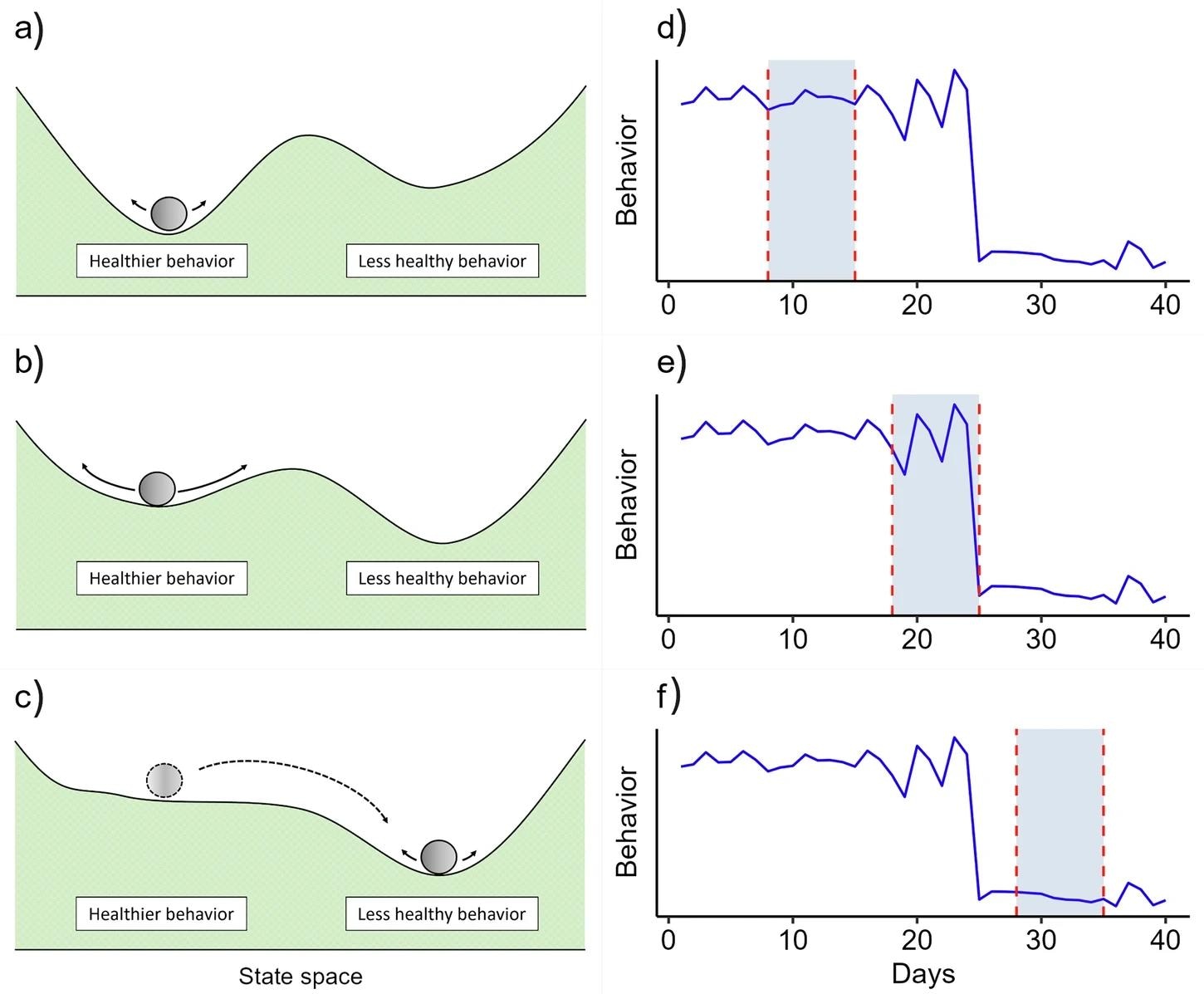
a–c Sudden transitions according to the attractor landscape metaphor. d–f Empirical illustration of corresponding phenomena from a time series perspective. The deep valley in a represents a strong attractor (e.g., Healthier Behavior), where the system exhibits minimal fluctuations, as indicated by the light blue band in (d). If perturbations push the system away from equilibrium, it tends to return quickly to its resting state. As the system approaches a tipping point, the Healthier Behavior attractor weakens, leading to increased critical fluctuations (b). The system begins to explore a broader range of states but has not yet transitioned to a new attractor. This phase is characterized by early-warning signals, such as the widening of fluctuations (light blue area in e), which indicate an increased likelihood of transition. c and f After crossing the tipping point, the system undergoes a sudden transition and stabilizes in a Less Healthy Behavior state, where a new attractor becomes dominant and stable.
Translational Relevance for Intervention Design
The current study provided evidence that critical fluctuations in daily step count may serve as early warning signals of sudden declines in walking behavior. At the population level, this association provides a basis for further developing and testing timely intervention strategies designed to prevent abrupt declines in physical activity.
Despite these promising results, several limitations should be acknowledged. The use of a regression-tree method to detect sudden changes, the absence of direct wear-time data, potential biases arising from missing-data mechanisms, and limited generalizability due to the study’s inclusion criteria may have influenced the outcomes.
The models established predictive associations at the group level but did not test prospective individualized risk prediction, sensitivity, or specificity. In addition, the researchers could not formally assess selection bias because data were unavailable for registrants excluded from the analytical sample. Although associations between early-warning signals and sudden losses have been established, the underlying mechanisms remain unclear.
Further research is needed to improve individualized risk prediction and test whether EWS-triggered interventions can effectively prevent sudden declines.
Journal reference:
- Baretta, D., Mazéas, A., Chalabaev, A., Inauen, J., & Chevance, G. (2026). Early warning signals of sudden changes in daily step count: An intensive longitudinal study of over 20,000 adults. Npj Exercise Medicine and Health, 1(1), 3. DOI: 10.1038/s44437-026-00003-4, https://www.nature.com/articles/s44437-026-00003-4
 What young cancer survivors revealed about stress, exercise and friendship