A person starts crying nearby. What does a dog do, and does its life with humans make a difference?
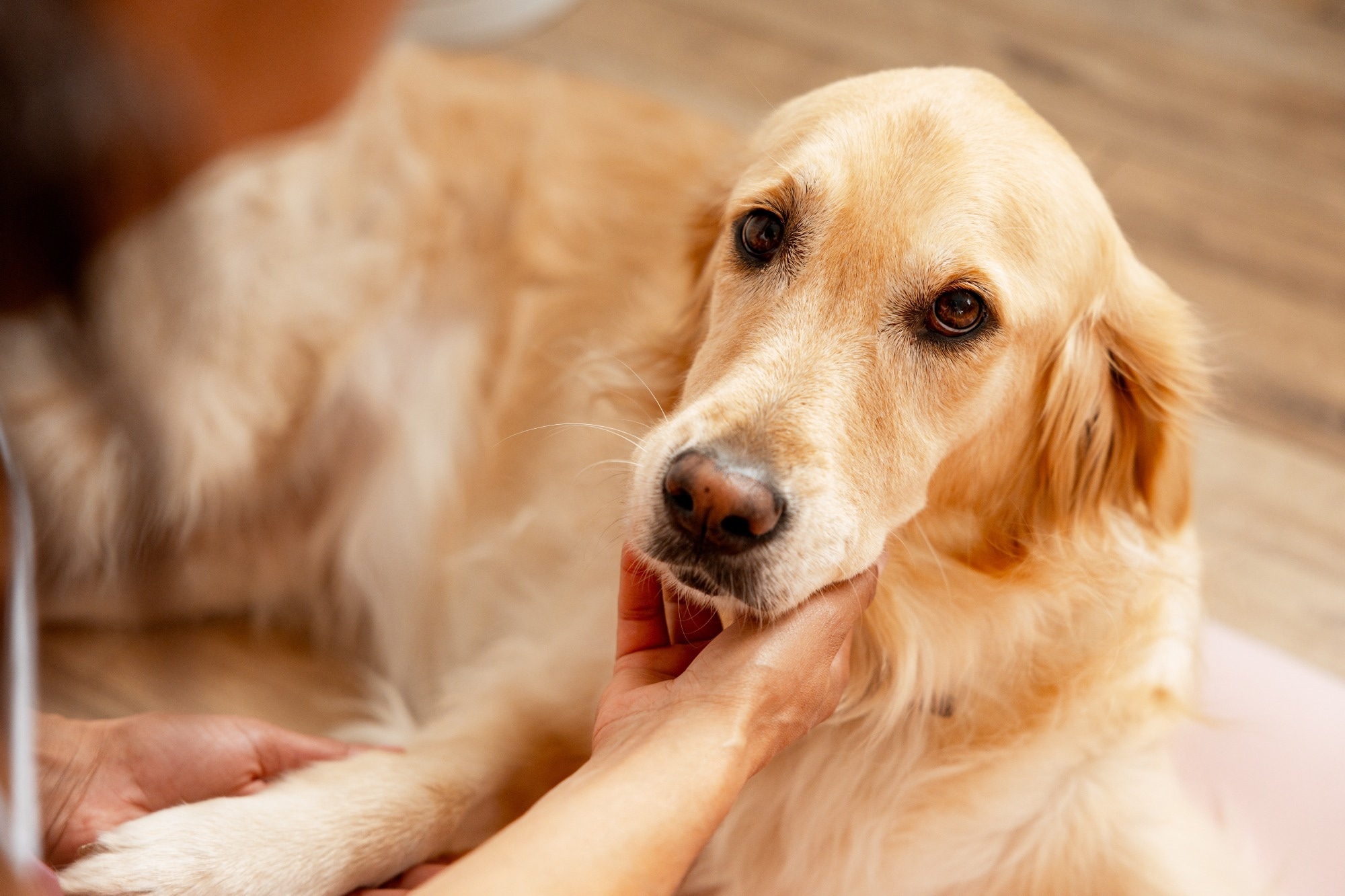 Study: Life experiences affect dogs' responses to human crying. Image Credit: AYO Production / Shutterstock.com
A recent study published in the journal Scientific Reports evaluated whether developmental and environmental experiences influence the behavioral responses of companion, shelter, and free-ranging dogs to simulated human crying.
Canine emotional responsiveness
Empathy, the capacity to perceive and be affected by others' emotional states, is fundamental to social behavior in many species. It operates through both automatic mechanisms, such as emotional contagion, and cognitive mechanisms, such as perspective-taking, and often underlies prosocial actions like helping or consolation. Identifying empathy in non-human animals is challenging, as similar behaviors may arise from different underlying motivations.
Dogs are a particularly valuable model for investigating emotional responsiveness because of their unique evolutionary history with humans and their refined sensitivity to human communication. Studies have found that dogs can recognize human emotions and respond to distress with distinct behavioral changes, including increased attention, proximity-seeking, and physiological alterations such as changes in heart rate or cortisol levels. It remains unclear whether these reactions stem from empathy or from responses to salient social cues.
Current research largely focuses on pet dogs, leaving shelter and free-ranging dogs, who make up most of the global population, understudied. These groups differ in their living conditions and opportunities for human interaction, limiting our understanding of how life history may affect canine emotional responsiveness. Comparative studies across diverse dog populations can help examine how experience and environment relate to responses to human distress.
Comparative study on canine emotional responsiveness
This study included free-ranging, shelter, and pet dogs to capture different life contexts. Free-ranging dogs in West Bengal, India, lived in groups and had diverse interactions with people, ranging from affiliative to aversive. Shelter dogs from Ouro Fino, Brazil, had lived there for at least three months and had limited daily contact with humans. Pet dogs in São Paulo, Brazil, lived with owners and were recruited via social media and volunteer registries.
The study included 112 adult dogs: 34 free-ranging, 33 shelter, and 45 pets. All dogs lived in their environments for at least three months. Free-ranging and shelter dogs were mixed-breed, whereas pet dogs included both mixed-breed and purebred animals.
Each group underwent tailored familiarization before testing. Pet dogs acclimated at home for 10 minutes, while shelter dogs received brief petting and five minutes of quiet in their kennels. Free-ranging dogs were allowed 30 seconds to remain nearby before testing. Shelter and free-ranging dogs underwent a five-day affiliative phase, with daily petting and food, to build familiarity with the experimenter. Dogs could enter the study after at least three sessions. Testing started only when dogs were calm and not seeking attention.
Each dog was subsequently exposed to four 20-second demonstrations in randomized order: a familiar person or an experimenter simulated crying or hummed a song. The familiar person was the owner for pet dogs and an experimenter from the affiliative phase for the other groups.
How dogs responded to crying and humming
Dogs' likelihood of looking towards the demonstrator decreased across repeated trials, consistent with habituation. Both the dogs' background (shelter, pet, or free-ranging) and the type of demonstration (crying vs. humming) significantly influenced their responses: dogs gazed more frequently and for longer durations during crying than humming. Free-ranging dogs gazed less often and for shorter periods than either shelter or pet dogs, which exhibited comparable patterns.
The likelihood of contact with the demonstrator also declined over time. While group, action, and person did not significantly affect contact frequency or duration, the odds of contact were 46.5% lower when the demonstrator was a familiar person than when the demonstrator was the experimenter. Contact did not differ significantly between crying and humming.
Demonstrator-directed behaviors (gaze plus contact) also declined with repeated trials. Both group and action were significant: free-ranging dogs were less likely to direct behavior toward the demonstrator and did so less often and for shorter periods than shelter or pet dogs. In contrast, shelter and pet dogs did not differ.
Dogs showed no comparable habituation in behaviors directed toward the neutral person. The likelihood of directing behaviors toward the neutral person depended on both the group and the context. When the demonstrator cried, pet dogs were more likely to interact with the neutral person than when the demonstrator hummed, while free-ranging dogs were less likely to do so than when the demonstrator hummed. With humming, no group differences emerged. Pet dogs also spent more time on these behaviors than shelter dogs.
Dogs became more likely to show non-people-oriented behaviors across trials. Group was the only significant factor; free-ranging dogs spent more time on these behaviors than shelter dogs and showed them more often than pet dogs.
Conclusions
Dogs' responses to simulated human crying varied across living contexts. Pet and shelter dogs paid more attention to the demonstrator overall than free-ranging dogs, who showed more behaviors unrelated to people on some measures. Free-ranging dogs still looked more toward a crying demonstrator than a humming one. Greater attention to crying did not establish that the dogs experienced distress or intended to offer comfort.
The groups were tested in different countries and settings, with different familiarization procedures. The study therefore cannot determine how much of the difference between the groups arose from life history rather than from the testing context. Its findings support further research across dog populations but do not establish a causal effect of experience on canine empathy.
Journal reference:
- Generoso, C., Nandi, S., Ayrosa, F., Resende, B., Bhadra, A., & Savalli, C. (2026). Life experiences affect dogs' responses to human crying. Scientific Reports. DOI: 10.1038/s41598-026-71958-5. https://www.nature.com/articles/s41598-026-71958-5.
 Older adults with higher polyphenol intake were less likely to have mild cognitive impairment