The latest medical innovations in cardiovascular research have been showcased by the British Heat Foundation Leicester Centre of Research Excellence.
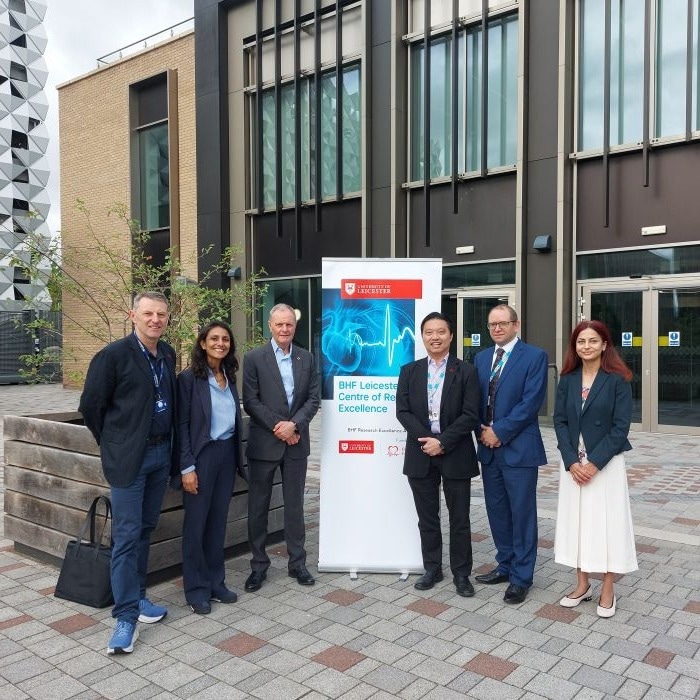 From left: Professor Gerry McCann, Dr Sonya Babu-Narayn (BHF), Professor Bryan Williams (BHF), Professor Andre Ng, Professor Matt Bown and Dr Anvesha Singh. Image Credit: University of Leicester
The center was launched by the University last year following a multi-million pound funding boost from BHF and the University.
Based at Glenfield Hospital it supports ground-breaking studies into the causes of common and rare cardiovascular diseases, as well as refining appropriate treatment and interventions.
Today (7 September) staff and students gathered for its annual conference to hear expert speakers share their knowledge and research and take part in panel discussions and interactive workshops.
It has been fantastic to see the breadth, quality and energy of cardiovascular research across Leicester brought together at our symposium. What has been particularly exciting is the way our researchers are working across traditional boundaries – from discovery science and cardiometabolic health to data, AI and population research – with a shared ambition to translate new knowledge into better cardiovascular health and patient care.”
André Ng MBE, Centre Director and Professor, University of Leicester
“The symposium has really demonstrated what the BHF Leicester Centre of Research Excellence is about – raising the next generation of world-class cardiovascular researchers. It has been especially encouraging to see our early-career researchers and PhD students contributing so strongly alongside established investigators, giving us great confidence in the future of cardiovascular research in Leicester.”
Among the topics the conference helped shine a light on was the development of a new genetic test using a patient’s DNA to target those most at risk of Abdominal Aortic Aneurysms.
The test aims to make sure that those at highest risk are checked in time to get treatment and save lives with research led by Professor of Vascular Surgery Matthew Bown.
Dr. Sarah Ayton spoke about dietary changes for those living with heart failure, while Professor Tom Yates, Director of the Leicester Lifestyle and Health Research Group gave a presentation on the benefits of combined exercise and meal replacement for diabetic remission. Dr. Xin Li also spoke about the use of AI to detect people at highest risk of sudden cardiac death.
The importance of patient and public involvement in cardiovascular research was another topic explored as part of the event, along with Body Mass Index (BMI) and its effect on patients with two or more long-term health conditions.
Participants were also given the chance to pitch their research ideas and receive feedback through interactive workshops and discuss the growing use of artificial intelligence to address cardiovascular challenges including critical diagnostic and predictive tests in patient care.
The conference concluded with the John Swales lecture given by Professor Thomas Lüscher, Director of Research, Education, and Development at the Royal Brompton & Harefield Hospitals and Immediate Past President of the European Society of Cardiology, who spoke about AI and machine learning in cardiovascular disease.
 Alcohol-free beer looks cheaper on the shelf, but the checkout tells a different story