What has changed in the lives of UK teenagers over the past 15 years? A large-scale study examining mental health, lifestyle habits, relationships, and risk-taking reveals striking differences between boys and girls, raising questions about the pressures facing today's adolescents.
Study: Trends in mental health and behavioural outcomes in UK 10–15 year olds from 2009 to 2024. Image Credit: Roman Samborskyi / Shutterstock
In a recent study published in the European Journal of Epidemiology, researchers examined changes in adolescent psychological wellbeing and behavioral patterns among over 16,000 United Kingdom (UK) adolescents aged 10 to 15 years between January 2009 and December 2024. Scientists from the University of Manchester, University College London, and the University of Cambridge in the United Kingdom conducted the research.
Emotional problems increased most among girls and White British adolescents, while hyperactivity showed the largest increases among adolescents from middle-income and less deprived households. Shoplifting rates also increased modestly. At the same time, risky behaviors, including alcohol intake, tobacco consumption, conflict with parents, and staying out late, declined during the study period, while reductions in conduct problems were driven by boys. Health behaviors worsened, with increased fast-food consumption, social media use, and e-cigarette use, alongside reduced participation in sports and fitness activities. The findings could help identify subgroups reporting greater difficulties and potentially requiring targeted support.
There has been a growing global concern regarding the mental health of youth. Adolescents are increasingly reporting low mood and anxiety issues, whereas risky and antisocial behaviors related to alcohol intake, cigarette smoking, substance use, and conduct problems seem to decline. Tracking long-term changes in adolescent emotional wellbeing and lifestyle patterns could help guide interventions during this critical period of growth and development.
About the study
In the present study, the researchers analyzed self-reported information obtained from participants of the 2009-2024 UK Household Longitudinal Study (UKHLS). The survey assessed emotional difficulties, hyperactivity, conduct problems, parent–child relationships, and health-related behaviors, including lifestyle habits, risk-taking, and antisocial activities. The team also explored the influence of sociodemographic characteristics such as sex, ethnicity, household income, and region.
Across 15 study waves, participants completed the Strengths and Difficulties Questionnaire (SDQ) every two waves to evaluate different aspects of their psychological and behavioral well-being. Elevated scores indicated substantial symptoms rather than clinically diagnosed mental health conditions. Health behaviors were assessed based on physical activity, diet, and social media usage, while parent-child communication and conflict were assessed to examine relationship patterns.
The analysis covered risk behaviors, including recent alcohol consumption, lifetime cigarette smoking, lifetime vaping, and unsupervised outings after 9 pm. The survey also recorded antisocial behaviors such as vandalism, physical violence, and shoplifting to contextualize mental health changes alongside broader shifts in adolescent behavior. Logistic regression models were used for analysis, with adjustments to account for demographic differences and repeated observations. For behavioral outcomes, the team quantified changes in prevalence between the earliest and latest available survey waves, accounting for survey weights.
Results
A total of 16,356 adolescents participated in the study, contributing 46,218 data points over a median follow-up of three years. Household response rates remained around 60% across survey waves, while adolescent self-completion rates declined from 77% in wave 1 to 42% in wave 15. Emotional difficulties rose from approximately 11% to over 27% during the study period, with the rate of increase accelerating after 2014 and again after 2019. The rise was particularly pronounced among girls (approximately 39% vs. 16% among boys in 2024) and adolescents identifying as White British. Older adolescents experienced greater increases than younger participants.
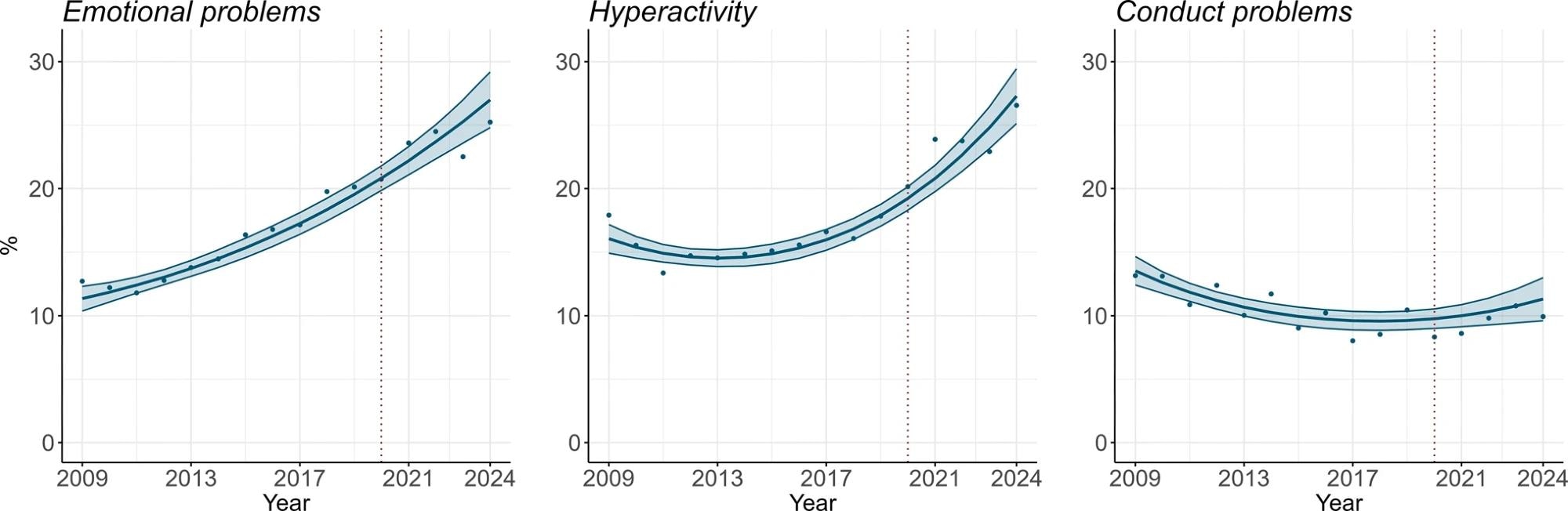
Trends in proportion of 10–15 year-olds with above threshold mental health symptoms between 2009 and 2024. * SDQ emotional problems scale ≥ 6; SDQ hyperactivity scale ≥ 5; SDQ conduct problems scale ≥ 7
Hyperactivity symptoms remained largely unchanged through 2017 (approximately 16%) but rose above 27% by the final survey wave, particularly among girls. By comparison, conduct problems declined gradually, falling from approximately 14% at the study's outset to around 11% in the final year, driven by boys, while girls showed a modest increase. Alcohol use, smoking, parental conflict, and staying out after 9 pm without parental knowledge became less common over the study period. The upward trend for emotional difficulties was broadly similar across household income groups, whereas hyperactivity patterns differed by income. Adolescents from middle-income households showed the largest relative increase, from approximately 16% to 29%, while those from the least deprived households experienced an increase from about 13% to nearly 24%.
Between 2009/10 and 2023/24, weekday social media use of at least four hours nearly doubled (6.2% to 11.7%), with reported use among boys rising to more than three times its earlier level. Changes to the survey questions, which later included gaming websites and apps, may have affected comparisons over time. Weekly fast-food consumption rose from 18% to 26%, and the proportion participating in sports or other fitness activities fewer than three days per week rose from approximately 25% to 35%.
Reports of rarely discussing important matters with parents and weekly parental quarrels declined, together with unsupervised outings after 9 pm, recent alcohol consumption, and lifetime cigarette smoking.
Lifetime vaping or e-cigarette use increased by 59% between 2016/17 and 2023/24, with the sharpest rise occurring after 2020. Shoplifting prevalence climbed to 5.7% in 2022/23 from 3.5% in 2011/12, while reported fighting and vandalism remained largely unchanged. Peer-related difficulties became more common, rising by 48% overall, with a larger relative increase among girls than boys. By 2024, one additional adolescent in 14 reported peer difficulties compared with 2009.
The study had several limitations. All outcomes were self-reported, and elevated symptom scores did not necessarily indicate diagnosed mental health conditions. Declining survey participation may have introduced selection bias, while estimates for some ethnic minority groups were less precise because of smaller sample sizes. The observational design also could not establish the causes of the changes in adolescent mental health and behavior.
Conclusion
The findings show that emotional difficulties increased while several risk behaviors and conduct problems declined among adolescents aged 10 to 15. These changes began before the COVID-19 pandemic and continued afterward. More targeted measures may be needed to support adolescents experiencing greater psychological difficulties, particularly girls and White British adolescents. Investment in research and prevention could help identify and address factors linked to worsening emotional health.
Future studies should examine interdependent behavioral factors to better address young people's needs. Longer-term studies are also needed to determine whether rising adolescent symptoms translate into greater risks of adverse adult outcomes.
Source:
Journal reference:
 Exercise benefits mental health, so why is the genetic evidence so mixed?