As measles cases rebound and rubella remains difficult to track, a 25-year global review examines how changing viral genetics and gaps in disease surveillance complicate efforts to eliminate both infections.
Review: Global Update on Measles and Rubella Molecular Epidemiology: 2000–2025. Image Credit: Yau Ming Low / Shutterstock
In a recent review of global surveillance data published in the journal Vaccines, researchers investigated the molecular epidemiology of measles and rubella (MR) viruses worldwide between 2000 and 2025, examining sequence submissions and the distribution of viral genotypes.
An international team of researchers from the UK Health Security Agency (UKHSA), World Health Organization (WHO) headquarters and regional offices, the Pan American Health Organization (PAHO), and the Pasteur Institute of Tunis at University Tunis El Manar conducted the review, spanning institutions across nine countries.
Measles virus (MeV) sequence submissions relative to reported cases have returned to pre-pandemic levels across all regions, but only two of the 24 historically recognized measles genotypes have been reported since 2021. The pandemic's impact on rubella surveillance remains difficult to determine, partly because few rubella virus (RuV) sequences are submitted to global surveillance databases.
The review also outlines challenges facing the World Health Organization's (WHO) Global Measles and Rubella Laboratory Network (GMRLN) and stresses the need for continued member-state participation to strengthen molecular surveillance.
Measles and rubella elimination remains a global public health priority. The WHO coordinates surveillance through GMRLN, which combines epidemiological reports and molecular data to track circulating strains and transmission. Member states contribute case reports and viral sequences to monitor genetic diversity, investigate outbreaks, and identify gaps in surveillance and vaccination.
Global measles and rubella surveillance
The review draws on global data from the Measles virus Nucleotide Surveillance (MeaNS2) and Rubella virus Nucleotide Surveillance (RubeNS2) databases through 2025. Most sequences are generated using reverse transcription-polymerase chain reaction (RT-PCR) and Sanger sequencing. Only WHO GMRLN-accredited laboratories that pass annual laboratory proficiency tests can submit data. Member states must submit representative sequences covering 80% or more of transmission chains no later than eight weeks after sample receipt.
MeV molecular surveillance relies mainly on the N-450 target, a 450-nucleotide segment located near the end of the nucleocapsid (N) gene. For RuV genotyping, laboratories examine a 739-nucleotide segment of the envelope glycoprotein 1 (E1) gene, designated E-739 (739-bp window). The WHO compiles annual MR case figures using the Joint Reporting Form (JRF), developed jointly with UNICEF. MeV genotypes are classified according to sequence similarities in the hemagglutinin (H) and nucleoprotein (N) genes.
Measles cases rebound after the pandemic
A total of 411,913 measles cases were reported worldwide during 2025, returning to levels comparable to those before the pandemic. Reported cases are estimated to account for only around 5% of actual measles cases globally. Missed childhood vaccinations and resulting immunity gaps likely drove the resurgence. The extent to which pandemic-era declines reflected reduced transmission or disrupted surveillance remains unclear.
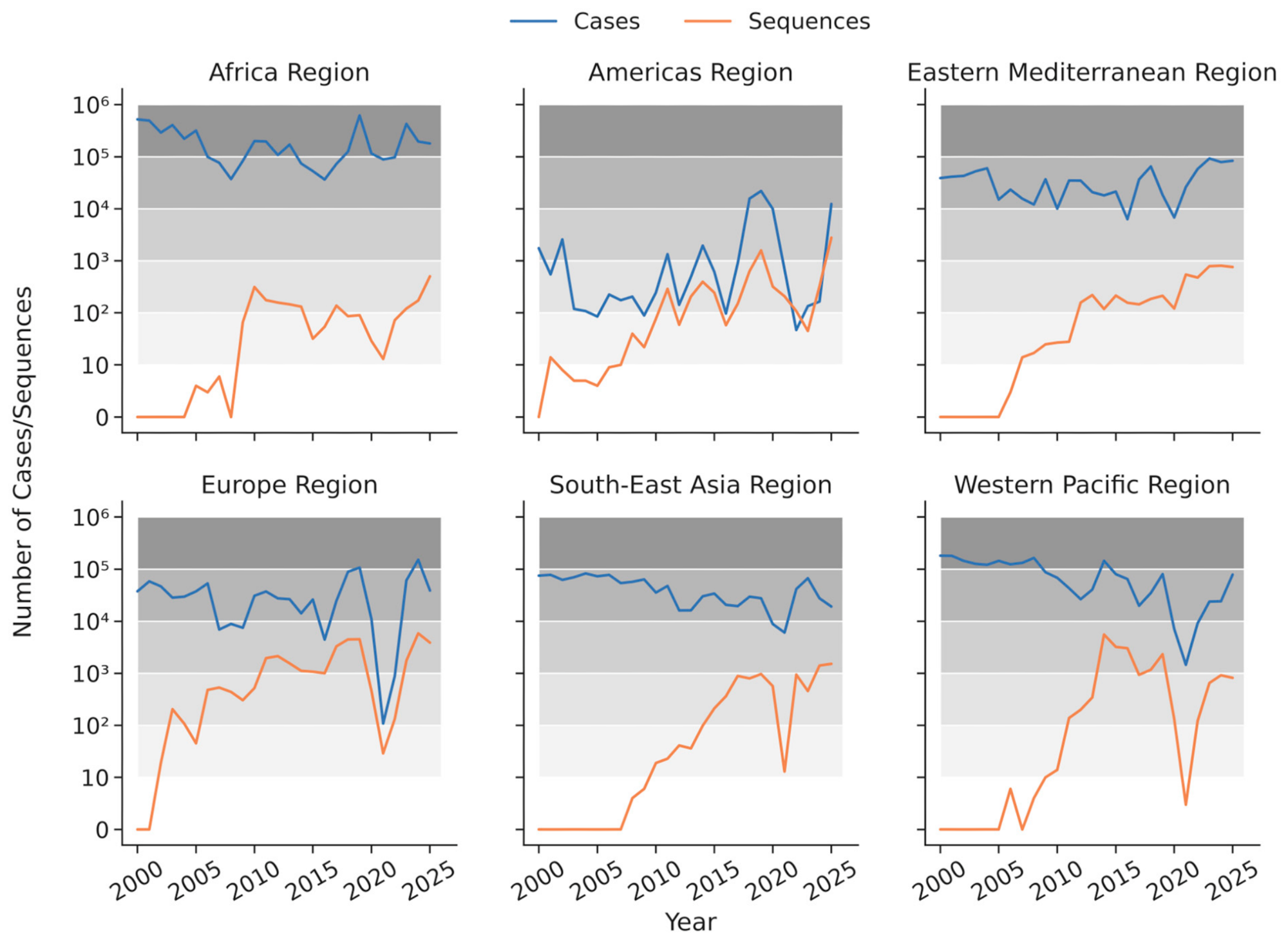
Number of reported measles virus cases and sequence submissions to MeaNS2, stratified by WHO region. Reported case numbers were obtained from the WHO/UNICEF Joint Reporting Form (JRF), while sequence counts represent MeV sequences submitted by WHO GMRLN-accredited laboratories to MeaNS2. Transparency of grey bars indicates y-scale in that area of the plot and orders of magnitude between points.
The European Region (EUR) recorded over 150,000 cases in 2024, its highest total since 1997, followed by a 75% decline in 2025. Cases rose from 2024 in the Region of the Americas (AMR), following previous regional measles elimination, while the African Region (AFR) and South-East Asia Region (SEAR) saw declines after their 2023 surges.
Sequencing coverage was highest in the AMR, with a median annual ratio of submitted sequences to reported cases of 20% between 2000 and 2025, compared with 4% in the EUR and less than 1% in the other four WHO regions. Incomplete case reporting inflated AMR estimates, while representative outbreak sampling partly explains lower sequencing-to-case ratios in high-incidence regions. The EUR and Western Pacific Region (WPR) together contributed approximately 70% of sequences in MeaNS2.
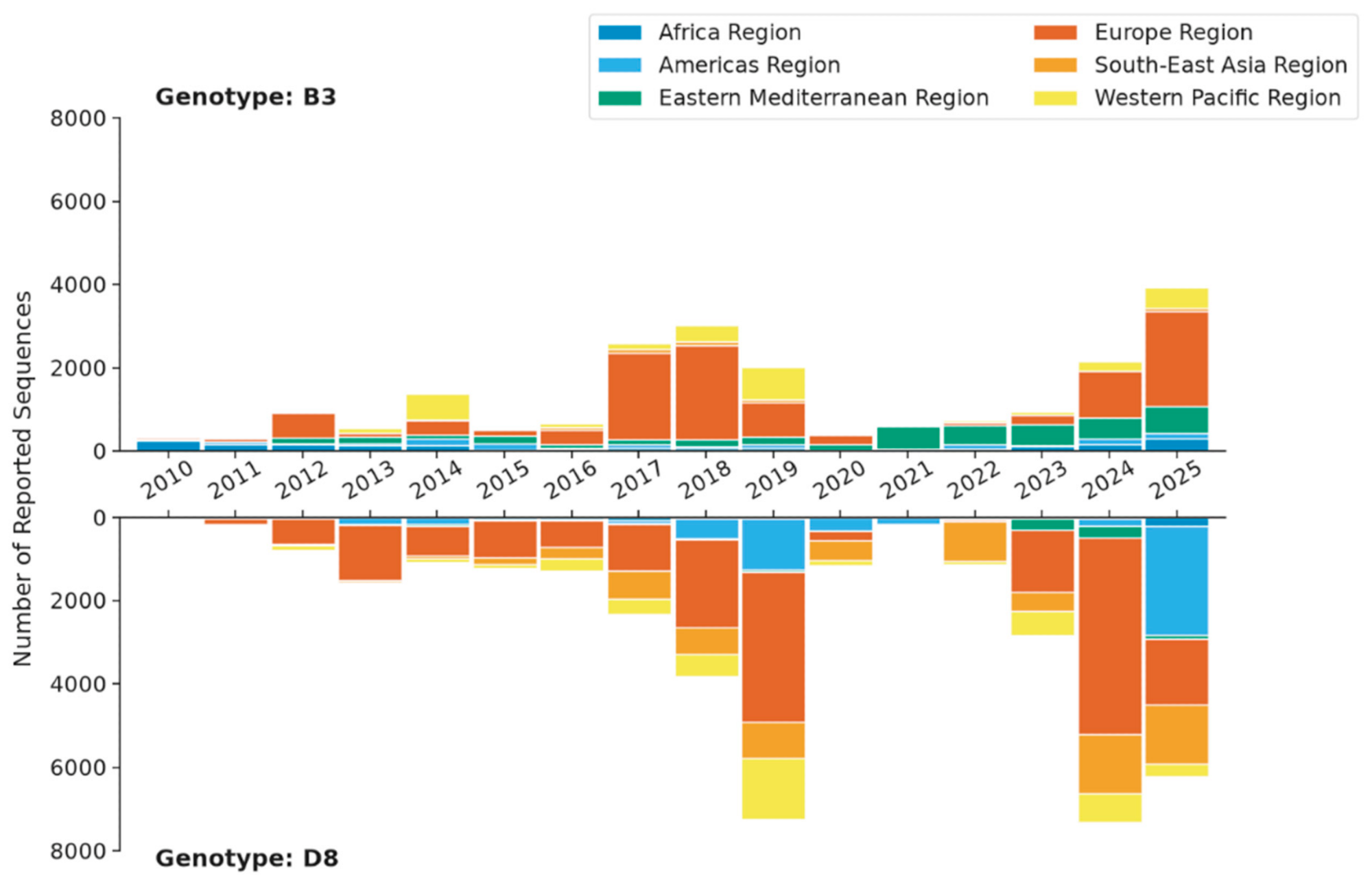
Annual distribution of MeV genotype B3 and D8 sequences submitted to MeaNS2, stratified by WHO region.
Measles genetic diversity continues to decline
The two remaining reported measles genotypes are B3 and D8. This reduction in genetic diversity is consistent with vaccination efforts limiting opportunities for viral transmission but makes distinguishing transmission chains through routine genotyping more difficult.
D8 has been the most frequently reported genotype globally since 2018, except in 2021, and accounted for nearly all genetically characterized cases during the AMR resurgence in 2025. B3 was more common in the Eastern Mediterranean Region (EMR), while both genotypes were reported at comparable frequencies in the AFR and WPR. Europe also reported more B3 than D8 sequences in 2025 for the first time since 2021.
Sequencing beyond the N-450 target has also increased since 2022, potentially improving transmission tracking. Among named strains, which represent frequently reported N-450 sequences, MVs/Gir Somnath.IND/42.16[D8] had the highest cumulative case count, with 6,595 recorded cases across 72 countries over a five-year period beginning in 2016.
Rubella surveillance reveals major data gaps
RuV molecular surveillance remains considerably more limited, with approximately one-tenth as many sequence submissions as measles. A shorter detection window, fewer detected cases, fewer accredited sequencing laboratories, lower viral RNA concentrations in clinical specimens, and the viral genome's high guanine-cytosine content may explain this gap.
Rubella trends also varied by region. Reported cases in the AFR rose more than 20-fold, from 865 in 2000 to 19,669 in 2025, amid outbreaks in Nigeria, South Africa, and Uganda. The WPR peaked at 126,827 cases in 2008, before declining during 2020–2025. Some historical increases in reported cases may partly reflect improved surveillance sensitivity. Meanwhile, cases in the EUR and AMR fell approximately 1,000-fold since 2000.
During the decade through 2025, approximately 247,000 rubella cases were reported globally, compared with more than 3.5 million measles cases. Incomplete reporting also means that the true rubella burden is likely higher. Fewer than one in 1,000 reported rubella cases were sequenced in previous years. Only 59 RuV sequences belonging to genotypes 1G and 2B were documented from 2022 onward, including just six in 2025.
Genotype 2B has been the only genotype reported globally since 2024, while 1G, previously predominant in the AFR, was last reported in 2023. Genotype 1E predominated in the WPR during expanded surveillance between 2018 and 2020 but has not been reported since 2021. Limited sequencing coverage prevents definitive conclusions about whether other rubella genotypes have disappeared.
Improving genomic surveillance and vaccination coverage
“Sequence data alone cannot reliably reconstruct transmission patterns, particularly for measles.”
Sustaining MR elimination will require investment in laboratory capacity, standardized sequencing protocols, quality assurance, surveillance, and vaccination. Whole-genome sequencing (WGS) and other extended sequencing approaches could improve the resolution of measles transmission tracking beyond the commonly used N-450 region. Their wider use is limited by costs, technical expertise, and inconsistent sequencing quality. Complete coding sequence (CDS) analysis could offer useful genetic detail while avoiding some technical challenges associated with non-coding regions, but its practical implementation would require high-throughput sequencing technology.
Mutations identified through extended sequencing require interpretation alongside epidemiological data, case timing, and rates of genetic change in the virus, since longer genomic regions are naturally expected to contain more mutations. Named strains do not necessarily represent individual transmission chains. Differences in surveillance sensitivity, laboratory capacity, reporting completeness, and the proportion of laboratory-confirmed cases limit direct regional comparisons.
Molecular surveillance must complement epidemiological investigations, with closer collaboration between laboratory scientists and epidemiologists needed to guide immunization efforts. No measles vaccine-escape strains have been reported. Maintaining high vaccination coverage and sensitive case detection remains central to MR elimination.
Source:
Journal reference:
- Weston, T., Cheng, C., Warrener, L. et al. (2026). Global Update on Measles and Rubella Molecular Epidemiology: 2000–2025. Vaccines, 14(11), 964. DOI: 10.3390/vaccines14110964, https://www.mdpi.com/2076-393X/14/11/964
 Measles outbreaks raise serious health concerns for expectant mothers and newborns