Could current blood test cutoffs be missing iron deficiency? New guidelines recommend higher ferritin thresholds for key patient groups, potentially helping clinicians identify depleted iron stores earlier, even when hemoglobin levels remain normal.
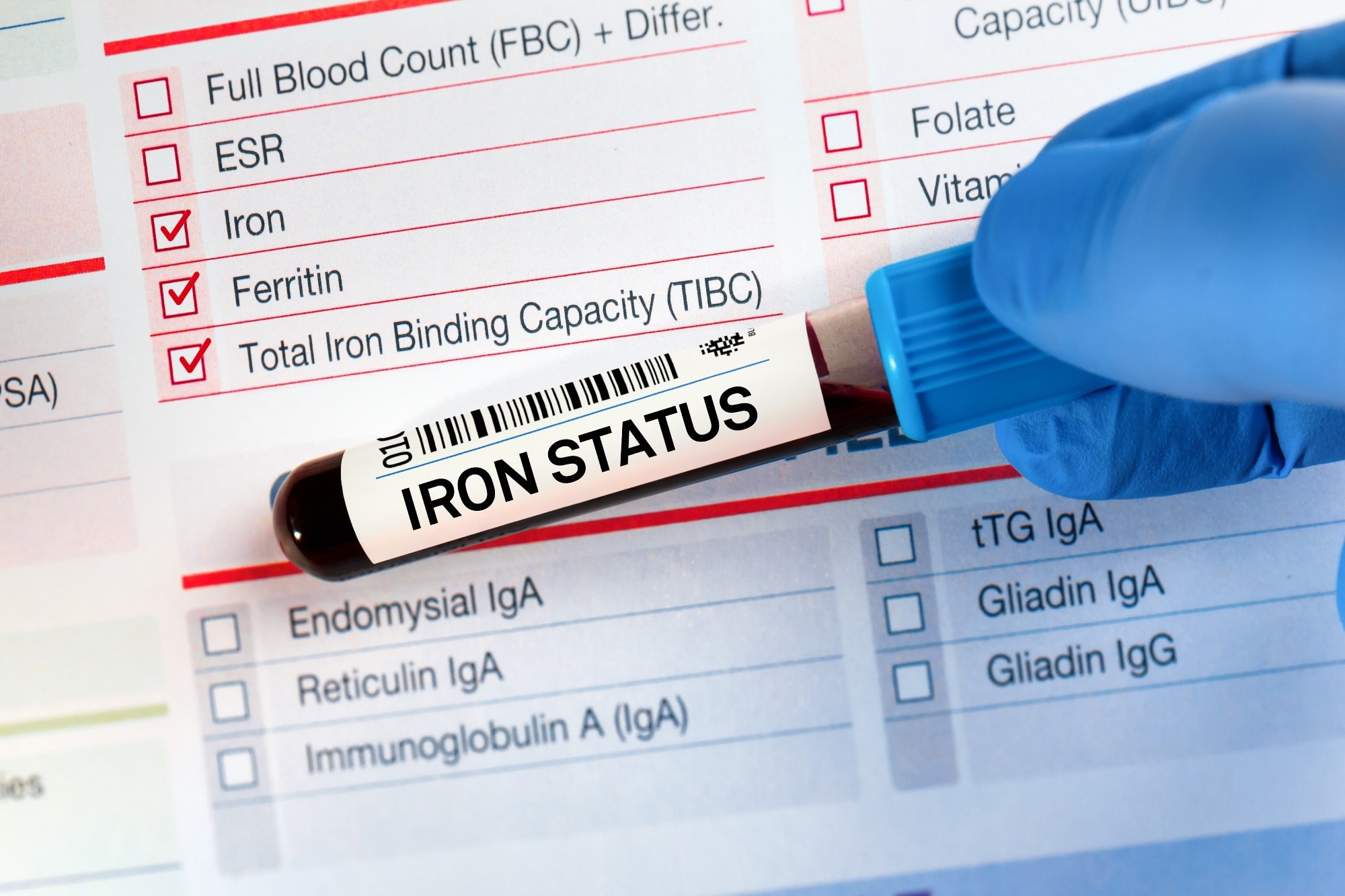 Study: American Society of Hematology 2026 guidelines for diagnosis of iron deficiency. Image credit: angellodeco/Shutterstock.com
A recent guideline article in the journal Blood Advances presents the American Society of Hematology (ASH) 2026 evidence-based guidelines for diagnosing iron deficiency. The guidelines recommend higher serum ferritin thresholds for several patient groups to improve the detection of iron deficiency, including in individuals without anemia.
New diagnostic guidance targets overlooked iron deficiency
Iron deficiency is a common cause of anemia and can also cause symptoms such as tiredness, irritability, headaches, and restless legs syndrome. Young children and women who are in the reproductive years are at greatest risk for iron deficiency, as are those in lower socioeconomic strata. Other risk factors include the presence of celiac disease, inflammatory bowel disease, prior bariatric surgery, a restricted diet, blood loss, heart failure, rheumatologic disease, and chronic kidney disease.
Iron deficiency can occur without anemia, and a lack of screening in high-risk populations, together with variations in laboratory reference ranges, may contribute to underdiagnosis and undertreatment.
In this context, the ASH issued a set of evidence-based guidelines for the diagnosis of iron deficiency. The guidelines were based on systematic reviews of evidence available up to July 2025, using the GRADE approach, with methodological support from the University of Kansas Health System.
Clinical expertise and patient perspectives guided recommendations
The panel included hematologists, a maternal-fetal medicine specialist, a neonatologist, a pharmacist, and one patient representative. In addition to their field expertise, several members were skilled in implementation science, cost-effectiveness assessment, transfusion medicine, and laboratory medicine. The two chairpersons had expertise in this area and in guideline development, respectively.
New guidelines aim to improve early iron deficiency detection
These guidelines aim to inform both healthcare providers and patients, using available evidence while acknowledging the uncertainty around much of the data. This may help support clinical decision-making in diagnosing iron deficiency and further care.
As such, they target hematologists, general healthcare providers across the spectrum of clinical practice, and patients. They may also help policymakers to develop better screening guidelines and set standardized laboratory threshold ranges for iron deficiency.
The guidelines prioritize better diagnosis to facilitate timely management of iron deficiency, whether or not anemia is present. The recommendations also consider local factors, including population-specific preferences, costs and cost-effectiveness, required resources, and aspects such as access, feasibility, and implications for health equity of each recommendation.
The role of serum ferritin
The panelists considered serum ferritin’s role in diagnosis of iron deficiency, as it accurately reflects iron status in healthy individuals without inflammation. In addition, it is commonly tested, widely available, and is the best indirect measure of total body iron.
However, ferritin is an acute-phase reactant, meaning that inflammation can increase its concentration even when iron stores are depleted. Consequently, a normal or elevated ferritin level does not necessarily exclude iron deficiency in individuals with inflammation.
They considered whether current serum ferritin thresholds are artificially low because the healthy populations screened actually included many who were iron-deficient. Conversely, they also considered the test's limitations: variable results across laboratory methods and non-standardization across platforms, which can lead to different results for the same sample, especially at higher values.
The panelists developed a clinically relevant threshold for decision-making, rather than simply using the lower limit of normal (LLN). They suggested using the clinically relevant threshold, rather than LLN, across all laboratories to improve iron-deficiency diagnosis.
Notably, the World Health Organization has recommended a serum ferritin threshold of <15 ng/mL for iron deficiency diagnosis in healthy individuals. Other thresholds were based on evidence from other guidelines and cross-sectional studies covering both young children and adults.
The panel also considered the methodological and functional limitations of the gold standard method of iron assessment, namely, bone marrow staining. They provided a way to compare serum ferritin thresholds and identify the most accurate thresholds for diagnosing iron deficiency, as defined by bone marrow staining.
Five recommendations redefine how clinicians diagnose iron deficiency
Recommendation 1
Children aged 9 months to 4 years: serum ferritin should be used for diagnosis, with a cut-off of ≤20 ng/mL in place of the earlier ≤12 ng/mL. This is intended to apply to children without known or suspected inflammation, as inflammation may require higher serum ferritin thresholds.
There is inadequate direct evidence to support specific diagnostic threshold recommendations for children older than 4 years, but the available evidence for young children supports using a threshold of ≤20 ng/mL from this age until adolescence, based on indirect evidence. For non-menstruating adolescents, a threshold of <30 ng/mL is suggested.
Recommendation 2
The suggested threshold is set at ≤30 ng/mL in adults, except for menstruating or pregnant individuals. Previously, this threshold was at ≤15 ng/mL. Both recommendations are based on low-certainty evidence.
The cut-off may be taken as ≤50 ng/mL in the presence of signs or symptoms of iron deficiency or ongoing risk factors for this condition. Again, this applies only to adults without known or suspected inflammation.
Recommendation 3
For menstruating individuals, a threshold of ≤30 ng/mL is suggested rather than ≤15 ng/mL to diagnose iron deficiency. However, the presence of heavy menstrual bleeding or other forms of abnormal uterine bleeding resulting in excessive blood loss may warrant a higher threshold of ≤50 ng/mL. The same higher threshold may be appropriate for individuals with symptoms of or risk factors for iron deficiency, imminent surgery, or plans to become pregnant.
The guideline committee emphasizes the importance of a careful menstrual history to help diagnose abnormal uterine bleeding, especially heavy menstrual bleeding, both of which should be identified and managed.
Recommendation 4
For pregnancy, the suggested threshold is ≤30 ng/mL, based on a conditional recommendation. The committee strongly recommends against using ≤15 ng/mL as the threshold in this situation, though both positions are based on low-certainty evidence. A threshold of ≤50 ng/mL may be appropriate if the pregnant individual has anemia, irrespective of the presence of symptoms of or risk factors for iron deficiency.
Recommendation 5
It is suggested using both serum ferritin and transferrin saturation (TSAT), rather than ferritin alone, to evaluate iron deficiency in adults with anemia of inflammation. Iron deficiency may be considered when either serum ferritin is <100 ng/mL or TSAT is <20%. Both thresholds do not need to be met. This is a conditional recommendation based on very-low-certainty evidence.
Because inflammation can elevate ferritin concentrations independently of iron stores, measuring TSAT provides additional information about circulating iron availability. The panel advises that TSAT should be measured after fasting for approximately 5–9 hours, including avoiding multivitamin or iron supplements during this period, because recent dietary intake can affect the result.
Conditions linked to inflammation include inflammatory bowel disease, infectious disease, cancer, chronic kidney disease, heart failure, rheumatologic disease, and other inflammatory conditions.
Download your PDF copy to save these recommendations by clicking here.
Using the guidelines
The committee emphasizes using clinical features, patient values and preferences, and local resources, along with these guidelines, to make patient-level healthcare decisions. Policymakers may find the guidelines useful in determining how to use scarce resources, but they do not represent the standard of care. Therefore, the guidelines include remarks that help interpret each recommendation. In addition, they include stated values and preferences that are integral to the guidelines.
The diagnostic thresholds are intended to guide clinical assessment rather than serve as automatic triggers for iron supplementation. Treatment decisions should consider the underlying cause of iron deficiency, the patient's clinical condition, and the potential benefits and harms of intervention.
The panelists recognize the potential harms of raising the diagnostic threshold in children, which could increase the number of children falsely diagnosed as iron-deficient, leading to more unnecessary testing, unnecessary iron treatment, and the risk of iron overload. Similarly, the thresholds in adolescents and adults need to balance the challenges of overdiagnosing with the benefits of more equitable recognition of iron deficiency.
Higher diagnostic thresholds may improve recognition of iron deficiency in individuals whose ferritin concentrations would previously have been considered normal, including those without anemia. However, the benefits of earlier detection must be weighed against the potential for false-positive diagnoses and unnecessary treatment.
These guidelines do not evaluate evidence on screening for iron deficiency, though other guidelines exist for children, menstruating individuals, and those with hereditary bleeding disorders.
Low-certainty evidence underpins most new diagnostic recommendations
These guidelines are limited mainly by the low certainty of the evidence reviewed. The first four recommendations are based on low-certainty evidence, while the recommendation concerning adults with anemia of inflammation is supported by very-low-certainty evidence.
The panel also identified important research gaps, including the need for prospective studies comparing diagnostic thresholds, assessments of patient-important outcomes, and studies evaluating the benefits, harms, cost-effectiveness, and equity implications of different diagnostic approaches.
These will be updated and revised regularly, in line with ASH, which also recommends adapting them to local circumstances.
Overall, the guidelines aim to improve recognition of iron deficiency across patient populations while emphasizing that laboratory thresholds must be interpreted alongside clinical findings, individual risk factors, and patient preferences.
 Regular exercisers show distinct metabolic and immune signatures in blood