Who really disturbs whom after bedtime? Four weeks of wearable sensor data offer a closer look at dogs' and their owners' nighttime movements.
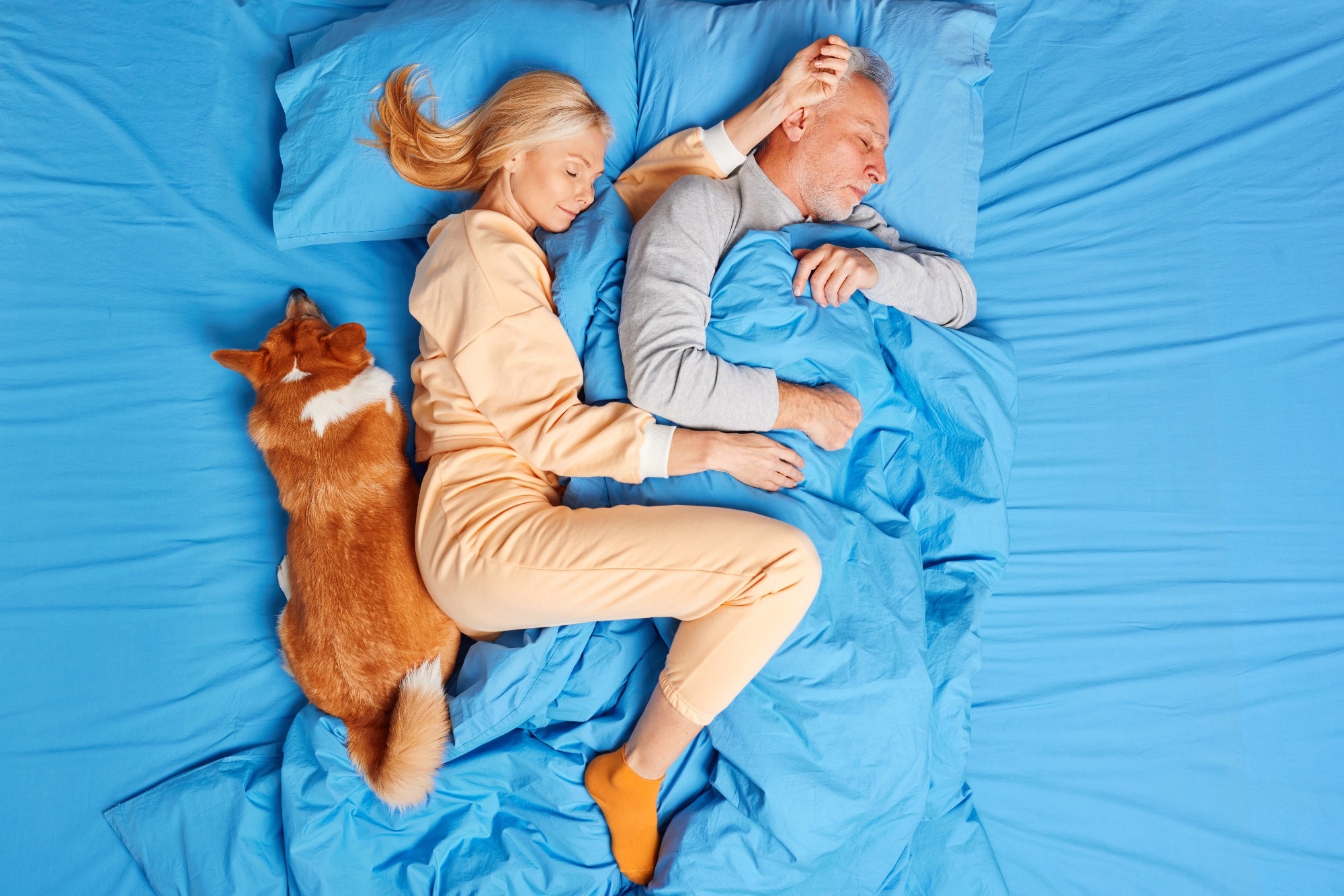
Study: Who is disrupting whom? Examining the nighttime activity patterns of humans and their dogs. Image Credit: Cast Of Thousands / Shutterstock
In a recent study published in PLOS ONE, researchers at the University of Toronto, Canada, examined how sleeping arrangements and household characteristics relate to human sleep quality and dogs' nighttime activity, and how humans and their dogs time their activity.
Background
Have you ever woken up because your dog moved, only to wonder whether your movement disturbed your pet first? For at least 15,000 years, people and dogs have lived side by side, and dogs have developed social skills for communicating with people.
Pet ownership can encourage physical activity and provide psychological benefits, but dogs' impact on sleep remains unclear. Some studies link sharing a bed with a dog to poorer human sleep, while others find no significant association.
Differences between studies using self-reported sleep quality and those using objective measurements further complicate these findings. Further research is needed to clarify how humans and dogs influence each other's nighttime activity and sleep.
About the study
The study recruited 25 adults and 38 dogs from Ontario, Canada, between August and October 2021. Participants were older than 18 years, and the dogs were huskies or malamutes aged 2–12 years without owner-reported medical conditions likely to affect activity.
The University of Toronto Human Research Ethics Board and Animal Care Committee approved the study, and written informed consent was obtained. Participants received monetary compensation after completing the study.
From November 2 to December 9, 2021, researchers monitored human and dog activity for approximately four weeks using MotionWatch 8 accelerometers. Humans wore the devices on their nondominant wrists, while dogs wore sensor-fitted collars. Movement was recorded in one-minute intervals. The device had not been validated to distinguish sleep from wakefulness in dogs, so researchers measured canine activity and inactivity rather than sleep directly. The tri-axial recording mode used to estimate human sleep had not been validated against polysomnography.
Researchers identified human sleep periods by detecting the transition from reduced activity at bedtime to increased activity upon waking. Participants also completed a questionnaire and the Pittsburgh Sleep Quality Index (PSQI), which measures perceived sleep quality over the preceding month.
Researchers excluded periods with missing data and dates when participants and their dogs were apart. The final objective activity analyses included 36 human-dog pairs, with some adults contributing more than one pair, while subjective sleep analyses included all 25 adults.
Statistical models assessed human sleep duration, sleep efficiency, canine nighttime movement, and self-reported sleep quality. Time-series analyses evaluated associations between human and dog activity states at one-minute resolution, examining whether one activity preceded the other by up to five minutes.
Study results
The study included 25 adults (21 women and 4 men) and 38 dogs (15 female and 23 male). Participants had a mean age of 38.9 years, while dogs averaged 4.8 years. Approximately half of the participants (52%) lived with multiple dogs, and 52% reported that their dogs always slept in the same room.
Regarding bedsharing, 16% always shared their beds with their dogs, 40% sometimes did, and 44% never did. Overall, 64% of participants shared a bed with another human. Nearly half (48%) reported that their dogs interrupted their sleep, while 72% said they felt safer with their dogs.
Human sleep duration and efficiency (the percentage of the sleep period spent asleep) showed no significant associations with the examined household and demographic characteristics. On average, participants slept for 6.23 hours per night, with a sleep efficiency of 79.31%. Across 777 nights analyzed, other dogs, human bed partners, and dogs sleeping on the bed were not statistically associated with objectively measured total sleep time or sleep efficiency. Human age, gender, and body mass index (BMI) also did not significantly predict nighttime sleep variability.
Participants living with multiple dogs reported poorer sleep quality than those with only one dog, according to their PSQI global scores. The association was statistically significant, but the overall model did not explain sleep quality significantly better than a model without household predictors. The result requires cautious interpretation, particularly given the small sample. Where dogs slept did not significantly affect perceived sleep quality.
Dog nighttime activity was not significantly associated with the measured household or biological characteristics. Across 1,093 dog-night observations, researchers found no significant associations between canine nighttime activity and the presence of other dogs, the number of humans in the household, whether dogs slept on the bed, feeding frequency, age, weight, or sex. These findings do not rule out smaller associations the study may have missed.
The researchers also found a small but statistically significant positive correlation between human and dog movements at night. Nights with greater canine movement generally coincided with more human movement. The analysis could not determine whether either individual's movement caused the other's activity.
Time-series analysis revealed more detail about the timing of these movement patterns. Of the 36 human-dog pairs examined, 22 (61.11%) demonstrated a positive association between activity states, while 14 (38.89%) showed no identifiable peak. These categories describe peak correlations rather than the cause of individual movements.
Among the 22 associated pairs, human activity preceded dog activity in 10 pairs (45.45%). Dog activity preceded human activity in four pairs (18.18%), while eight pairs (36.36%) showed their strongest activity association within the same one-minute interval.
Among the three pairs that always shared a bed and had identifiable peaks, two showed human activity preceding dog activity, while one showed its strongest activity association within the same minute.
Conclusions
Bedsharing arrangements were not significantly associated with objectively measured human sleep duration, sleep efficiency, or canine nighttime activity. Owners of multiple dogs reported poorer subjective sleep quality, suggesting that perceptions of sleep may differ from objective measurements.
The overall subjective sleep model was not statistically significant. Human and dog nighttime activities were positively associated, with human movement preceding dog movement more frequently than the reverse among pairs with identifiable peaks. The timing of movements cannot establish whether either species caused the other's activity or sleep disruptions.
The small sample, restriction to huskies and malamutes, COVID-19 restrictions, absence of a non-dog-owning comparison group, and lack of direct behavioral observation limit the findings. Larger studies could clarify how sleeping arrangements affect both humans and dogs.
Sources:
Journal references:
- Li, M. F., Nagendran, L., Kiru, C., Schroeder, L., & Samson, D. R. (2026). Who is disrupting whom? Examining the nighttime activity patterns of humans and their dogs. PLOS ONE, 21(10), e0358453. DOI: 10.1371/journal.pone.0358453. https://journals.plos.org/plosone/article?id=10.1371/journal.pone.0358453
 Five lipids revealed a divide between active and inactive pregnancies