The goal of this study was to create and validate a non-invasive optogenetic pacemaker that could directly pace cardiomyocytes and control heart rhythms.
With a rising interest in the Heart-Brain axis and evidence relating higher heart rate variability to panic and anxiety-related diseases, this technology was used to investigate how tachycardia affects anxiety-related behaviors.
Key findings
- Created a non-invasive optogenetic pacemaker for right or left ventricular pacing that is capable of driving heart rates up to 900 bpm
- Effectively paced the heart to 600, 800, and 1000 bpm in vivo, as proven by the Rodent Surgical Monitor ECG validation
- Induced intermittent ventricular tachycardia to mimic non-sustained arrhythmias, resulting in enhanced anxiety-related behavior in certain settings
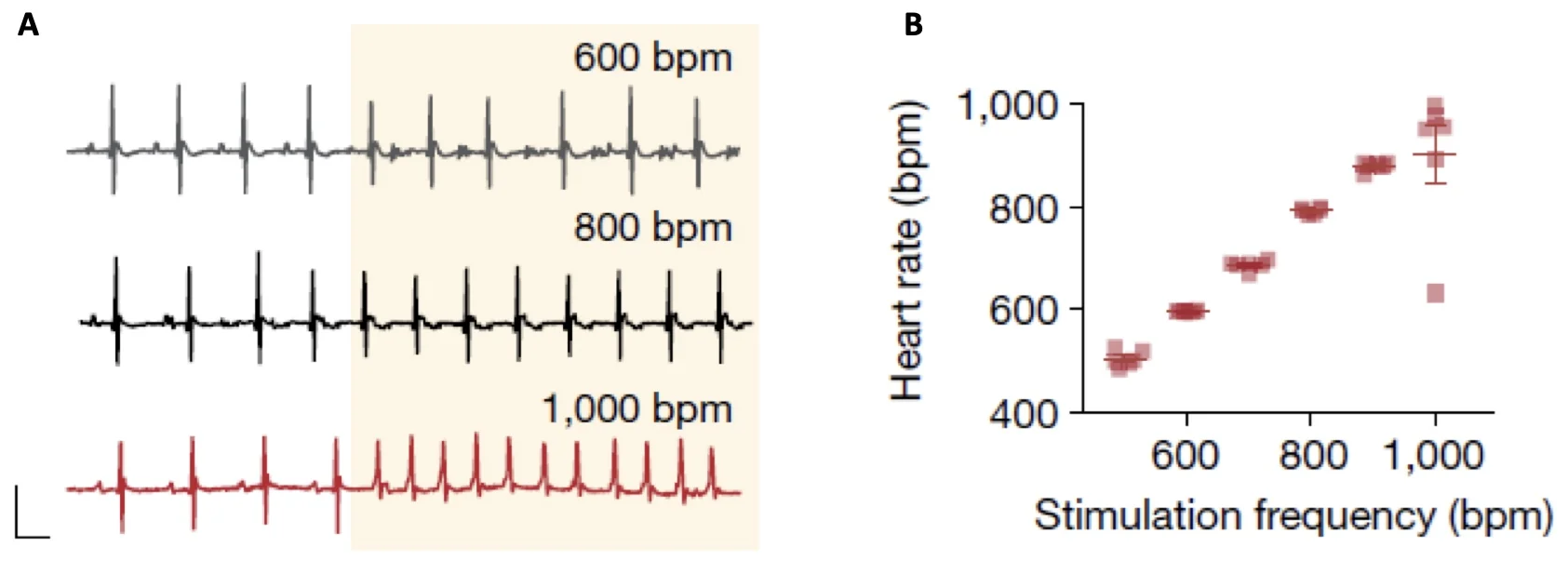
Figure 1. Development of a noninvasive optical pacemaker. A: Example ECG traces of pacing at 600, 800, and 1000 bpm. Scale bar, 50 ms, 0.5 mV. The shaded area indicates the period of illumination at the specified frequency at 100 % duty cycle. B: Characterization of optical pacing fidelity, showing stimulation frequency versus ECG-measured heart rate (n = 6 mice). All ECG measurements were performed in anaesthetized mice. Data are mean ± sem. Image Credit: Figure adapted from Hsueh, B. et al. Nature 2023 615:7951 615, 292–299 (2023)1.
- Identified the posterior insular cortex as a critical modulator of anxiety-related behaviors caused by cardiac pacing
- Inhibiting this brain region reduced pacing-induced anxiety, indicating integration of both central and peripheral processes.
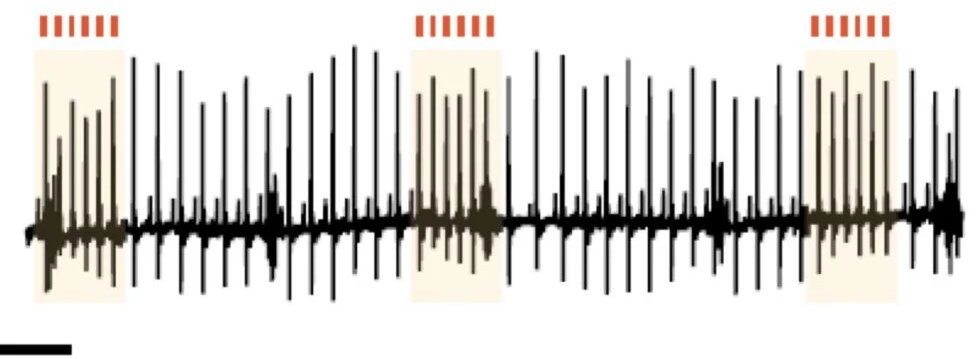
Figure 2. Optically induced tachycardia model. Representative ECG trace of optically induced tachycardia (900 bpm for 500 ms every 2 s) used for all behavioral assays. Scale bar, 0.2 mV, 500 ms. Image Credit: Figure adapted from Hsueh, B. et al. Nature 2023 615:7951 615, 292-299 (2023)1.
Conclusion and next steps
This study emphasizes the role of heart activity in determining emotional states and anxiety-related actions.
Researchers may now examine the Heart-Brain axis with higher precision and less invasiveness thanks to a new non-invasive optical pacing approach. The Rodent Surgical Monitor contributed significantly to the validation of this study by allowing for high-resolution ECG collection across a wide range of heart rates.
Future research could reveal how interoceptive signals from the heart influence higher-order brain activities and lead to affective disorders.
References
- Hsueh, B., et al. (2023). Cardiogenic control of affective behavioural state. Nature, [online] 615(7951). DOI: 10.1038/s41586-023-05748-8. https://www.nature.com/articles/s41586-023-05748-8.
- Gorman, J. M., and Sloan, R. P. (2000). Heart rate variability in depressive and anxiety disorders. American Heart Journal, 140(4), S77–S83. DOI: 10.1067/mhj.2000.109981. https://www.sciencedirect.com/science/article/pii/S0002870300160053.
- Wang, Z., et al. (2025). Heart rate variability in mental disorders: an umbrella review of meta-analyses. Translational psychiatry, (online) 15(1), p.104. DOI: 10.1038/s41398-025-03339-x. https://www.nature.com/articles/s41398-025-03339-x.
- Allen, W.E., et al. (2017). Thirst-associated preoptic neurons encode an aversive motivational drive. Science, 357(6356), pp.1149–1155. DOI: 10.1126/science.aan6747. https://www.science.org/doi/full/10.1126/science.aan6747.
About Scintica Instrumentation Inc.
At Scintica, we advance science and medicine by supplying researchers with reliable research instrumentation and equipment. Our carefully selected portfolio of imaging systems, research tools, and supporting technologies is designed to reduce complexity and help scientists focus on what matters most, generating
meaningful results.
We partner closely with the preclinical research community to connect teams with solutions that are scientifically robust and built to support research challenges. From system selection through long-term support, our goal is to make research more productive, efficient, and impactful.
Sponsored Content Policy: News-Medical.net publishes articles and related content that may be derived from sources where we have existing commercial relationships, provided such content adds value to the core editorial ethos of News-Medical.net, which is to educate and inform site visitors interested in medical research, science, medical devices and treatments.