Introduction
Types of mycotoxins
Sources of contamination
Health effects
Vulnerable populations
Diagnosis of dietary exposure
Prevention and control
Testing methods
Conclusions
References
Further reading
Mycotoxins are toxic fungal metabolites that contaminate staple foods across the supply chain, posing widespread risks to human health even at low exposure levels. This article explains how mycotoxins enter food, the diseases they cause, who is most vulnerable, and how contamination can be detected and prevented.
 Image Credit: Kateryna Kon / Shutterstock.com
Introduction
Mycotoxins are toxic secondary metabolites produced by filamentous fungi that contaminate food during pre-harvest, storage, transport, and processing. Even at low concentrations, mycotoxins threaten human and animal health by contributing to immunosuppression, mutagenesis, and carcinogenesis. Globally, it is estimated that between 25% and 80% of food crops may be contaminated, reflecting substantial geographic, climatic, and methodological variability in surveillance1.
The most common sources of mycotoxins are Aspergillus, Penicillium, and Fusarium species. Typically, Fusarium species contaminate grains in the field, whereas Aspergillus and Penicillium emerge during storage. Staple crops such as maize, wheat, and rice are frequent substrates, thus emphasizing the importance of adequate surveillance, regulation, and improved agronomic and storage practices to reduce exposure and protect public health. Climate change is expected to further alter fungal ecology, increasing the likelihood of contamination and multi-mycotoxin co-occurrence1,7.
Types of mycotoxins
Major mycotoxins include aflatoxins (AFs), ochratoxin A (OTA), fumonisins (FBs), zearalenone (ZEN), and trichothecenes such as deoxynivalenol (DON) and T-2 toxin/HT-2 toxin (T-2/HT-2), each of which varies in its sources, mechanisms, and health risks. These toxins frequently co-occur in food commodities, leading to additive or synergistic toxicological effects that are not fully captured by single-toxin risk assessments2,7.
AFs are toxic metabolites from Aspergillus species. Aflatoxin B1 (AFB1) is classified by the International Agency for Research on Cancer (IARC) as a Group 1 human carcinogen and forms reactive epoxides that bind to deoxyribonucleic acid (DNA), including the tumor protein p53 (TP53) gene, driving hepatocarcinoma and acute aflatoxicosis.
OTA, which is produced by Aspergillus and Penicillium, often contaminates cereals, coffee, cocoa, grapes, and meats. This mycotoxin is efficiently absorbed, binds to plasma albumin, and causes nephrotoxicity, neurotoxicity, immunotoxicity, and teratogenicity. OTA has also been implicated in Balkan endemic nephropathy, although causality in humans remains under investigation2,6.
FBs, especially fumonisin B1 (FB1) and fumonisin B2 (FB2), from Fusarium in corn and grapes inhibit ceramide synthases, disrupt sphingolipid metabolism, and are IARC Group 2B carcinogens linked to animal disease and human cancers. ZEN from Fusarium contaminates cereals and binds the estrogen receptor (ER), thereby disrupting endocrine function.
Trichothecenes like DON and T-2/ HT-2 are often found in oats, corn, barley, and wheat. These mycotoxins target ribosomes, block protein synthesis, suppress immunity, and, for T-2, cause alimentary toxic aleukia (ATA). DON is the most frequently detected mycotoxin globally and is a leading cause of cereal-related gastrointestinal outbreaks1,4.
Sources of contamination
Cereals and grains such as maize, wheat, barley, rice, and oats are the most commonly affected by mycotoxin contamination. However, tree nuts like peanuts and almonds, as well as coffee, cocoa, spices, and dried fruits, can also be contaminated. Animal-derived foods may contain mycotoxins indirectly through contaminated feed, particularly AFM1 in milk3,5.
Field infections by Fusarium often precede harvest, whereas Aspergillus and Penicillium are primarily detected during storage and handling. Post-harvest risk rises when kernels are damaged by insects, not sufficiently dried, or stored with excessive moisture and poor aeration. Delayed harvesting and extreme weather events further increase contamination risk1,3.
FBs increase in maize at high water activity and within the temperature range of 20–30 °C. Comparatively, OTA often proliferates in stored grains, nuts, coffee, spices, wines, and grain husks.
Maintaining grain moisture below 14% and controlling insects reduces the risk of mycotoxin contamination. Indoor and storage settings such as damp bins, prolonged storage, and mold-damaged building or packaging materials are ideal conditions for toxin-producing molds, including sterigmatocystin producers. Masked or modified mycotoxins formed during plant metabolism may evade routine detection yet contribute to overall exposure2,8.
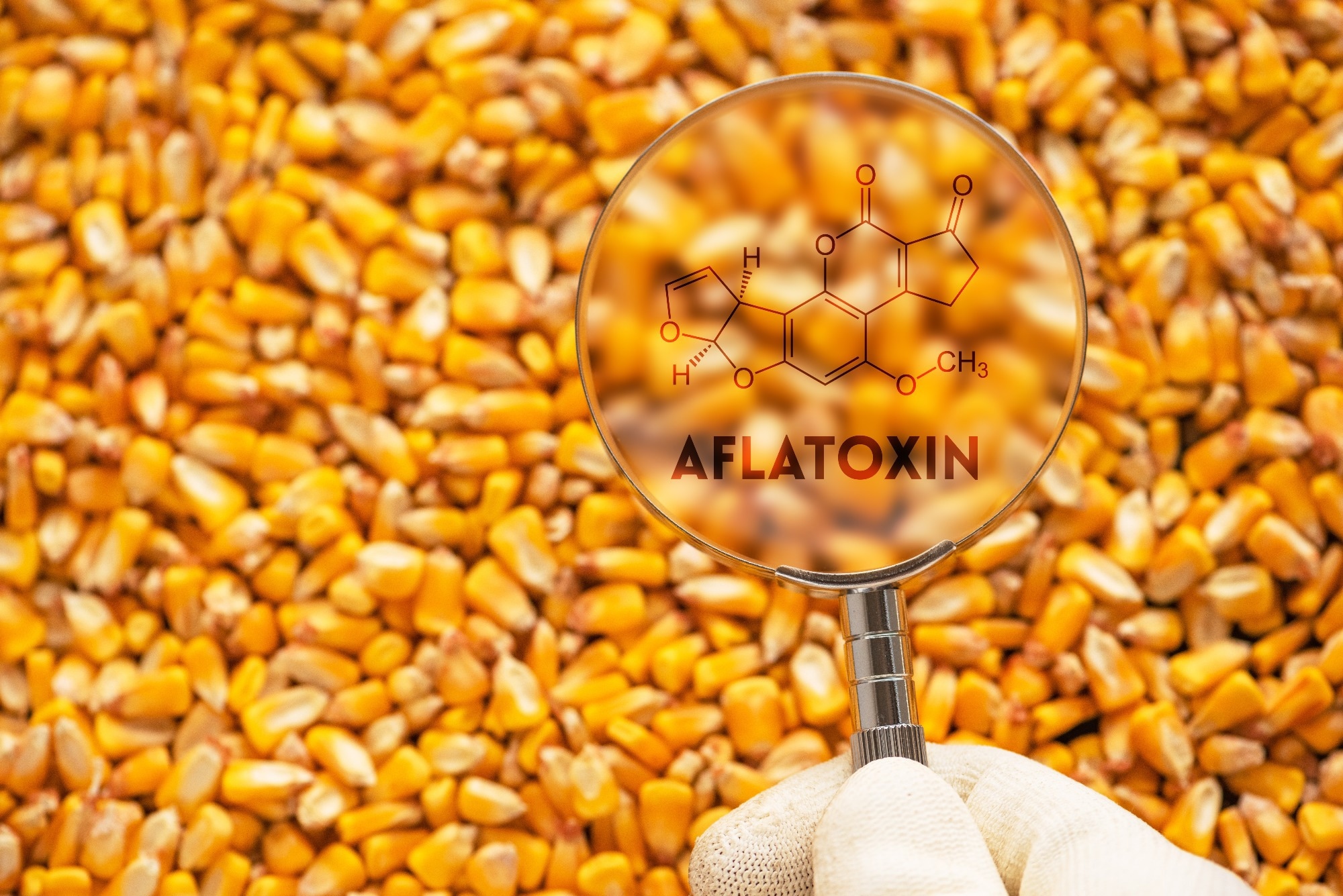 Image Credit: Bits and splits / Shutterstock.com
Health effects
Numerous human outbreaks of DON have been reported throughout the world among patients presenting with rapid-onset gastrointestinal illness, such as fever, dizziness, diarrhea, abdominal pain, vomiting, and nausea, after consuming contaminated cereals. Comparatively, dietary exposure to AFB1 leads to a characteristic TP53 codon-249 mutation that causes hepatocellular carcinoma, a carcinogenicity risk that is particularly high in settings with hepatitis B virus co-exposure. Chronic low-dose exposure has also been linked to immune suppression and childhood growth impairment4,5.
Nephrotoxicity is a characteristic feature of OTA, a storage-related contaminant in cereals and vine products. OTA concentrates in the kidneys, has a long human plasma half-life, and is associated with progressive nephropathy and possible urinary-tract tumors in animals.
Neurotoxicity is frequently observed following exposure to ergot alkaloids, which causes ergotism, a condition that can present with convulsive or gangrenous symptoms. Hormonal disruption is prominent with ZEN exposure, as estrogenic metabolites such as α-zearalenol bind estrogen receptors and alter steroid-metabolism mechanisms. Combined exposure to multiple mycotoxins may amplify these adverse outcomes4,7.
Vulnerable populations
Children, pregnant individuals, and people who are immunocompromised are at an increased risk of severe health effects following exposure to mycotoxins. Children receive higher doses due to their lower body weight and have immature detoxification pathways, thereby increasing their susceptibility to growth impairment, immune dysfunction, and organ toxicity from contaminated cereals, nuts, milk, and baby foods.
During pregnancy, AFs cross the placenta and increase the risk of low birth weight, while FBs are associated with neural tube defects. After delivery, transfer of mycotoxins through breast milk can continue exposure. Human biomonitoring studies consistently detect AFM1, OTA, and FBs in maternal and infant samples worldwide5.
Immunocompromised people, such as those with chronic illness or undernutrition, may be more vulnerable to immunotoxic effects of AFs, OTA, FBs, trichothecenes, and ZEN, even at low concentrations persisting through processing. Preventive strategies include surveillance of infant foods and formulas, targeted diet guidance, and biomonitoring to reduce exposure.
Diagnosis of dietary exposure
Urinary aflatoxin-N7-guanine and aflatoxin M1 (AFM1) reflect recent exposure to AFs, whereas serum aflatoxin-albumin (AF-alb), which is quantified as aflatoxin-lysine (AF-lysine), estimates exposure over approximately two months while correlating this value with dietary aflatoxin intake. AF-alb is currently the most validated biomarker for chronic aflatoxin exposure in epidemiological studies6.
FB exposure is assessed by sphinganine/sphingosine (Sa/So) ratios in urine, serum, or buccal cells. Total DON can be identified within 24 hours of exposure in urine, whereas OTA is often monitored in serum due to albumin binding and its long half-life. Multi-mycotoxin LC–MS/MS methods increasingly allow simultaneous biomarker assessment, though quantitative interpretation remains challenging6.
Prevention and control
Inadequate pre-harvest fungicide treatment and early harvest increase the risk of mycotoxin contamination, which was the cause of Kenya’s aflatoxicosis outbreak linked to maize that was not properly dried or treated before storage. Pre-harvest biocontrol/biodegradation can reduce the toxin load, as certain microbes and enzymes, such as Trichosporon mycotoxinvorans, esterase, and the bacterial strain Eubacterium BBSH 797, reduce mycotoxin levels before harvest.
After harvesting, rapid drying is crucial to reduce excess moisture. Cool, low-humidity storage is essential, as warm, damp conditions facilitate fungal growth. Physical separation, nixtamalization, heat treatment, washing, milling, irradiation, and other chemical/biological detoxification methods can also be adopted. Non-thermal and biological approaches are increasingly favored to preserve nutritional quality4.
Maximum residue levels for AFM1 in milk are set at 50 ng/kg in the European Union and 500 ng/kg in the United States. For OTA, the Joint Food and Agriculture Organization (FAO) and World Health Organization Expert Committee on Food Additives recommends a provisional tolerable weekly intake of 100 ng/kg body weight.
Testing methods
Liquid chromatography mass spectroscopy (LC-MS)/MS separates multiple analytes without derivatization, reaches sub-regulatory limits, and enables multiplex quantification. However, this method requires expensive instruments and skilled analysts.
Both direct and indirect enzyme-linked immunosorbent assays (ELISAs) use antibody-antigen binding with an enzymatic readout for rapid, high-throughput screening. Nevertheless, matrix effects and cross-reactivity can occur, thus necessitating LC-MS/MS confirmation.
Rapid tests such as lateral flow assays (LFAs) and emerging biosensors provide portable, on-site, and qualitative or semi-quantitative results within minutes. Recent innovations using nanomaterials, aptamers, and microfluidics have significantly improved sensitivity and robustness for field deployment2,8.
Conclusions
Field hygiene, resistant cultivars, biocontrol, timely drying, sanitary storage, and grain sorting reduce the growth of Fusarium, Aspergillus, and Penicillium species that produce mycotoxins. Routine monitoring through ELISA or rapid tests, confirmed by LC-MS/MS, is essential to protect vulnerable groups such as children, pregnant individuals, and the immunocompromised.
Given the high prevalence of co-exposure and climate-driven shifts in contamination patterns, integrated surveillance and multi-mycotoxin risk assessment are increasingly critical for food safety1,7.
References
- Niaz, W., Iqbal, S. Z., Ahmad, K., et al. (2025). Mycotoxins: A comprehensive review of its global trends in major cereals, advancements in chromatographic detections and future prospectives. Food Chemistry: X 27. DOI: 10.1016/j.fochx.2025.102350. https://www.sciencedirect.com/science/article/pii/S259015752500197X
- Khan, R., Anwar, F., & Ghazali, F. M. (2024). A comprehensive review of mycotoxins: Toxicology, detection, and effective mitigation approaches. Heliyon 10(8). DOI: 10.1016/j.heliyon.2024.e28361. https://www.sciencedirect.com/science/article/pii/S2405844024043925
- Awuchi, C. G., Ondari, E. N., Ogbonna, C. U., et al. (2021). Mycotoxins Affecting Animals, Foods, Humans, and Plants: Types, Occurrence, Toxicities, Action Mechanisms, Prevention, and Detoxification Strategies - A Revisit. Foods 10(6). DOI: 10.3390/foods10061279. https://www.mdpi.com/2304-8158/10/6/1279
- Awuchi, C. G., Ondari, E. N., Nwozo, S., et al. (2022). Mycotoxins’ Toxicological Mechanisms Involving Humans, Livestock and Their Associated Health Concerns: A Review. Toxins 14(3). DOI: 10.3390/toxins14030167. https://www.mdpi.com/2072-6651/14/3/167
- Alvito, P., & Pereira-da-Silva, L. (2022). Mycotoxin Exposure during the First 1000 Days of Life and Its Impact on Children’s Health: A Clinical Overview. Toxins 14(3). DOI: 10.3390/toxins14030189. https://www.mdpi.com/2072-6651/14/3/189
- Turner, P. C., & Snyder, J. A. (2021). Development and Limitations of Exposure Biomarkers to Dietary Contaminants Mycotoxins. Toxins 13(5). DOI: 10.3390/toxins13050314. https://www.mdpi.com/2072-6651/13/5/314
- Goessens, T., Mouchtaris-Michailidis, T., Tesfamariam, K., et al. (2024). Dietary mycotoxin exposure and human health risks: A protocol for a systematic review. Environment International 184. DOI: 10.1016/j.envint.2024.108456. https://www.sciencedirect.com/science/article/pii/S0160412024000424
- Singh, J., & Mehta, A. (2020). Rapid and sensitive detection of mycotoxins by advanced and emerging analytical methods: A review. Food Science & Nutrition 8(5). 2183-2204. DOI: 10.1002/fsn3.1474. https://onlinelibrary.wiley.com/doi/10.1002/fsn3.1474
Further Reading
Last Updated: Dec 14, 2025
 First-trimester protein intake linked to lower odds of small-for-gestational-age birth