Visual brain areas involved in processing hands also encode information about the correct way to hold tools, according to new research published in JNeurosci.
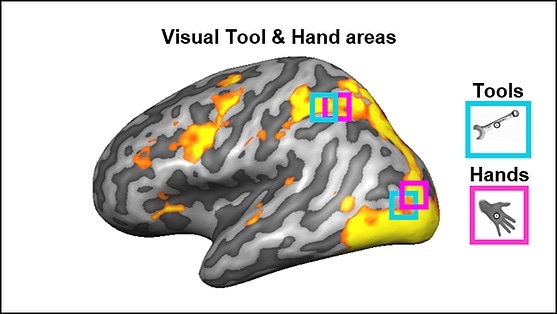
Image Credit: Society of Neuroscience
Each part of the brain’s visual system activates in response to a certain type of item — whether it’s faces, tools, objects, or hands. Scientists assumed the brain segregates visual information in this way to optimize motor actions with tools. Yet most studies investigating the brain mechanisms for tool grasping used images of tools or hands, and no actual hand movements were performed.
Knights et al. used fMRI to measure the brain activity of participants as they grasped 3D-printed kitchen tools (spoon, knife, and pizza cutter) and similar-sized non-tools. Based on activity patterns in hand-sensitive visual areas, the research team was able to determine when a participant gripped a tool correctly or incorrectly. The same ability did not extend to activity from grasping non-tools, or in tool-sensitive visual areas. This indicates brain regions involved in processing visual information about hands also encode the proper way to hold tools. These results challenge current understanding of how the brain controls hand movement and could be useful in efforts to improve brain-machine interfaces for prosthetics.
Source:
Journal reference:
Knights, E., et al. (2021) Hand-selective visual regions represent how to grasp 3D tools: brain decoding during real actions. Journal of Neuroscience. doi.org/10.1523/JNEUROSCI.0083-21.2021.
 Study uncovers a protective role for microglia in Parkinson's disease