New research shows that young Canadians who take pre-workout supplements are more than twice as likely to sleep five hours or less, raising new questions about how workout stimulants may be affecting recovery, mood, and next-day performance.
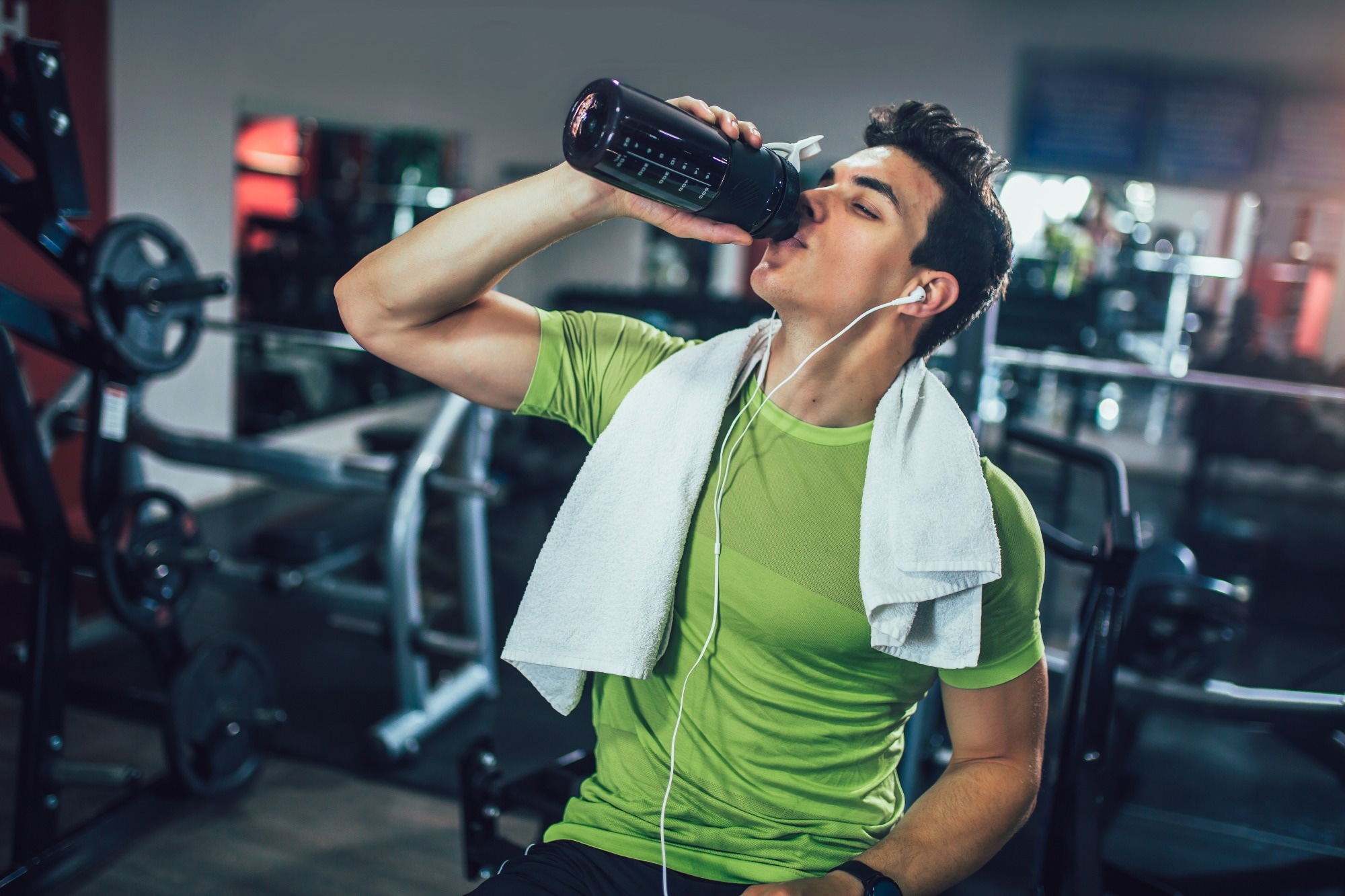 Study: Use of pre-workout dietary supplements is associated with lower sleep duration among adolescents and young adults. Image credit: adriaticfoto/Shutterstock.com
In a recent study published in Sleep Epidemiology, a group of researchers determined whether the use of multi-ingredient pre-workout dietary supplements is associated with average sleep duration among adolescents and young adults.
Why teens chase pre-workouts despite next-day fatigue
Teenagers and college-age adults often fuel their workouts with flashy “pre-workout” drinks, yet many also report feeling tired the next day. Sleep plays a crucial role in regulating mood, memory, immunity, and muscle recovery. These pre-workout products commonly include caffeine, creatine, nitrates, amino acids, and sweeteners. Caffeine can shorten sleep duration and delay the onset of melatonin rhythms. Young people often train after school or work, placing intake close to bedtime.
Clear guidance on timing and risks remains limited. Further research is needed to understand how dose, timing, and formulation of pre-workouts influence sleep duration and quality in real-world settings.
Measuring supplement use against sleep routines
Participants were drawn from Wave 2 of the Canadian Study of Adolescent Health Behaviors, an online survey conducted among individuals aged 16 to 30 years across Canada. Data were collected in Qualtrics with safeguards against bots (reCAPTCHA, attention checks, honeypot items). Ethics approval was granted by the University of Toronto Health Sciences Research Ethics Board, and written informed consent was obtained.
Pre-workout use in the prior 12 months was recorded as 'any' versus 'none' from a checklist of appearance- and performance-enhancing supplements. The average sleep over the previous two weeks was self-reported in hours and grouped as ≤5, 6, 7, 8 (reference), or ≥9; eight hours served as the reference because it aligns with current sleep guidelines.
Covariates included age, gender, race/ethnicity, sexual orientation, education, symptoms of depression and anxiety measured by the Patient Health Questionnaire 9-Item (PHQ-9) and Generalized Anxiety Disorder 7-Item (GAD-7), and any weight training in the prior 30 days.
Multinomial logistic regression estimated associations between pre-workout use and sleep categories, adjusting for covariates. Multicollinearity was evaluated using Variance Inflation Factors (VIFs); the PHQ-9 and GAD-7 were correlated, while other VIFs were <2. Effect modification by gender was tested and was not statistically significant. Model fit was evaluated with chi-square and pseudo-R², while analyses were conducted using Stata 17.0.
One in five reported pre-workout use this year
In a demographically diverse sample (mean age 23.4 years, Standard Deviation (SD) 3.8), 57.4 % identified as girls and young women, 33.8 % as boys and young men, and 8.8 % as transgender or gender-expansive. Participants were 62.2 % White, 17.1 % Asian, 3.5 % Black, 11.0 % multiracial, and 6.2 % other; 55.1 % identified as heterosexual.
About one in five participants (22.2%) had used pre-workout supplements in the past year. When it came to sleep over the previous two weeks, the most common pattern was around seven hours a night (34.9 %). Another 25 % averaged six hours, 20.4 % reached the recommended eight hours, 9 % slept nine hours or more. However, 10.6 % reported getting five hours or less.
The model performed well statistically. Even after accounting for demographics, mental health symptoms, and weight training habits, pre-workout use emerged as a strong predictor of very short sleep. Compared with those who typically slept eight hours a night, users were more than twice as likely to report sleeping five hours or less. No meaningful relationship was found between pre-workout use and getting six, seven, or nine-plus hours of sleep.
These results are consistent with what is known about caffeine in pre-workout supplements, which can shorten sleep duration by interfering with normal sleep–wake processes. From a real-world standpoint, the pattern is relevant for high school and college students who train late in the afternoon or evening, after classes or work, when intake occurs relatively close to bedtime.
Although the analyses accounted for mood symptoms and weight training, the cross-sectional design limits conclusions about cause and effect. It’s also possible that people who sleep less may turn to pre-workouts to boost energy.
Nonetheless, the magnitude of the association for short sleep is notable, suggesting that even occasional pre-workout use could push susceptible users into sleep durations far below the recommended guidelines. The sleep distribution further indicates that fewer than one in three participants met the recommended eight hours or more per night, underscoring the widespread issue of short sleep in this age group.
Together, the adjusted estimates demonstrate a specific elevation of risk for the shortest sleep category rather than a uniform shift across all categories.
Guidance needed on timing, dose and sleep protection
This study shows that adolescents and young adults who use pre-workout supplements face substantially higher odds of extremely short sleep, even after accounting for demographics, mood symptoms, and recent weight training.
Given how often workouts occur late in the day, timing appears central: stimulant intake close to bedtime can undermine recovery, learning, mental health, and athletic goals. Practical guidance should emphasize avoiding pre-workouts well before bedtime, reading labels for caffeine content, and prioritizing sleep hygiene at home.
Future investigations should test dose, timing, and ingredient patterns prospectively to clarify causal pathways and to inform targeted education, policy, and clinical practice.
Download your PDF copy now!
 Pink noise boosts brain waste clearance during sleep