A four-season study shows that while menstrual bleeding does not increase how often injuries happen in elite women’s football, it is linked to injuries that sideline players for far longer 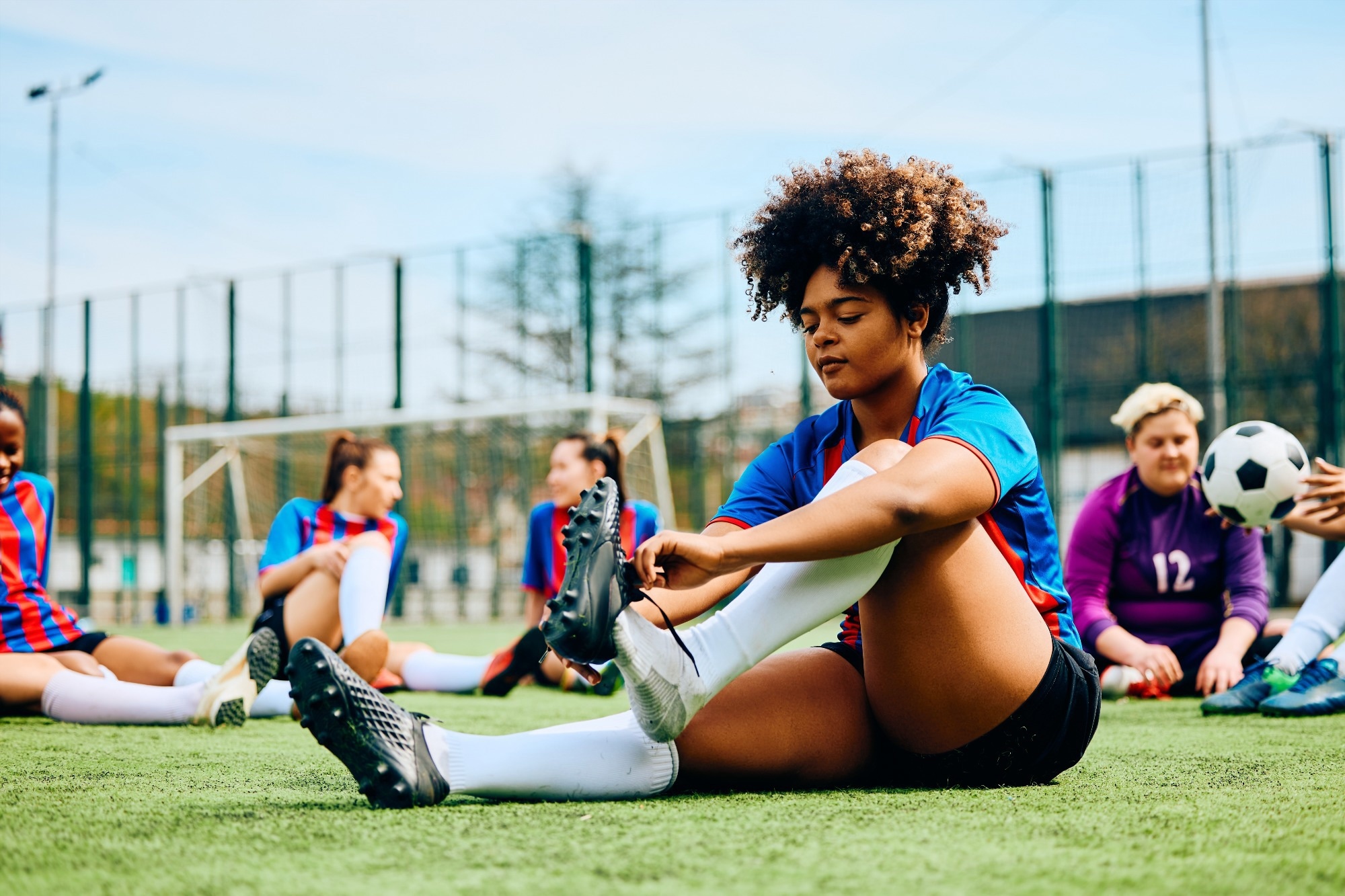 Study: Menstruation and injury occurrence; a four season observational study in elite female football players. Image credit: Drazen Zigic/Shutterstock.com
A recent paper published in the journal Frontiers in Sports and Active Living examines injury rates in elite women's footballers during the days of bleeding (the early follicular phase), when ovarian hormone levels are expected to be low.
Hormonal shifts raise questions about injury risk
Menstrual bleeding results in the loss of one milligram of iron per day, over a period of 4 to 8 days each cycle. This can lead to iron deficiency, which reduces the training load, weakens endurance, and slows recovery. Muscle health, post-training recovery, inflammation, and neuromuscular performance are other areas that may be susceptible to fluctuations in hormones during the menstrual cycle.
Much prior research has focused on tracking injury risk across the menstrual cycle. Conflicting findings from earlier studies make it challenging to determine whether any specific menstrual cycle phase increases the risk of injury. The difficulty lies in the need for invasive testing to identify each phase by hormonal measurements accurately.
Such knowledge would shape safe and optimal training and recovery strategies to protect the health of women athletes and prevent injuries where possible.
Four seasons of injury and cycle tracking
The study included 33 players from a single professional Spanish team. They were tracked over four seasons, from 2019-20 to 2022-23, during which they won two UEFA Women’s League titles. None of them were on combined oral contraception, and all were menstruating during the study period.
While 17 players were included in the first season, the second and third seasons had 20 and 18 players, respectively, and the last had 22. There were eleven players tracked through all four seasons.
Their cycles were charted using a digital calendar, with a mean length of 31 days. The average number of bleeding days was four, accounting for 13 % of the entire cycle. Only bleeding days were counted as early follicular phase days for this study; the rest were documented as non-bleeding days.
This classification was used since no hormonal measurements were available, and menstruation is the only phase in which ovarian hormone concentrations can be inferred with relative confidence.
Injuries were documented and classified with the Orchard Sports Injury Classification System (OSICS-10) codes.
Injury severity was reported by the number of time-loss injuries, injuries that led to absence from the next training session or match. They were classified according to the UEFA model, based on the number of days from the time of injury to the end of medical leave. Mild, moderate, and severe injuries led to the loss of 1-7, 8-28, and >28 days, respectively.
Injury frequency unchanged, but injury impact rises
The players had a total of 80 injuries over 852 menstrual cycles. In-match injuries accounted for 22.5 % compared to 77.5 % that occurred during training. Most injuries (57.5 %) involved muscles, with ligaments and tendons accounting for 30 % and 12.5 %, respectively.
There were eleven injuries during the bleeding days, comprising 13.7 % of the total. The injury incidence in this phase was 5.46 per 1,000 hours vs 6.6 per 1,000 hours during all other phases. The overall incidence was 6.42 per 1,000 hours. Thus, injury incidence is not associated with bleeding days.
Importantly, bleeding days made up a very small proportion of the total, which limited the study’s power to accurately detect injury risk during these days.
A much higher injury burden occurred during the bleeding phase. Soft tissue injuries during the bleeding days caused approximately three times as many days lost, at 684 days per 1,000 hours. In contrast, only 205 lost days were tracked during all other phases.
This may be partly attributed to the fact that two of four total cruciate ligament injuries occurred during the bleeding days, these being notorious for their very long recovery times.
Ligament injuries caused the most days lost among all injury types, a median of 29 days and a total of 187 days, though they occurred much less frequently than muscle injuries at 1.9 vs ~3.7, respectively. In contrast, days lost due to muscle injury were approximately 84, less than half the number lost due to ligament injuries.
Severe injuries made up 31 % of all injuries, but moderate injuries caused the greatest total number of days lost. Severe injuries made up 2.01 per 1,000 hours, vs 3.05 and 1.4 for moderate and mild injuries, respectively.
This suggests that “injuries sustained during menstruation resulted in more severe consequences.” One possible explanation is that estrogen levels are low during the early follicular phase; however, the authors caution that this alone is unlikely to fully explain the findings. Low estrogen has been linked to exercise-induced muscle damage, increased delayed onset muscle soreness (DOMS), and less strength regained after an injury.
This could mean that women athletes experience differences in recovery and injury consequences, rather than a higher likelihood of injury occurrence, when estrogen availability is low. Further large studies are required to confirm this hypothesis, particularly given that injury risk is multifactorial, and especially as high estrogen levels are also associated with less tissue stiffness and reduced neuromuscular control.
Another recent study in women who exercised for recreation suggested that symptoms were most prominent during menstruation. The women felt they performed more poorly and took longer to recover during these days.
Symptom severity, fatigue, training load, nutrition, and recovery factors could therefore contribute to the observed increase in the burden of severe injuries, independently of hormonal effects.
Tracking menstrual cycles may improve injury management
While there is no significant increase in injury incidence during menstrual bleeding, injury severity is markedly higher, indicating that elite women athletes are at risk for more severe injuries in the bleeding phase.
These findings highlight the importance of individualized menstrual tracking for injury prevention and athlete health management.
However, the authors emphasize that calendar-based tracking has limitations and that future work should validate these findings using objective hormonal measurements, alongside broader physiological and contextual data, better to inform training and recovery strategies in women athletes.
Download your PDF copy now!
 Study finds oral hormone replacement therapy increases venous thromboembolism risk