A first-of-its-kind European survey reveals that thousands of health and social care workers face regular exposure to cancer risk factors, with ionizing radiation, diesel exhaust, and solar UV emerging as the most common workplace hazards.
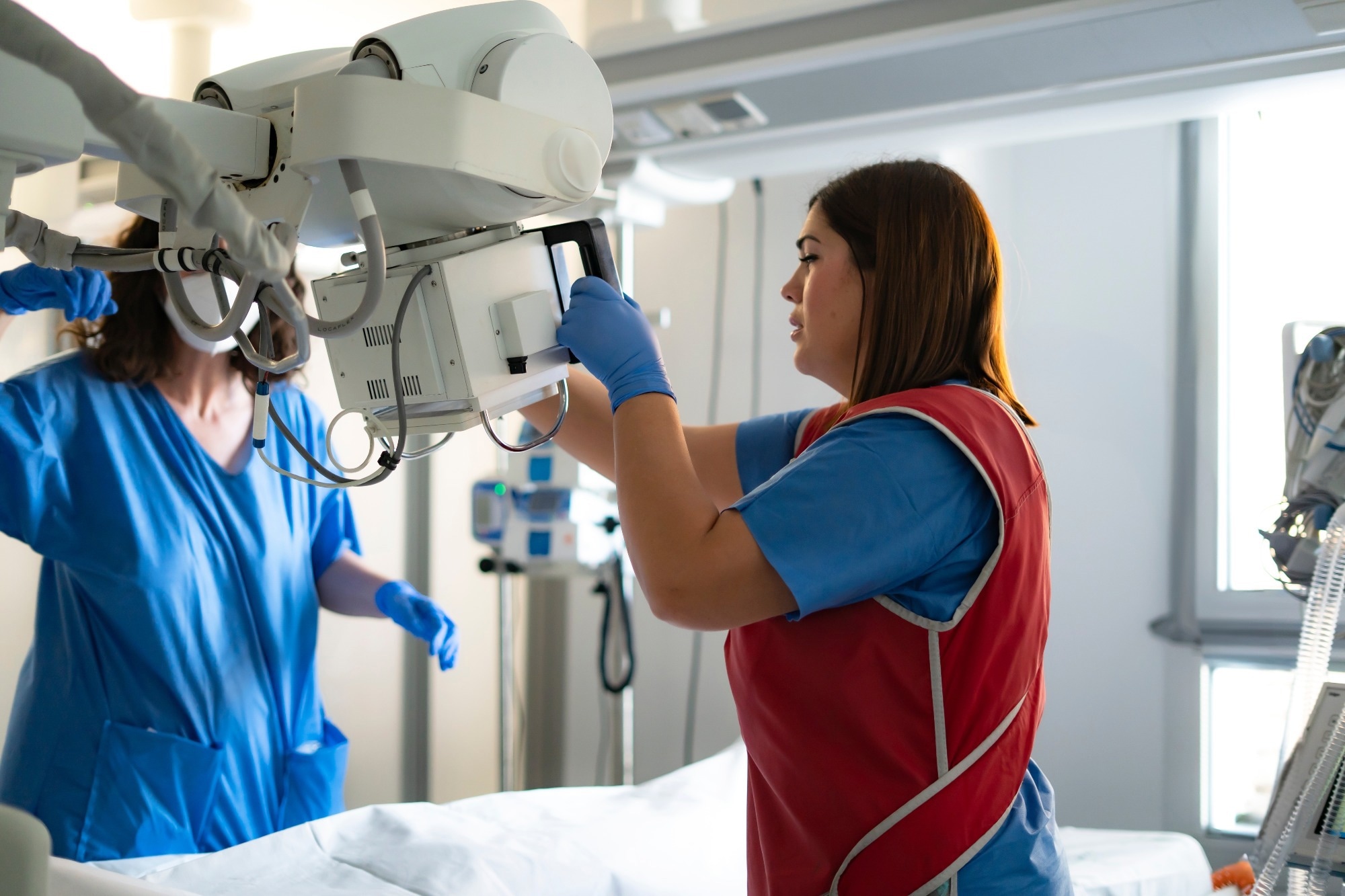 Study: Occupational exposure to cancer risk factors among health and social care workers in Europe: results from the Workers’ Exposure Survey. Image credit: killa1/Shutterstock.com
A recent European Journal of Public Health study investigated the prevalence and patterns of occupational exposure to known cancer risk factors among health and social care workers in Europe.
Occupational exposure to cancer risk factors in europe
Occupational exposure to cancer risk factors remains a pressing public health challenge, both globally and within Europe. In 2016, 14 recognized occupational carcinogens were linked to approximately 349,000 cancer-related deaths worldwide, including nearly 300,000 lung cancer fatalities.
The International Agency for Research on Cancer (IARC) has identified 47 Group 1 carcinogens relevant to occupational environments, linked to 23 different cancer types, a figure that is steadily increasing. Despite this acknowledged burden, significant data gaps persist regarding the prevalence of occupational exposure to cancer risk factors at both European and global levels.
To address these data gaps, the European Agency for Safety and Health at Work (EU-OSHA) launched the Workers’ Exposure Survey (WES), which assessed exposure to 24 occupational cancer risk factors, including industrial chemicals, physical agents, and process-generated substances and mixtures, and related prevention strategies using the Occupational Integrated Database Exposure Assessment System (OccIDEAS) web-based platform, adapted for the EU context.
WES gathered data from 24,402 respondents, representing 98.5 million workers across Finland, France, Germany, Hungary, Ireland, and Spain, making it the first survey of its scope in Europe. The survey collected detailed information on job tasks, exposure scenarios, and protective measures, enabling algorithm-based estimates of probable exposure prevalence and exposure intensity.
Approximately 47.3% of surveyed workers were exposed to at least one of the included cancer risk factors in the previous working week, with the most common exposures being solar ultraviolet (UV) radiation (20.8%), diesel engine exhaust (DEE) emissions (19.9%), and benzene (12.8%). Exposure prevalence reflected any probable exposure during the previous working week, regardless of the duration, frequency, or intensity of that exposure. Among workers exposed to at least one cancer risk factor, the largest proportions worked in manufacturing (14%), wholesale and retail trade (14%), and human health and social work activities (13%).
Task-based assessment captured real-world exposure scenarios
This study is the first to analyze WES data specifically for the human health and social care (HeSCare) sector, which represents 11% of Europe's workforce. The sector covers human health (Q-86), residential care (Q-87), and social work without accommodation (Q-88), including both formal and home-based settings. Workers encounter a range of occupational hazards, notably occupational exposures to cancer risk factors that are often overlooked.
WES sampling involved random digit dialing of mobile phones, with intentional oversampling of occupations at higher risk of exposure to cancer risk factors. For each worker, OccIDEAS automatically assigned the probability of exposure to a cancer risk factor (‘no’, ‘possible’, ‘probable’) and estimated the exposure level (‘low’, ‘medium’, ‘high’).
The exposure assessment accounted for preventive measures such as ventilation and respiratory protection. Exposure levels corresponded roughly to EU occupational exposure limits: low (<10% of the OEL), medium (10–80% of the OEL), and high (near the OEL). If a worker had multiple exposures, the highest level was used.
Prevalence and patterns of exposure to cancer risk factors among HeSCare workers
Of 24,402 surveyed workers, 12.5% were in the HeSCare sector, mainly in healthcare (81.5%), followed by residential care and social work. Most respondents were from Germany, with others from Finland, Hungary, France, Spain, and Ireland. Health workers comprised 91.3% of the sector; laboratory, food, office, and cleaning staff made up smaller shares. Primary tasks included equipment sterilization, vehicle operation or maintenance, hand hygiene, outdoor work, medical radiation, and lab work. Driving and outdoor work were more frequent in residential care and social work than in healthcare.
Women made up 65.3% of HeSCare workers, rising to 85.1% in social work. Most were native-born. Permanent contracts were common, with 15.3% self-employed and 8.6% on temporary contracts. Women were more likely to hold permanent positions; men were more often self-employed. Most worked for small companies, and social work staff often worked alone or in very small teams. The typical workweek was 31–40 hours, averaging 37.7 hours.
Nearly 30% of HeSCare workers were probably exposed to at least one cancer risk factor during the previous working week, with male workers more affected than female workers. Most exposed workers faced a single risk, while 7.8% encountered two or more. Healthcare showed similar patterns.
The most common exposures were ionizing radiation (7.4%), diesel engine exhaust (6.2%), and solar UV radiation (6.1%). The highest-intensity exposures were estimated for formaldehyde (2.3% of workers) and ethylene oxide (2.0%), although exposure levels varied substantially depending on the task being performed. Some workers experienced multiple exposures, including diesel exhaust and solar UV radiation.
In healthcare, key exposures included ionizing radiation, formaldehyde, and DEE. Residential care workers most often reported exposure to solar UV radiation (14.7%) and DEE (9.1%). In social work, solar UV (19.5%), benzene (19.3%), and DEE (18.0%) were the most common.
Exposure sources included X-ray machines, vehicle use or maintenance, outdoor work, anatomy labs, sterilization, and vehicle fueling. Use of protective measures varied by the circumstances of exposure. Most workers used protective measures such as radiation shields, solar UV clothing, fume hoods or ventilation for formaldehyde, and ventilation for ethylene oxide and respirable crystalline silica. However, the survey also identified gaps in the use of protection in some situations, particularly for solar UV radiation and certain chemical exposures. Sunglasses and sunscreen were less common for UV protection.
Prevention gaps persist despite widespread protective measures
HeSCare workers are exposed to a range of occupational cancer risk factors, often facing more than one risk factor depending on their specific job role and sex. While many workers employ protective measures, gaps remain, particularly in the use of personal protective equipment against solar UV radiation. These findings highlight the need for ongoing surveillance, tailored preventive strategies, and improved education about occupational cancer risks to better protect all categories of HeSCare staff.
The authors note several limitations. Exposure estimates were based on workers’ reported tasks during the previous working week rather than long-term occupational histories, and the survey covered only six European countries. Data collection took place primarily during autumn and winter, which may have influenced estimates for seasonally variable exposures such as solar UV radiation. In addition, the survey did not include all potential occupational cancer hazards relevant to health and social care settings, such as some hazardous medicinal products and antineoplastic drugs.
Overall, the study provides task-based estimates of probable occupational exposure rather than direct exposure measurements or assessments of cancer incidence. By identifying specific exposure circumstances and prevention practices, the findings offer valuable evidence to support targeted occupational cancer prevention efforts across Europe’s health and social care workforce.
Download your PDF copy by clicking here.
Journal reference:
-
Khan, M. W. et al. (2026). Occupational exposure to cancer risk factors among health and social care workers in Europe: Results from the Workers’ Exposure Survey. European Journal of Public Health. 36(2). DOI: https://doi.org/10.1093/eurpub/ckag056. https://academic.oup.com/eurpub/article/36/2/ckag056/8586541
 Long-term endocrine therapy adherence remains low after breast cancer surgery