Babies' brains respond to structured music from as early as three months, but the ability to coordinate movement with a musical beat appears to develop later, shedding new light on how musicality emerges during infancy.
 Study: Development of auditory and spontaneous movement responses to music over the first postnatal year. Image credit: Kandybka Alina/Shutterstock.com
 *Important notice: eLife publishes preliminary scientific reports that are not peer-reviewed and, therefore, should not be regarded as conclusive, guide clinical practice/health-related behavior, or treated as established information.
A recent study published in the journal eLife found that while infants respond to musical sounds through auditory processing and auditory-motor coupling, their movements were not coordinated with the musical beat, even at the end of the first year of life. This study adds to current knowledge about the neurodevelopmental trajectory of early music processing in infancy.
Researchers investigate when babies begin moving to music
Musicality, the ability to perceive, appreciate, and produce music, is considered a fundamental human trait. An important part of this ability is moving to music, which depends on both the brain's ability to process sound and the body's ability to translate those sounds into movement.
Previous research has shown that even very young infants can perceive musical features. Using electroencephalography (EEG), scientists have detected brain responses such as the phase-locked P1 response to both music and speech. Other neural signals, known as steady-state evoked potentials, have also revealed that the developing auditory system can detect key elements of musical structure, including rhythm, pitch differences, and tone patterns.
While the sensory side of musicality is increasingly well understood, far less is known about how musical perception translates into action. This motor component ranges from simple body movements or vocalizations in response to music to more complex behaviors such as dancing. Importantly, studies have yet to examine the sensory and motor aspects of musicality simultaneously during infancy.
Earlier research has shown that fetuses and infants naturally move in response to music, with faster musical tempos often eliciting faster movements. However, these movements are not synchronized with the musical beat, and exactly when coordinated movement begins to emerge remains unknown.
Another unanswered question is whether these movements are unique to music or simply reflect responses to sound more broadly. Researchers have also suggested that infants may respond differently to pitch and rhythm. For example, caregivers naturally speak to babies using higher-pitched voices, slower intonation, and simpler language. This mirrors evidence that high-pitched sounds are particularly effective at capturing infants' attention and strengthening their neural responses, whereas adults tend to respond more strongly to lower-pitched sounds.
The current study investigated both the sensory and motor components of musicality in infants while also examining how musical pitch influences each of these responses
EEG and motion tracking captured musical responses
The study included 79 infants aged 3, 6, and 12 months, who were presented with children’s songs, the same songs scrambled, and versions in which the melody was shifted one octave higher or the bassline one octave lower. Neural responses to the songs were monitored using EEG, along with full-body spontaneous movements using automated motion-tracking videos.
The investigators thus examined the differences in these responses over time to characterize maturing responses.
Key findings
To understand how infant brains process music, the researchers first compared their responses with those of adults. In adults, rapidly rising sounds typically produce a characteristic three-phase EEG pattern. Both the early P1 and later P2 responses are stronger when listening to structured music than to scrambled versions of the same sounds. These adult responses served as a benchmark for assessing how musical processing develops during infancy.
Structured music triggered stronger infant brain responses
To investigate how infants process music, the researchers compared their brain activity with that of adults listening to the same sounds. Adults showed a characteristic pattern of brain responses to structured music that was stronger than their response to scrambled versions of the same songs, providing a benchmark for interpreting infant brain activity.
Even at just three months of age, infants displayed an early brain response (P1 response) that became stronger and occurred more quickly as they grew older. Like adults, infants consistently showed a larger P1 response when listening to structured music than to scrambled music, suggesting that their brains were already sensitive to musical organization.
By 12 months, infants also began to show a second, later brain response (P2 response), indicating that their auditory processing was becoming more mature. Although infants responded to scrambled music, these neural signals were weaker and less clearly defined than those evoked by structured music.
Further analyses showed that these differences could not be explained simply by the spacing between notes, suggesting that infants were encoding aspects of musical structure itself. However, because the scrambled versions altered both the timing and pitch order of the music, the researchers could not determine whether rhythm, melody, or a combination of the two was primarily responsible for the stronger brain responses.
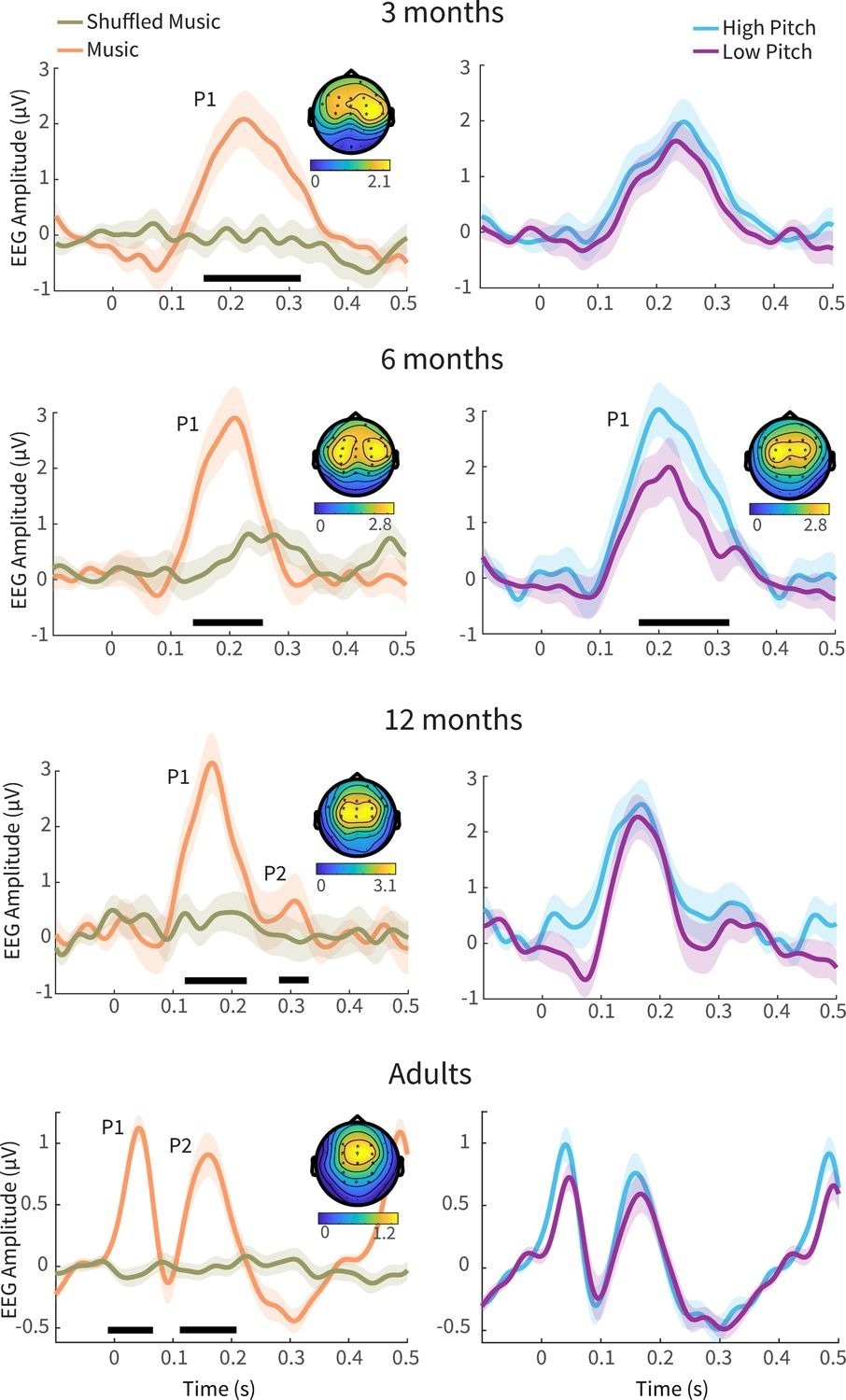 Electroencephalography (EEG) responses recorded from infants aged 3, 6, and 12 months, alongside adults, while listening to structured music, scrambled music, and high- or low-pitched musical stimuli. Structured music elicited stronger early brain responses (P1) throughout infancy, while enhanced responses to high-pitched music were observed only at six months. Adapted from the study published in eLife.
Pitch influenced brain activity but not movement quantity
Overall, both infants and adults showed similar patterns of brain activity when listening to the high- and low-pitched versions of the songs.
However, only six-month-old infants showed a stronger P1 response to high-pitched music than to low-pitched music, suggesting a temporary period of heightened sensitivity to higher-pitched sounds during development. This effect was not seen in either three- or 12-month-old infants.
Interestingly, this increased neural sensitivity did not translate into more movement. Instead, high-pitched music appeared to predict the timing of infants' movements more effectively than low-pitched music, indicating stronger auditory-motor coupling without increasing the overall amount of movement. The authors suggest this may reflect an important stage in the development of both musical and communicative processing. Future studies are needed to examine how pitch and rhythm influence movement beyond the first year of life.
Music encouraged movement but not beat synchronization
The researchers also tracked infants' full-body movements while they listened to the different sounds. Only 12-month-old infants moved more when listening to structured music than to scrambled music, with the increase largely driven by upper-body and arm movements.
This pattern suggests that while lower-body movement remained relatively stable during the first year, older infants increasingly incorporated their upper body into spontaneous movements while seated.
The analyses also showed that changes in music intensity were linked to subsequent infant movements, whereas scrambled music did not produce the same effect. The relationship between music and movement was generally stronger for high-pitched music, and this coupling appeared to become more pronounced with age.
Despite these increasingly sophisticated movement patterns, none of the infants moved in time with the musical beat. Although their spontaneous movements often followed a rhythmic pattern, they were not synchronized with the music itself.
According to the researchers, this finding fits with what is already known about child development. Coordinating movement to a musical rhythm requires both sensory processing and motor control, abilities that continue to mature well beyond the first year of life. As children develop, they gradually progress from controlling individual muscles to coordinating groups of muscles for increasingly complex actions such as crawling, walking, running, and eventually, dancing.
The authors suggest this gradual progression may reflect the slow maturation of the brain's dorsal auditory pathway, which is thought to play an important role in perceiving rhythm and translating sound into coordinated movement.
More broadly, the findings support the idea that the brain continuously draws on prior listening experiences to predict upcoming musical patterns. Scrambled music may disrupt this predictive process, making it more difficult for infants to recognize and engage with the underlying structure of the sounds.
Music perception develops before synchronized musical movement
The findings suggest the early onset of music sensitivity, which persists into infancy, perhaps due to the brain’s processing of past observations to make current predictions about what it hears. However, coordinated movements in time with the music were not observed during the first year of life.
Together, these findings provide initial insights into how the developing brain gradually transforms music into spontaneous movements of increasing complexity.
Further research is essential to explore the importance of music-induced movement that begins after the first year of life.
Download your PDF copy now!
*Important notice: eLife publishes preliminary scientific reports that are not peer-reviewed and, therefore, should not be regarded as conclusive, guide clinical practice/health-related behavior, or treated as established information.
Journal reference:
- Preliminary scientific report.
Nguyen, T., Bigand, F., Reisner, S., et al. (2026). Development of auditory and spontaneous movement responses to music over the first postnatal year. eLife. DOI: https://doi.org/10.7554/eLife.107088.4. https://elifesciences.org/articles/107088
 Positive parenting, consistent discipline reduce children's behavioral and emotional problems