A review of seven sweeteners and mixed exposures shows why dose, formulation, diet, and individual biology matter when interpreting their potential effects on the gut and metabolism.

Effects of Non-Nutritive Artificial Sweeteners on Gut Microbiota and Host Metabolism and Health-Related Outcomes: A Review. Image Credit: Towfiqu ahamed barbhuiya / Shuttertock
A recent narrative review in the journal Nutrients synthesized the effects of seven individual non-nutritive artificial sweeteners (NASs) and mixed NAS exposures on gut microbiota composition and host metabolic health and developed an interactive knowledge graph to organize and navigate the available evidence.
Uncertain Health Impacts of NASs
The rising prevalence of obesity and diabetes has led to increased reliance on non-nutritive artificial sweeteners as sugar substitutes. However, the metabolic effects of NASs remain ambiguous due to their diverse structures, metabolic pathways, and formulations, making it difficult to generalize their health impacts.
Human multi-omics studies indicate that gut microbial metabolism, metabolite production, and community interactions can contribute to host metabolic processes, including insulin resistance and glycemic variability. These studies also highlight that the interplay between specific NAS compounds, formulations, and complex dietary matrices further shapes gut microbiota composition and metabolic outcomes.
As NAS research expands beyond taste and energy balance, attention has shifted to intestinal signaling, microbial physiology, and host-microbe interactions. These mechanisms are interconnected, as a sweetener can influence both microbes and host physiology through overlapping pathways.
Some studies have linked NASs to changes in gut microbiota and individualized metabolic responses, underscoring the importance of assessing compound identity, microbial function, and host phenotype across different evidence layers. Yet, findings in humans are inconsistent: some NASs alter metabolic or microbial profiles depending on the compound, dose, formulation, duration, study population, and research setting, while others show neutral effects. This variability highlights a persistent research gap regarding which NASs and exposures have meaningful biological or clinically relevant health impacts.
Moreover, shifts in microbiota composition do not always translate into measurable host outcomes, and functional changes may occur without alterations in microbial diversity. This underscores the need to distinguish between compound mixtures, compositional and functional changes, and association versus causation.
Assessing Evidence Linked to Artificial Sweetener Use, Gut Microbiota, and Health Outcomes
The bibliometric analysis searched relevant English-language journal articles and reviews on non-nutritive artificial sweeteners, gut microbiota, and metabolic or health outcomes from the Web of Science Core Collection and Scopus in March 2026. PubMed was subsequently cross-checked during publication selection for the narrative synthesis. Studies on sugar alcohols or natural sweeteners that focused only on sensory properties, food formulation, or analytical chemistry, or that lacked gut-relevant microbiota endpoints or microbiota-related host outcome assessment were excluded.
A total of 624 unique publications formed the bibliometric dataset after duplicates were removed. Selected studies, including in vitro, ex vivo, animal, and human studies, were grouped by sweetener and evidence layer. As a narrative review, no formal risk-of-bias assessment or meta-analysis was performed.
The review included seven individual NASs: saccharin, cyclamate, aspartame, acesulfame potassium, sucralose, neotame, and neohesperidin dihydrochalcone (NHDC), as well as studies of mixed exposures. These NASs differ in molecular structure, solubility, thermal stability, and sweetness, influencing their suitability in different food systems.
The NAS-MAP knowledge graph was created to help organize and navigate scientific evidence from published studies. It connects information on artificial sweetener exposure, study conditions, gut microbiota results, host health effects, and the sources.
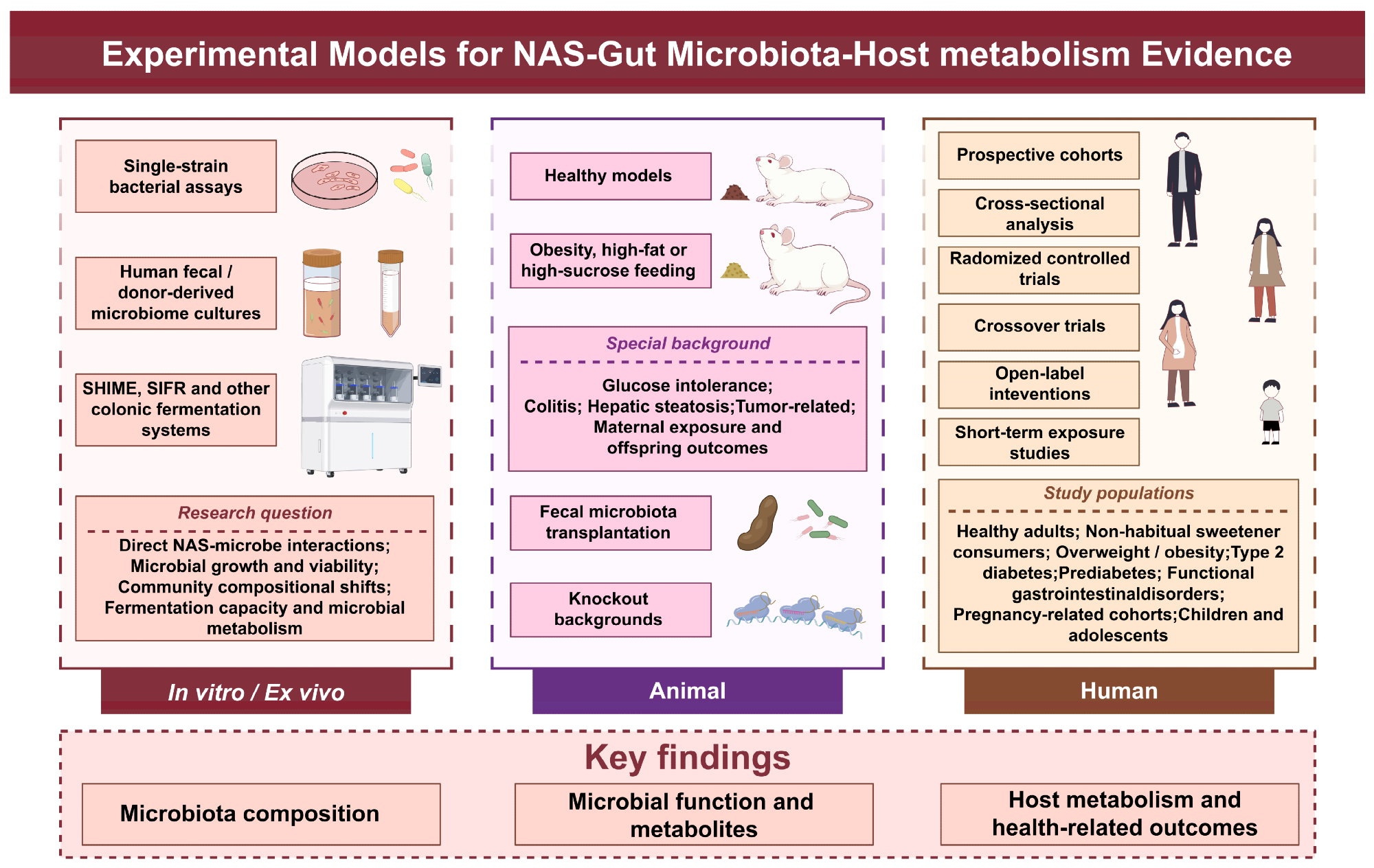
Experimental models for studies of NASs, gut microbiota and host-related outcomes.
Reported Effects of NASs on Gut Microbiota, Metabolism, and Health
Artificial sweeteners have diverse and sometimes inconsistent effects on gut microbiota and host metabolism, with outcomes varying by compound, dose, and individual factors. The effects of common artificial sweeteners are discussed below.
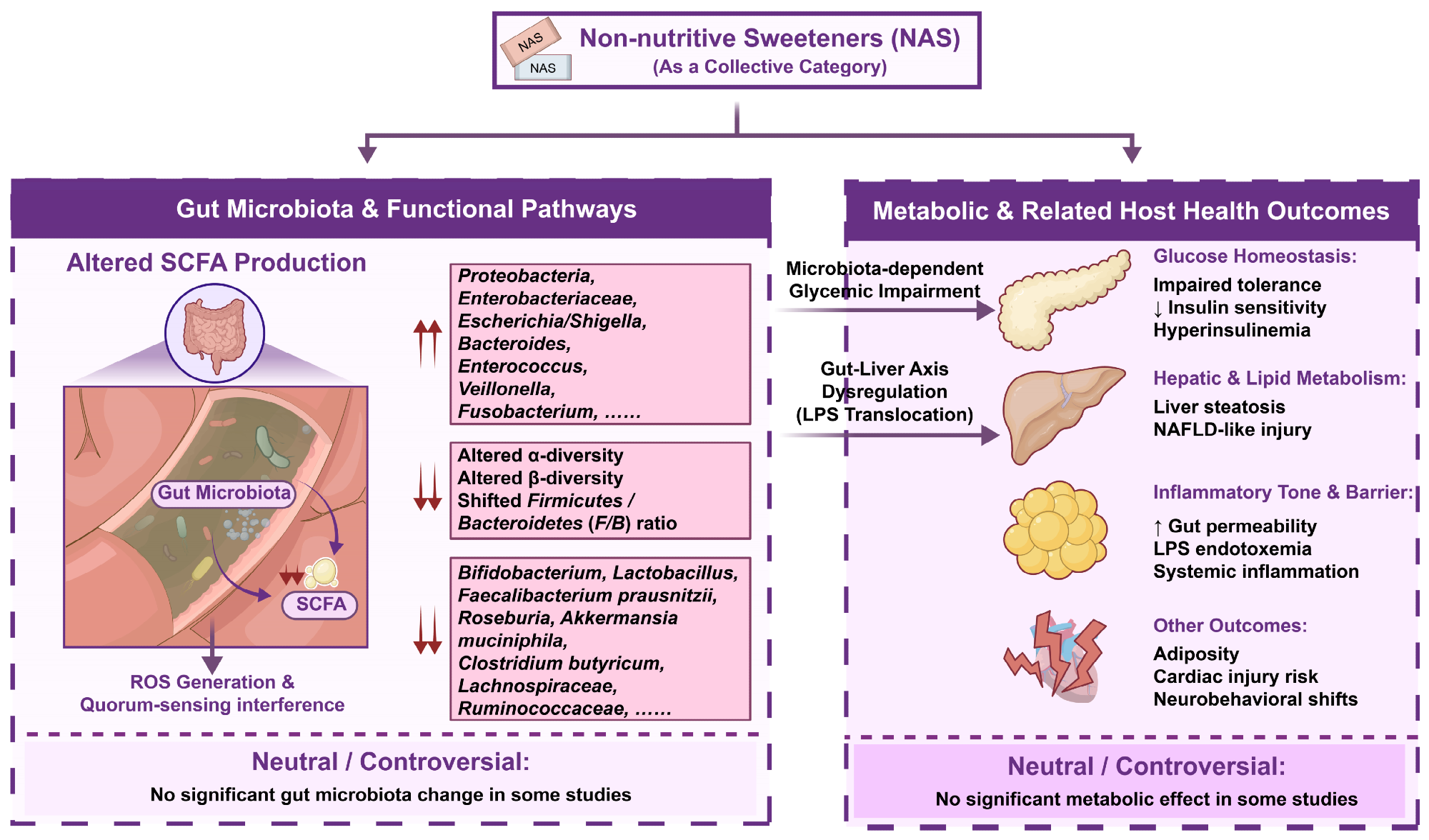
Compound-specific and context-dependent response framework for NAS effects on gut microbiota and host-related outcomes. The figure summarizes how individual NASs and mixed formulations may be linked to gut microbiota composition, gut microbial function or metabolites, and host outcomes such as glycemic regulation, intestinal barrier function, inflammation, hepatic lipid metabolism, adiposity, or neurobehavioral endpoints. Note: arrows and outcome labels should be interpreted as evidence-mapping relationships rather than uniform category-level effects, because reported directions vary by compound, dose, formulation, exposure duration, host background, model system, and endpoint layer.
Sucralose
Sucralose’s effects on gut microbiota are highly variable. Across human fecal and ex vivo systems, animal models, and human studies, reductions in Roseburia, Faecalibacterium prausnitzii, Lactobacillus, and Bifidobacterium, and increases in taxa including Enterococcus, Veillonella, Escherichia-Shigella, Bilophila, and Bacteroides have been reported. These changes have been reported alongside lower butyrate production, altered bile acids, and greater microbial gene transfer. Animal studies have associated sucralose exposure with impaired glycemic control, insulin resistance, gut-liver axis disruption, and inflammatory or liver-related injury, with possible offspring effects after maternal exposure in animal models. However, some studies show minimal changes in microbiota or even improved insulin sensitivity, depending on dose, product, and diet.
Aspartame
Aspartame has been associated with altered microbial function and metabolism, including increased acetate and propionate, reduced branched-chain fatty acids, and sometimes increased Bifidobacterium. While some animal studies link aspartame to worsened glucose regulation and inflammation, human data are less consistent, often showing no clear metabolic impairment. One human observational study reported lower serum interleukin-6 (IL-6) and interleukin-10 (IL-10), although the clinical significance of these findings is uncertain, and findings on glycemic outcomes are mixed.
Saccharin
Saccharin’s impact on the microbiota and host metabolism is inconsistent. Some studies find reductions in certain bacteria and increases in Escherichia coli, along with metabolic disruptions such as impaired glucose tolerance, weight gain, and liver inflammation. Evidence that microbiota changes mediate effects is strongest for glucose intolerance, based on antibiotic, fecal-transfer, and personalized microbiome experiments. However, one high-dose study in healthy humans and mice found little effect on microbial diversity or glycemic outcomes. Effects depend on dose, host, and study design.
Acesulfame Potassium
Acesulfame potassium (Ace-K) may induce gut microbial shifts, inflammation, impaired barrier function, and metabolic changes in mice, with some sex-specific effects. However, not all studies observe these changes, and some report little or no impact, especially in ex vivo or long-term settings. Dietary and host factors strongly influence outcomes, but their effects are not consistently reproduced.
Neohesperidin Dihydrochalcone
NHDC, studied mainly in animals, may shift the microbiota toward less disease-associated profiles, increase short-chain fatty acid production, and improve metabolic and inflammatory markers. However, evidence is preclinical, and human data are lacking.
Neotame
Neotame alters the gut microbiota and metabolites in animal models but shows limited, inconsistent effects on host metabolism or health. A small human crossover trial found lower post-meal insulin responses with neotame-sweetened biscuits than with sucrose, although post-meal glucose did not differ significantly.
Cyclamate
Evidence for cyclamate’s impact on the gut microbiota is limited and inconclusive, with no strong links between microbiota changes and health outcomes and a lack of human microbiome studies. A rat study reported cardiac inflammatory and injury-related changes, but it did not establish a gut microbiota-mediated mechanism.
Mixed NAS Exposures
Studies on mixed NAS show variable effects, which may depend on the component sweeteners, formulation, dietary substitution, and host factors. Some report metabolic and microbial disturbances, while others find minimal changes, highlighting the complexity of interpreting NAS mixtures. Notably, a one-year trial of sweeteners and sweetness enhancers supported weight-loss maintenance and altered overall gut microbiota composition without major deterioration in cardiometabolic markers.
NAS-MAP: An Interactive Evidence-Mapping Framework for NAS-Microbiota Research
NAS-MAP is a lightweight, interactive knowledge graph and question-answering (QA) interface for NAS-microbiota-host phenotype relationships. It connects NAS compounds and mixtures to reported doses, research models, microbiota findings, host outcomes, and digital object identifier-linked sources. The global view presents these elements as evidence paths, making it easy to trace how outcomes are reported across compounds and experimental contexts.
A QA panel allows users to search for or select terms related to NAS, changes in gut microbiota, and health outcomes. Upon selection, the system generates a summary and DOI links for review. For example, selecting “α-diversity decreased” yields a summary of 9 records, 7 DOI-linked articles, and 6 model contexts, with concise interpretations and verification links. The graph maintains visual connections between selected outcomes and related nodes, mapping both neutral and adverse host findings and highlighting the distribution of evidence across sweeteners and models. This approach frames the graph as an evidence map rather than a causal tool.
NAS-MAP is a team-managed framework that prioritizes traceability and structured synthesis over database scale or evidence grading. Current limitations include limited data, insufficient evidence strength, and non-standardized reporting. Future development should emphasize standardized, quantitative, and interoperable evidence fields to support future artificial intelligence (AI) and machine learning applications.
Journal reference:
- Xin, Y., Fu, T., Weiskirchen, R., Chen, H., Cheng, M., Zhu, R., & Wang, H. (2026). Effects of Non-Nutritive Artificial Sweeteners on Gut Microbiota and Host Metabolism and Health-Related Outcomes: A Review. Nutrients, 18(14), 2402. DOI: 10.3390/nu18142402, https://www.mdpi.com/2072-6643/18/14/2402
 Rice, fish and pickles: Is the traditional Japanese diet as healthy as we think?