A meta-analysis of more than 6,000 adults reveals how semaglutide affects weight and key metabolic markers, while new evidence from higher doses raises an important question about how far its benefits could extend.
Study: Effects of subcutaneous semaglutide on weight loss and inflammatory markers in adults with overweight or obesity without diabetes: a systematic review and meta-analysis. Image Credit: Edugrafo / Shutterstock
In a recent systematic review published in the International Journal of Obesity, researchers used a meta-analytic approach to assess the efficacy and safety profile of subcutaneous semaglutide for weight management. The review focused on adults (n = 6,239 participants) with clinically established overweight or obesity but without concurrent diabetes.
The analyses leveraged data from nine independent randomized controlled trials (RCTs) and investigated changes in body weight, waist circumference, C-reactive protein (CRP), and the occurrence of serious adverse events (SAEs). Review findings revealed that, compared with placebo, subcutaneous semaglutide was associated with a 12.04-percentage-point greater reduction in body weight, a 9.36 cm greater reduction in waist circumference, and a 40.90-percentage-point greater reduction in CRP.
These findings indicate that semaglutide produces substantial improvements in weight-related outcomes and reduces waist circumference and CRP in adults without diabetes. The authors further cite emerging evidence that indicates possible additional therapeutic gains at higher doses, although these findings remain exploratory.
Background
Obesity is a common chronic, relapsing disease associated with substantial health risks and multiple serious comorbidities. Global public health records indicate that adult obesity has more than doubled since 1990, while approximately 2.5 billion adults were overweight in 2022.
Overweight and obesity have long been associated with severe comorbidities, including cardiovascular diseases (CVDs), osteoarthritis, respiratory impairment, and certain malignancies, highlighting the importance of weight management in patients and vulnerable populations.
Weight-loss strategies have included dietary and lifestyle modification, pharmacological treatment, and bariatric surgery. The introduction of glucagon-like peptide-1 receptor agonists (GLP-1 RAs), particularly semaglutide, has expanded the pharmacological options available for weight management.
While a growing body of peer-reviewed literature demonstrates semaglutide’s substantial efficacy for weight loss and improvements in cardiometabolic risk factors, more recent trials, including those evaluating higher-dose semaglutide, may refine current estimates of its efficacy and safety.
About the review
The present systematic review aimed to address this knowledge gap and inform future pharmacological weight management interventions by synthesizing the latest evidence to provide an updated assessment of semaglutide's therapeutic efficacy and safety in non-diabetic populations.
The review was registered on PROSPERO. Its methodology initially involved a systematic keyword search for eligible RCTs in PubMed, the Cochrane Library, and ClinicalTrials.gov from the inception of each database through November 15, 2025. The publications thus identified were screened for eligibility. The methodological quality of the included publications was assessed using the Cochrane Risk of Bias 2 (RoB 2) tool.
The review subsequently pooled data from the nine finalized RCTs (total sample size n = 6,239), including 4,203 participants assigned to semaglutide and 2,036 to placebo. The endpoints of primary interest included: 1. Participants’ percentage change in body weight, 2. Their concurrent change in waist circumference, 3. Relative change in participants’ circulating CRP, and 4. The proportion of participants who experienced SAEs.
Pooled between-group effects were estimated using random-effects models in Review Manager (RevMan 10.1.1), while leave-one-out sensitivity analyses were used to investigate potential sources of heterogeneity.
Review findings
The review’s random-effects models revealed that, compared with placebo in controls, subcutaneous semaglutide produced substantial improvements in the experimental cohorts across the investigated efficacy outcomes.
When considering only weight management, semaglutide was associated with a pooled 12.04-percentage-point greater reduction in body weight from baseline than placebo. This difference rose to 14.13 percentage points under trial-policy analyses that estimate treatment effects under more idealized trial conditions.
Waist circumference outcomes mirrored these findings, demonstrating a 9.36 cm greater reduction in waist circumference with semaglutide than placebo. Furthermore, semaglutide was associated with a 40.90-percentage-point greater reduction in CRP than placebo, indicating an improvement in this inflammatory marker.
Sensitivity analyses identified the higher-dose STEP UP trial, which evaluated semaglutide 7.2 mg, as a major contributor to statistical heterogeneity (I2 = 74% for weight loss; I2 = 54% for CRP). STEP UP showed larger reductions in body weight (-14.80 percentage points versus placebo) and CRP (-50.00 percentage points versus placebo) than were generally observed across the 2.4 mg trials. However, the authors emphasized that this apparent dose-related pattern remains exploratory, as evidence for the 7.2 mg dose is largely based on a single trial.
Safety evaluations revealed that while overall SAE risk did not differ statistically between the semaglutide and placebo cohorts (P = 0.55), excluding data from the STEP HFpEF trial, a heart failure trial with lower semaglutide SAE rates, increased the pooled SAE risk ratio to 1.31, which reached statistical significance (P = 0.03). The authors cautioned that this sensitivity finding may reflect differences between clinical populations and should be interpreted cautiously.
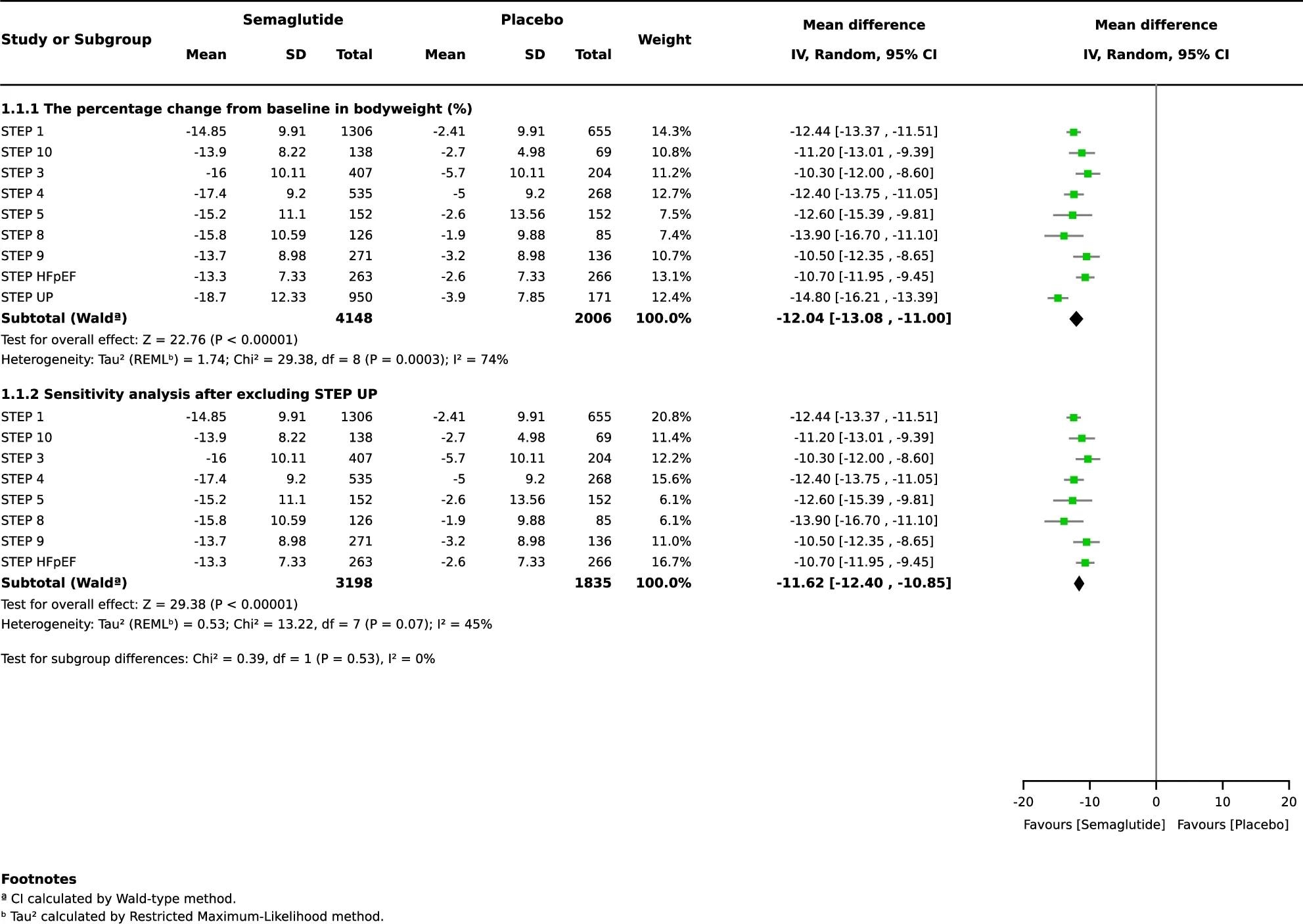
The percentage change from baseline in bodyweight (%).
Conclusions
The present systematic review and meta-analysis support subcutaneous semaglutide as a clinically efficacious intervention in overweight and obese populations without concurrent diabetes.
Current evidence shows statistically significant improvements in body weight and waist circumference, along with substantial reductions in CRP. Data from the STEP UP trial further suggest greater weight-loss efficacy with the higher 7.2 mg dose, although this finding requires confirmation.
The review was notably limited by single-trial data for the 7.2 mg dose, variable treatment durations (52 to 104 weeks), clinical and methodological heterogeneity across the included trials, and the absence of broader inflammatory biomarkers such as interleukin-6 and TNF-alpha. Long-term safety beyond the included trial durations also remains uncertain, thereby necessitating longer-term trials to evaluate multi-year safety profiles and physiological benefits across diverse patient cohorts.
Journal reference:
- Milluzzo, A., Oteri, V., Manuella, L., Pulvirenti, A., & Frittitta, L. (2026). Effects of subcutaneous semaglutide on weight loss and inflammatory markers in adults with overweight or obesity without diabetes: a systematic review and meta-analysis. International Journal of Obesity. DOI: 10.1038/s41366-026-02189-x. https://www.nature.com/articles/s41366-026-02189-x
 Semaglutide extended lifespan in older female mice, but that was not the only finding