Researchers mapped nearly 2,000 vaginal metagenomes to investigate how microbial community states, resistance genes, and pregnancy outcomes intersect within this largely unexplored reservoir of antimicrobial resistance.
Study: Bacterial community structure shapes the vaginal resistome during pregnancy. Image Credit: Anusorn Nakdee / Shutterstock
In a recent study published in the journal npj Biofilms and Microbiomes, researchers investigated how vaginal bacterial community structure could potentially shape antibiotic resistance gene (ARG) carriage.
Researchers characterized the vaginal resistome across 1,547 pregnant women (1,957 metagenomic samples) and found that 56% (1,097 of 1,957) of samples harbored clinically relevant ARGs. Among ARG-positive samples, genes conferring macrolide-lincosamide-streptogramin (MLS) resistance accounted for 57% to 60% of ARG relative abundance, while tetracycline resistance accounted for 23% to 27%, while β-lactams were observed to exhibit the greatest genetic richness (68 unique genes).
The analysis showed that ARG carriage mirrored microbial community state types (CSTs): Lactobacillus crispatus-dominated communities (CST I) were largely devoid of resistance genes (75% ARG-negative), whereas anaerobic states (CST IV) and L. iners communities (CST III) harbored substantial resistance burdens.
Further analysis showed that preterm premature rupture of membranes (PPROM) was associated with expanded predicted resistance breadth among ARG-positive samples, consistent with qualitative restructuring of the resistome, thereby informing future research in the field.
Background
Maternal-fetal infections are a major global public health concern, with reports from 2021 estimating ~19 million cases globally in that year alone. Research aimed at mitigating the global burden of maternal-fetal infections indicates that while antibiotic therapy is essential for perinatal care, the rapid dissemination of antimicrobial resistance (AMR) increasingly threatens these drugs’ clinical efficacy.
Simultaneously, research aimed at characterizing the gestational vaginal microbiome (VMB) has established that vaginal microbial composition during pregnancy is commonly categorized into five predominant microbial community state types (CSTs): CST I (L. crispatus), CST II (L. gasseri), CST III (L. iners), CST V (L. jensenii), and CST IV (other anaerobic taxa).
However, how these community structures relate to antibiotic resistance gene (ARG) profiles and whether resistome configurations are associated with adverse pregnancy outcomes remain poorly characterized.
About the study
The present study aimed to resolve these empirical ambiguities by establishing a baseline of the vaginal resistome during the third trimester of pregnancy. Researchers analyzed 1,957 vaginal swabs from 1,547 pregnant women across three maternity hospitals in France (InSPIRe cohort), including 399 paired inclusion and delivery samples (median maternal age = 33.0 years).
The cohort comprised four clinically distinct groups: 1. Full-term controls (n = 480 individuals, 611 samples), 2. Term premature rupture of membranes (TPROM; n = 331 individuals, 368 samples), 3. Preterm labor (PTL; n = 356 individuals, 491 samples), and 4. Preterm premature rupture of membranes (PPROM; n = 380 individuals, 487 samples).
Primary analyses leveraged shotgun metagenomic sequencing (~1.5 × 10^6 reads per sample) to identify ARGs from all included samples. These ARGs were subsequently compared with the ResFinder database (3,124 reference genes) and cross-checked against the Comprehensive Antibiotic Resistance Database (CARD).
Study findings
Microbial profiling revealed that Lactobacillus-dominated states accounted for more than 50% of the evaluated samples. Across all samples, the most common dominant taxa were L. crispatus (33%), L. iners (21%), and Gardnerella vaginalis (10%). Longitudinal evaluations showed that L. crispatus exhibited the highest overall persistence across the sampled cohorts, while community stability varied significantly depending on the dominant species.
ARG diversity was strongly associated with CST classification. Furthermore, while CST I was found to be 75% ARG-negative, ARG absence was rare in CST IV (25.7%) and CST III (10.8%). The three most ubiquitous ARGs were lsa(C), tet(M), and erm(B).
Genome-resolved analyses notably corroborated this observed divergence, finding that 58.2% (245/421) of L. iners MAGs carried tet(M) and 22.3% (94/421) carried erm(B). In contrast, these genes were found to be rare or absent in L. crispatus, L. gasseri, and L. jensenii.
Finally, comparisons across pregnancy outcomes revealed distinct differences in microbial and resistome profiles. Preterm labor was overrepresented by CST III (31.7% vs. 24.4% in controls), while PPROM was dominated by anaerobic CST IV (30.0% vs. 18.8%).
PPROM samples exhibited significantly greater predicted resistance breadth among ARG-positive samples, as measured by PRDI, without a corresponding increase in ARG detection. This pattern coincided with enrichment of opportunistic Enterobacterales, particularly Escherichia coli, and increased abundance of resistance genes including β-lactam (blaTEM-1, cfxA), sulfonamide (sul2), and tetracycline (tet(A)) determinants. Antibiotic exposure was common in the cohort, particularly among women with PPROM, and the authors cautioned that these exploratory associations could not establish temporal or selective effects.
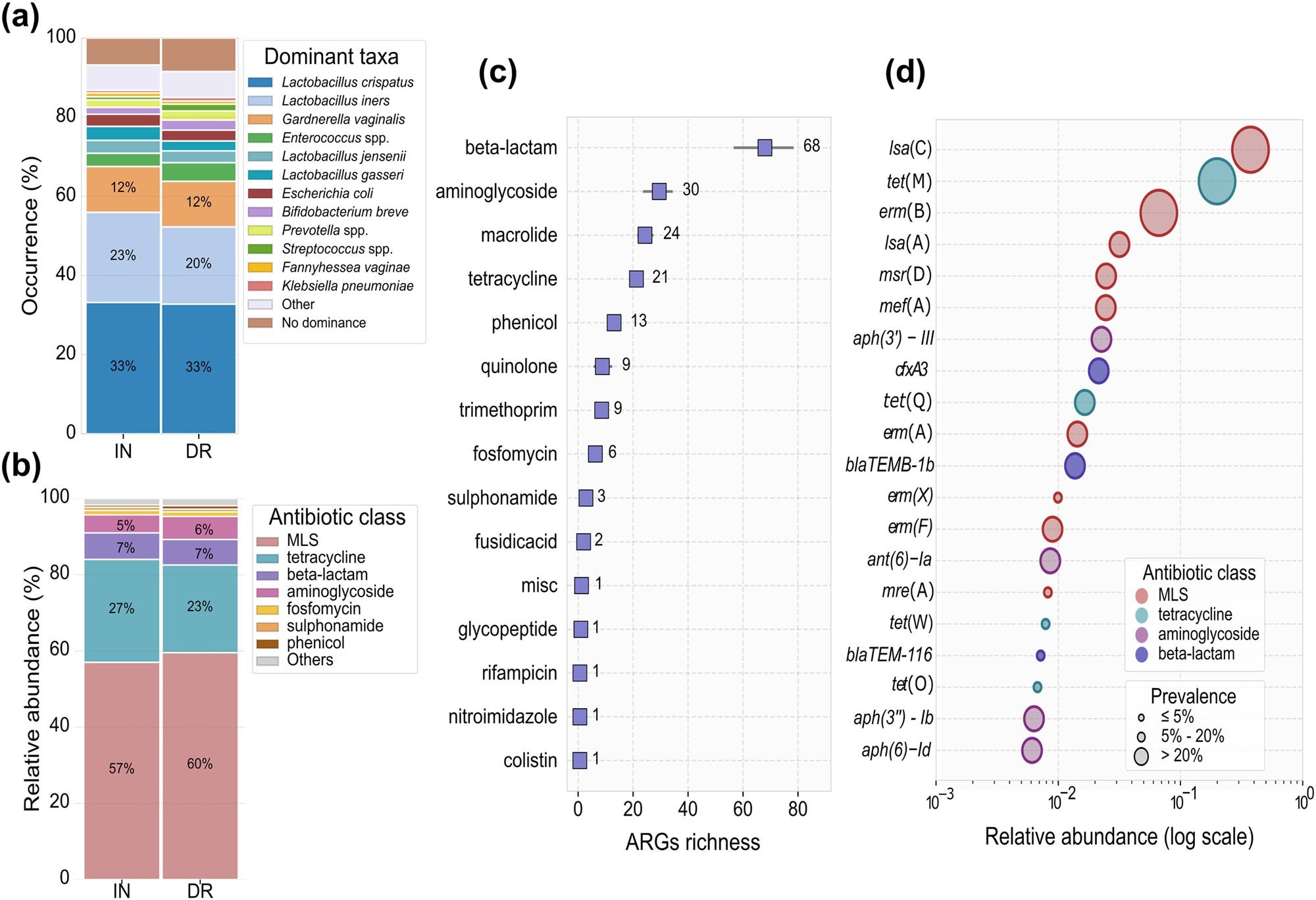
Dominant taxa and ARGs distribution. a Prevalence of microbial profiles based on the dominant taxa in inclusion (IN) and during delivery (DR) samples, displayed as the proportion of samples in which each taxon is dominant. Taxa were classified as dominant if they constituted ≥ 30% of the profile. ‘other’ refers to the number of samples with a different dominant taxon; ‘No dominance’ refers to the number of samples where no single species reached at least 30%. b Distribution of the top seven antibiotic classes across IN and DR ARG-positive samples. MLS refers to Macrolide-Lincosamide-Streptogramin antibiotic class (c) Average richness (number of unique resistance genes) per antibiotic class in all ARG-positive samples. Numerical values indicate average richness per class, with 90% confidence intervals. d Prevalence and mean relative abundance per sample of the top 20 ARGs in all ARG-positive samples. Each bubble represents one ARG; horizontal position shows the mean relative abundance (log scale); bubble size reflects prevalence, and color corresponds to antibiotic class.
Conclusions
The present study provides a large metagenomic characterization of the relationship between vaginal bacterial community structure and the gestational resistome. Its findings indicate that while L. crispatus-dominated communities are associated with a comparatively low burden of acquired ARGs and MGEs, L. iners-dominated CST III and anaerobe-rich CST IV communities harbor greater ARG and MGE diversity.
These findings represent significant progress in researchers’ understanding of the ecological factors associated with antimicrobial resistance during pregnancy. However, PRDI reflects predicted annotated resistance phenotypes rather than measured resistance and cannot yet be used to inform treatment decisions. Because the analysis focused on well-characterized acquired ARGs, it may also underestimate the full range of resistance determinants in the vaginal microbiome.
Future studies should clarify how maternal antibiotic exposure shapes the vaginal resistome and determine whether resistance genes can be transmitted vertically to newborns.
 Sugar-rich foods may worsen antibiotic-related gut disruption