From intermittent fasting to ketogenic diets and higher protein intake, a new scientific position stand examines how different weight-loss strategies affect body fat, muscle mass, and long-term results.
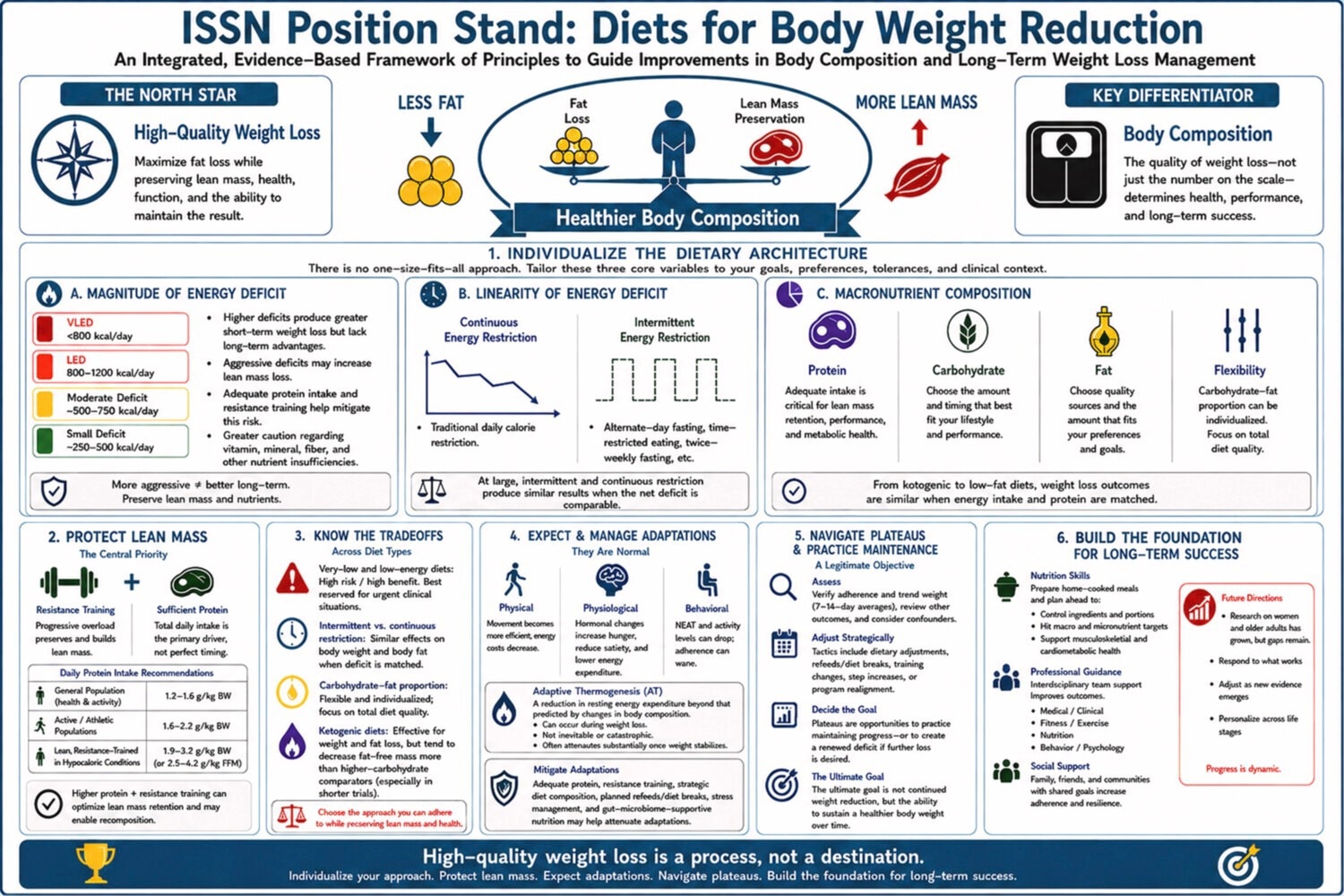
Diets for body weight reduction: position stand summary of principles & practical applications. Integrated overview of evidence-based principles for high-quality weight loss, emphasizing individualized dietary approaches, lean mass preservation, management of adaptations and plateaus, and the behavioral and support strategies underlying long-term weight management. Figure designed with assistance from ChatGPT (OpenAI).
A recent position paper published in the Journal of the International Society of Sports Nutrition outlines the International Society of Sports Nutrition (ISSN)’s recommendations for dietary weight loss. The paper highlights sustained calorie deficits, adequate protein intake, resistance training, and meal planning, while discussing low-fat, ketogenic, and low-carbohydrate diets.
Obesity prevalence has increased worldwide over recent decades. Given associations between obesity and an increased risk of non-communicable diseases, including cardiovascular disease, diabetes, stroke, and some cancers, there is an urgent need for recommendations and guidelines to reduce body weight through diet, exercise, and a healthy lifestyle. Weight reduction may confer several health benefits, including improved glycemic control, mobility, and gut microbial diversity, as well as decreases in triglyceride (TG) levels, blood pressure, joint pain, depressive symptoms, and cardiovascular mortality risk.
About the paper
The ISSN position stand discusses dietary strategies to reduce body weight and fat mass while preserving lean mass in generally healthy, physically active, or athletic adults. It also draws on clinical research involving people with overweight or obesity, which may not directly apply to lean athletes. It does not cover acute dehydration, glucagon-like peptide-1 receptor agonist (GLP-1RA) medications, and bariatric surgeries.
The researchers searched Google Scholar and PubMed databases through 7 August 2026 for relevant records, prioritizing meta-analyses, systematic reviews, and randomized controlled trials (RCTs), supplemented by controlled feeding and mechanistic studies. Manual searches of reference lists provided additional records. The researchers appraised the evidence qualitatively, without a formal GRADE assessment.
Key Findings of the Position Paper
Diets for weight reduction differ in their proportions of protein, fat, and carbohydrates, the size of the calorie deficit, and whether restriction is continuous or intermittent. Health professionals should tailor these factors to individual goals, preferences, and tolerances.
Diets providing 800–1,200 kcal per day (low-energy diets or LEDs) or fewer than 800 kcal per day (very-low energy diets or VLEDs) typically produce greater initial weight loss but do not consistently achieve better long-term results than less restrictive diets. VLEDs are mainly used for clinical weight management in people with obesity, may require medical supervision, and are unsuitable for normal-weight individuals. Sufficient protein intake, combined with strength training, may help preserve lean mass.
Healthcare providers should monitor potential deficiencies in fiber, minerals, and vitamins. Recent studies suggest that severe calorie restriction may also reduce bone mineral density and cause headaches, dizziness, constipation, and muscle weakness or fatigue. These findings show the importance of balancing the pace of weight loss with nutritional adequacy and lean mass preservation, rather than focusing on changes in body weight alone.
Intermittent fasting (IF), including time-restricted eating (TRE), twice-weekly fasting (TWF), and alternate-day fasting (ADF), has not consistently outperformed continuous energy restriction (CER) for anthropometric outcomes. The quality of carbohydrates, fats, and proteins also matters for maintaining metabolic health and healthy body composition.
Meal frequency has little influence on weight and fat loss when total daily nutrition remains similar. Physically active individuals may benefit from distributing their protein intake over at least three protein-rich eating occasions to preserve lean mass and maintain performance during calorie restriction. Still, the total amount of protein consumed each day is more important than its distribution across individual meals.
In general, consuming 1.2 to 1.6 g per kg body weight per day may support physical activity, promote fat loss, and benefit cardiometabolic and musculoskeletal health. Higher intakes of 1.6 to 2.2 g per kg body weight per day alongside strength training may support muscle growth and preservation. In lean, resistance-trained individuals following a calorie-restricted diet, 1.9 to 3.2 g per kg body weight per day may help preserve lean mass. For people with obesity, the authors advise calculating these amounts from ideal or target body weight rather than current weight. High protein intake may promote satiety, reduce the consumption of other macronutrients, and increase energy expenditure.
Individuals can tailor their carbohydrate-to-fat intake to their preferences and weight-loss goals, as low-fat and ketogenic diets show similar overall performance when calorie and protein intakes are matched. Ketogenic diets may reduce body fat, but they can also cause greater fat-free mass (FFM) loss, particularly in short-term interventions, when initial weight reduction partly reflects water loss and changes in glycogen stores. These changes do not necessarily reflect equivalent muscle loss. Ketogenic diets may also raise low-density lipoprotein (LDL) cholesterol, making dietary fat quality an important consideration.
Weight loss triggers physiological and behavioral adaptations that reduce energy expenditure and counter the calorie deficit. Adaptive thermogenesis (AT) is a reduction in resting energy expenditure (REE) beyond what would be expected from changes in body composition. It does not affect everyone and may diminish once weight stabilizes. Strategies to manage weight-loss plateaus include dietary and exercise adjustments. Periods of weight stability can also help people practice maintaining their progress. Weight loss may increase ghrelin and reduce appetite-suppressing hormones, potentially increasing hunger, while progressive resistance training can increase lean mass even as fat mass declines.
Monitoring body composition and anthropometric measures, rather than scale weight alone, can help track progress. Suggested body fat percentage ranges are approximately 11%–22% for men and 20%–35% for women. These are approximate reference ranges, not universal targets, and excessive leanness can increase health risks.
Interdisciplinary efforts and social support may improve weight-management outcomes. Preparing meals at home and planning them ahead can help individuals manage their diet and maintain a healthy weight and composition.
Conclusion
The ISSN position paper identifies sustained calorie restriction as the basis of weight loss, with lean mass preservation a major goal. Adequate protein and resistance training can help preserve lean mass, while flexible meal patterns allow individuals to adapt dietary strategies to their preferences. Combining these approaches with meal planning, professional guidance, and social support may help individuals maintain weight loss while preserving muscle mass, physical performance, and metabolic health.
Source:
Journal reference:
 A New Approach to Preventing Bladder Cancer Recurrence