Bulk and single-cell RNA sequencing (scRNA-seq) appeared almost simultaneously, with the first bulk RNA-seq study published in 2008 and the first single-cell publication only a year later.1,2
Image Credit: Kateryna Kon/Shutterstock.com
While bulk sequencing quickly became the preferred method, scRNA-seq has increased in popularity over the last decade.
In 2015, just 6 % of RNA-seq papers used single-cell methodologies. By 2025, the proportion had increased to more than a third,3 and a wide range of strategies for capturing and analyzing single-cell transcriptomes are now established.
This article will outline the three basic types of scRNA-seq methods: plate, droplet, and microwell based, and explain how each works.
Plate-based methods
The early scRNA-seq approaches were plate based, with individual cells sorted into separate wells for processing.
SMART-seq (switching mechanism at the 5' end of RNA template sequencing) is an early plate-based sequencing technique (Figure 1). It employs a flow cytometer to sort single cells into 96 or 384 well plates.
After sorting, the cells are lysed, and the RNA sequences are reverse transcribed, amplified, and produced as sequencing-ready libraries. The first SMART-seq procedures lacked unique chemical barcodes that could be used to assign sequencing data to specific cells.
As a result, libraries from each cell had to be created and sequenced individually. Over time, the approach has evolved, and SMART-seq3 now includes cell-specific barcodes during library preparation.
This breakthrough enables the pooling, combined processing, and simultaneous sequencing of numerous cells, resulting in a more efficient workflow and higher throughput.4
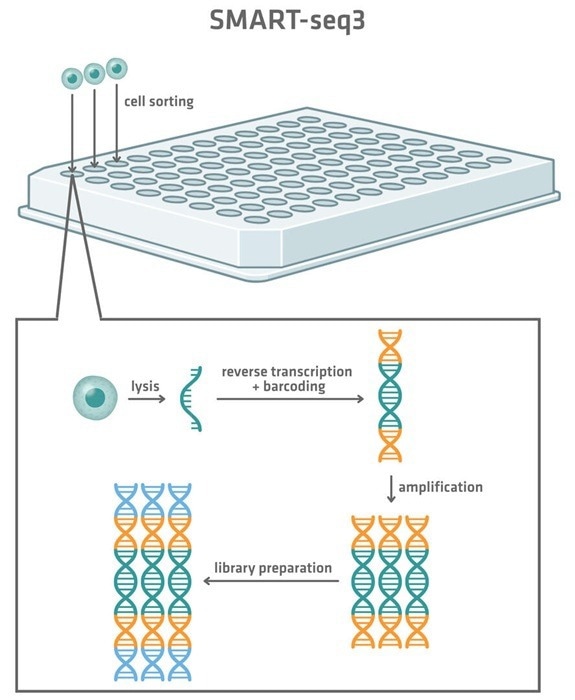
Figure 1. In the SMART-seq3 protocol, cells are lysed, and the RNA sequences are reverse-transcribed, amplified, and prepared into sequencing-ready libraries. Image credit: INTEGRA Biosciences
CEL-seq (cell expression by linear amplification and sequencing) is a plate-based technology that allows the pooling and combined sequencing of RNA sequences from many cells from the start of the process. Individual cells are separated into microwells and then lysed.
A unique barcoded primer is always used for reverse transcription of the RNA into cDNA, allowing the cDNA from all wells to be pooled before amplification and sequencing platform-specific adaptor ligation.
More recent plate-based scRNA-seq approaches use combinatorial indexing to barcode the genetic material of individual cells (Figure 2). These approaches identify each cell with a longer combinatorial barcode made up of multiple shorter barcodes. This is how the technique works:
- Cells are fixed and permeabilized for reagent flow. These can serve as reaction compartments in the next steps.
- Cells are sorted into wells on a 96, 384, or 1,536 well plate. Each well can accommodate several cells.
- Each cell's RNA is reverse transcribed and barcoded with a unique barcode.
- Cells are pooled, mixed, and redistributed into a new plate with 96, 384, or 1,536 wells.
- In the second plate, each cell's cDNA is identified by a unique barcode. This combination of barcodes allows sequencing readings to be attributed to individual cells.
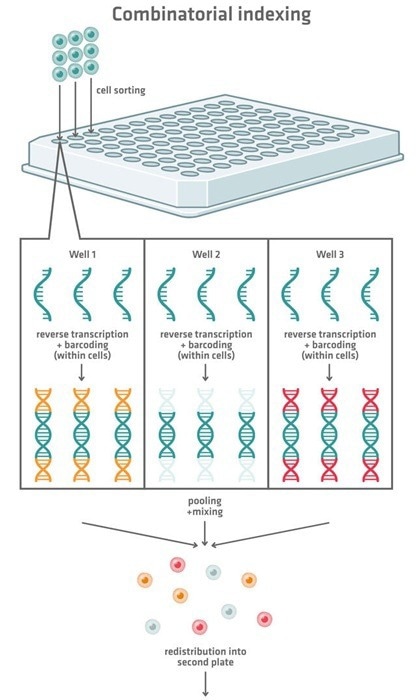
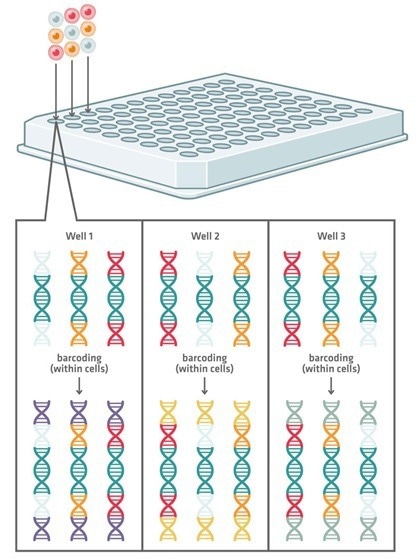
Figure 2. Combinatorial indexing scRNA-seq uses successive rounds of well-specific barcoding across multiple plates, generating unique barcode combinations that allow sequencing reads to be traced back to individual cells. Image credit: INTEGRA Biosciences
The number of cells to be sequenced determines whether this approach uses 96, 384, or 1,536 well plates. Working with 96 well plates yields around 10,000 potential well combinations.
If approximately 1,000 cells are to be sequenced, the chances of two cells ending up in the same well on both plates is slim.
Increasing the number of wells being dealt with increases the number of potential combinations, allowing more cells to be barcoded while reducing the probability of two cells receiving the same barcode combination.
For example, while working with 1,536 well plates, there are approximately 2.4 million possible combinations. If this is not enough, a third and fourth round of barcoding could be added.
Parse Biosciences is a firm that provides combinatorial indexing for single-cell sequencing. Its Evercode™ technology can process up to one million cells and 96 biological samples simultaneously and integrates flawlessly with INTEGRA’s ASSIST PLUS pipetting robot.
While SMART-seq3 and CEL-seq have limited throughput, combinatorial indexing schemes greatly improve scalability.
The microfluidic droplet- and microwell-based approaches described below are often preferred for high-throughput experiments due to their increased miniaturization, which results in a reduced sequencing cost per cell. Despite this, plate-based approaches continue to be popular due to their improved sensitivity.
Droplet-based methods
Droplet-based single-cell sequencing approaches employ microfluidics equipment (Figure 3). This article outlines the methodologies used by DropSeq and 10x Genomics Chromium in greater detail.4
Both methods begin by combining cells with beads that contain unique barcodes. This aqueous solution is then mixed with oil to form an emulsion of thousands of nanoliter-sized droplets, each of which ideally contains one cell and one bead.
When cells are lysed, their RNA molecules are released and hybridize with the barcoded bead inside each droplet. The DropSeq technology breaks down the emulsion and reverse transcribes all of the RNA molecules bound to the beads.
In comparison, in the 10x Genomics Chromium technique, the beads are reverse transcribed before the emulsion is broken down. Both procedures amplify the resultant cDNA and transform it into sequencing-ready libraries. Following sequencing, reads can be assigned back to individual cells using bead-derived barcodes.
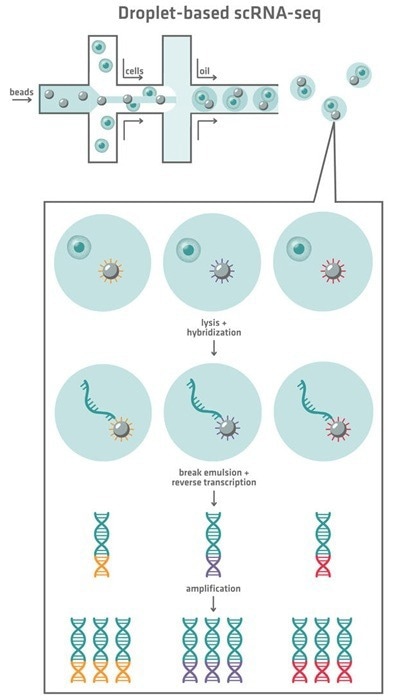
Figure 3. In droplet-based scRNA-seq, individual cells are encapsulated with barcoded beads in oil droplets, enabling cell lysis, RNA capture, reverse transcription, and amplification to generate uniquely barcoded cDNA for each cell. Image credit: INTEGRA Biosciences
Ideally, the emulsion produced by microfluidics systems should contain only droplets with one cell and one bead. In actuality, there will be empty droplets, droplets with only one cell or bead, and droplets with two or more cells or beads.
Empty droplets or droplets containing just one bead do not affect the quality of sequencing data, whereas droplets containing only cells reduce sequencing output. Droplets including a cell and many beads, or multiple cells and a bead, are the most difficult.
If a single cell's RNA molecules hybridize with many beads, readings from that cell may be incorrectly allocated to multiple cells. On the other hand, if RNA molecules of several cells hybridize to a single bead, the reads from those cells can be allocated to the same cell. This is why droplets containing more than one cell or bead should be avoided.
The distribution of beads and cells is random when using the DropSeq microfluidics device, which was the first droplet-based technology. This means that both cells and beads must be supplied at low concentrations to avoid forming an excessive number of droplets containing one or more cells or beads.
The later-released 10x Genomics Chromium was designed so that most droplets contained exactly one bead, enhancing efficiency and allowing beads to be loaded at larger concentrations.
Cells must still be loaded at low concentrations, however, to avoid having two cells encased in a single droplet, unless computational approaches are used to identify and delete doublets (microwells containing more than one cell) from the sequencing data.
One such technique is antibody labeling. This involves binding an antibody to a universal surface antigen and labeling different aliquots of this antibody with separate barcodes, before mixing each aliquot with a sample. This allows each sample to be uniquely labeled before pooling.
When pooled samples are introduced into the microfluidics system, doublets are likely to form from separate samples. They should consequently have unique antibody barcodes, enabling the elimination of these sequencing reads from data processing.
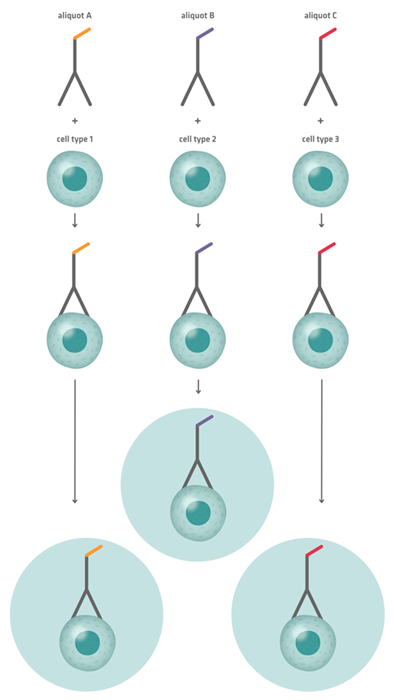
Figure 4. Antibody labeling strategies, in which aliquots of a universal antibody are barcoded and mixed with separate samples before pooling, can be used to identify and exclude doublets from analysis. Image credit: INTEGRA Biosciences
Microwell-based methods
A third single-cell sequencing technique isolates individual cells using microwells rather than droplets. Microwell plate systems involve the loading of a chip with hundreds of thousands of small wells with individually labeled beads. As the beads settle, they normally occupy an individual well.
The chip can then be loaded with cells, which should ideally settle in separate wells. The following steps are quite similar to droplet-based methods: cells are lysed, RNA molecules hybridize to the bead and are reverse transcribed, and the resultant cDNA is amplified and ready for sequencing.
During sequencing, all cDNA fragments can be pooled because the uniquely labeled beads will have tagged the genetic material from each cell with a unique barcode.
Doublets can also cause problems with microwell-based approaches. To increase the number of cells loaded per chip, the same computational techniques used for droplet-based methods should be employed to remove doublets from sequencing data.
The primary distinction between droplet- and microwell-based approaches is how cells are isolated: either in droplets or in wells on the chip.
For microwell platforms, customized chips can raise sequencing costs per cell, and the chip size can limit throughput, resulting in slightly smaller sample quantities than droplet-based systems.
These chips offer more control over cell capture, meaning they are better suited for low-volume and valuable samples. Droplet-based approaches, on the other hand, necessitate a significant initial investment in microfluidics equipment, rendering them less cost effective for smaller investigations.
Conclusion
From plate-based techniques to the introduction of droplet and microwell devices, scRNA-seq methods have steadily increased the opportunities for examining gene expression at the cellular level.
Each strategy uses various principles for isolating and barcoding single cells, but they all have the same goal: to allow researchers to collect transcriptomes at the single-cell resolution. The advantages and disadvantages of each strategy are listed in the table below.
Source: INTEGRA Biosciences
| |
Plate-based
scRNA-seq |
Droplet-based
scRNA-seq |
Microwell-based
scRNA-seq |
| Throughput |
Lowest, although combinatorial indexing
improves scalability |
Highest |
Intermediate |
| Cost per cell |
Highest, due to greater reagent consumption |
Lowest, due to microfluidics
miniaturization |
Intermediate |
| Sensitivity |
Highest |
Lower than plate-based |
Lower than plate-based |
| Workflow |
Flexible but labor intensive (involves manual cell sorting and numerous pipetting steps) |
Highly automated, but requires expensive microfluidics equipment |
Partially automated |
| Best for |
Smaller-scale, in-depth studies |
Large-scale studies |
Medium- to large-scale studies |
References
- Mortazavi, A., et al. (2008). Mapping and quantifying mammalian transcriptomes by RNA-Seq. Nature Methods, 5(7), pp.621–628. DOI: 10.1038/nmeth.1226. https://www.nature.com/articles/nmeth.1226.
- Tang, F., et al. (2009). mRNA-Seq whole-transcriptome analysis of a single cell. Nature Methods, 6(5), pp.377–382. DOI: 10.1038/nmeth.1315. https://www.nature.com/articles/nmeth.1315.
- Pierre, L.T. (2023). Writing a Successful Single Cell RNA Sequencing Grant Proposal. Parse Biosciences. Available at: https://www.parsebiosciences.com/blog/successful-single-cell-grant-proposals.
- iBiology Techniques (2021). Single Cell Sequencing - Eric Chow (UCSF). Available at: https://www.youtube.com/watch?v=k9VFNLLQP8c.
Acknowledgments
Produced using materials originally authored by Stefan Zeyen from INTEGRA Biosciences.
About INTEGRA Biosciences
INTEGRA provides innovative solutions for liquid handling and media preparation applications that serve the needs of its customers in research, diagnostics, and quality control laboratories.
Its instruments and plastic consumables are developed and manufactured in Zizers, Switzerland, and Hudson, NH, USA. To remain close to its customers, INTEGRA maintains a direct sales and support organization in several North American, European, and Asian countries, as well as a network of over 100 highly trained distribution partners worldwide.
In recent years, INTEGRA has focused on developing a new and technologically advanced range of lab devices that are simple to use and meet the ergonomic needs of its customers.
Today, the company is proud to offer the widest range of electronic pipettes on the market, covering everything from single-channel pipettes to 384 channel benchtop instruments.
Sponsored Content Policy: News-Medical.net publishes articles and related content that may be derived from sources where we have existing commercial relationships, provided such content adds value to the core editorial ethos of News-Medical.net, which is to educate and inform site visitors interested in medical research, science, medical devices, and treatments.