Sponsored Content by BenchlingReviewed by Ify IsiborJul 15 2026
It typically requires around 10 years and millions to sometimes billions of dollars for most new pharmaceuticals to reach the market. Predictably, this timeframe and cost structure is insufficient for drug development participants, companies, and clinical trial sponsors. One of the earliest phases that can be refined is DNA construct development for early drug discovery, as it influences all subsequent procedures.
A fundamental first step in drug discovery involves recombinant protein production. The expression and purification of the desired target protein enable candidate drug assessment and also structural and mechanistic examinations that guide the formulation and appraisal of candidate drugs. Subsequently, cell lines are modified and utilized in in vitro evaluations to assess toxicity and confirm a candidate drug's mechanism of action. These initial tests are crucial for the prompt elimination of ineffective and harmful drugs before billions of dollars are expended on clinical trials destined for failure.
DNA constructs – artificially created vectors or plasmids that deliver target DNA sequences into cells, where the gene product is then manufactured – are foundational to recombinant protein production and cell line modification. The rapid and adaptable creation of these constructs at scale is one of the most restrictive initial stages in drug discovery. A significant time drain associated with this process is the de novo synthesis of extended coding sequences, a predicament that modular cloning kits have not effectively resolved.
To address this, AstraZeneca devised a comprehensive DNA assembly architecture, which they incorporated into Benchling to facilitate swift, economical, and scalable construct creation. Their distinctive approach requires an unprecedented three weeks and led to financial savings from 50% to 90%.
Fragment recycling substantially reduces DNA synthesis duration and expenditures
AstraZeneca’s innovation is an elegant amalgamation of multiple software platforms and automation, spearheaded by Associate Principal Scientist David Öling and his cohort in Sweden. This team provides the majority of DNA constructs utilized by AstraZeneca's units throughout Sweden and the U.K.
Öling’s group began by optimizing a Golden Gate assembly-based method for constructing DNA constructs. They formulated and validated 19 distinct modules that are adequate for most complex constructs. Nevertheless, the cornerstone of AstraZeneca’s success resides in how the segments that are plugged into those modules to fashion the complete construct are identified, generated, and assembled.
Conventionally, a considerable portion of synthesis time and expense is dedicated to DNA sequences present repeatedly within a construct, as those sequences must be ordered individually as many times as they appear. To overcome this challenge, Öling and his team partnered with the computational biology division at AstraZeneca to develop what he terms “a workaround for the entire DNA synthesis sector” – an algorithm for fragment recycling designated FRAGLER (FRAGment recycLER).
Fragment recycling pinpoints shared coding sequence regions across the construct, ensuring those sequences are ordered only once, thereby lowering both the cost of DNA synthesis and the time needed to produce DNA fragments. FRAGLER not only performs amino acid sequence alignment and codon optimization of sought-after sequences but also fragments those sequences to enhance the likelihood of successful DNA production. Fragmentation of lengthy sequences into shorter portions of 300-900 base pairs diminishes synthesis time and guarantees production success, according to Öling. Moreover, fragmentation eradicates sequence intricacies and minimizes cancellations, which are very common for longer sequences.
To exemplify FRAGLER’s functionality, AstraZeneca utilized its software solution to rapidly produce elaborate SARS-CoV-2 spike protein constructs for expression enhancement (Figure 1). The spike protein coding sequence was segmented into four sub-modules, which could then be combined with various signal peptides and trimerization domains. The resultant constructs were expressed in HEK293 cells. FRAGLER was also employed to fragment 30 full-length SARS-CoV-2 spike protein variations, yielding 55 unique fragments and recycling 11 fragments 65 times – a base pair recycle rate of 55.3%.
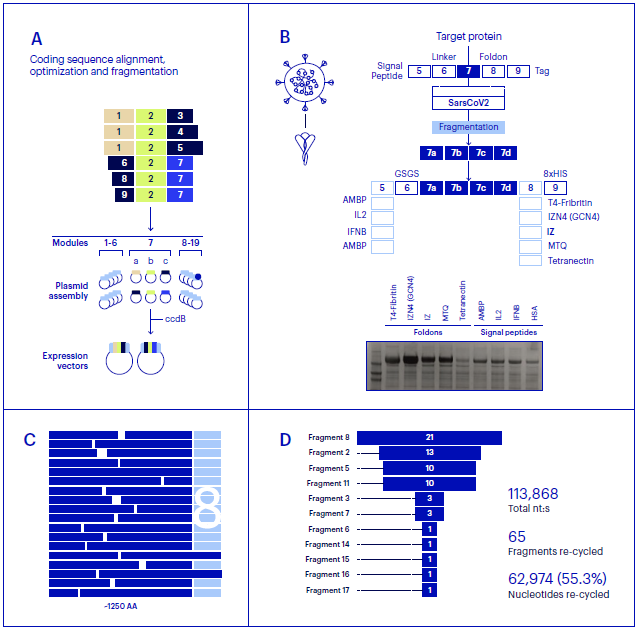
Figure 1. FRAGLER enables rapid generation of SarsCoV2 expression constructs. A) Sequence alignment, codon optimization, and fragmentation performed by FRAGLER which runs in Benchling to algorithmically search pre-existing DNA sequences. B) Top: Schematic of the coronavirus spike protein, with module 7 fragmented into four submodules (a, b, c and d) to reduce production timelines. Submodules are combined with various signal peptides (module 5) and trimerization domains (module 8) (top). Bottom: Coomassie-stained gel from a small-scale purification of HIS-tagged spike protein constructs and expression in Hek293 cells. C) Schematic of SARS-CoV-2 spike protein (PODTC2) alignment and fragmentation with the top 30 hits from Uniprot (90% identity) listed. D) Top: Graphical representation of recycled fragments. Bottom: Total number of recycled nucleotides and fragments. Image Credit: Benchling
According to Öling, the savings provided by this methodology equate to at least a 50% reduction in costs, and occasionally even more, contingent on the constructs. For instance, a substantial portion of the DNA can be reutilized when conducting single-point mutations across a hundred constructs, yielding cost reductions upward of 80-90%. These extended, complex constructs were rapidly fabricated through the fragmentation approach.
Integration with Benchling unleashes the scale-up potential of a fully automated pipeline
While FRAGLER can and has been operated offline, offline deployment does not offer the magnitude of scale that AstraZeneca required. Although sequence fragmentation and fragment recycling can significantly decrease expenses, that strategy realizes its full benefit only if the fragments to be reused can be located. Öling elaborates, “There needs to be an algorithmic search to properly identify preexisting fragments for FRAGLER to align. No human can keep track of everything if thousands of constructs are generated annually. Benchling allows us to achieve speed and scale by transforming previously manual processes relying on Excel and various in-house tools into fully automated steps.”
By utilizing Benchling’s developer platform, the Benchling team constructed an integration to fully automate the process of generating de novo fragments. It also permits rapid exploration of the Benchling repository across thousands of existing fragments to create fully assembled in silico constructs.
Through the integration of FRAGLER into Benchling, pre-existing fragments are identified and gathered for the multiple sequence alignment and fragmentation phases. Benchling also generates pooling directives for the resulting fragments that are employed for construct assembly. Files containing details about the pools and their corresponding construct(s) can then be re-entered into the platform.
Furthermore, Benchling aids in QC procedures, such as monitoring plasmid purity and concentration. The consequence for AstraZeneca is increased throughput combined with high assurance in data quality, given that Benchling serves as the definitive record for each step.
AstraZeneca created an internal design and request portal to allow global teams throughout Sweden and the U.K. to request constructs. Similar to FRAGLER, this portal was readily integrated with Benchling via the developer platform and open APIs. The complete process of DNA construct generation, from initial request to sequence-verified plasmid, is automated and can be finished in approximately three weeks, in contrast to the 4-8 weeks previously needed by leveraging the synergistic combination between FRAGLER and Benchling (Figure 2). This represents a timeline that no DNA synthesis supplier can match, according to Öling, particularly for lengthy, intricate sequences like SarsCoV or Cas9 expression constructs.
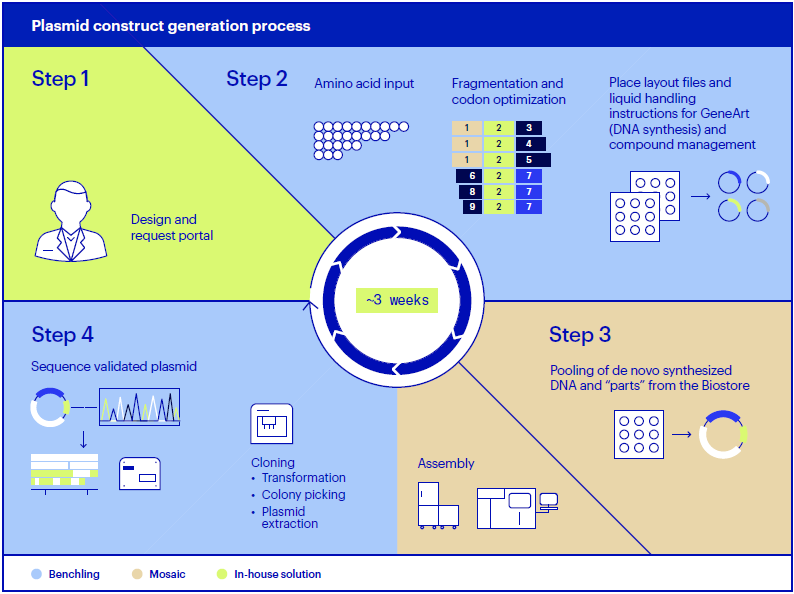
Figure 2. Automated plasmid generation workflow. Step 1. Multiple Amino acid sequences are requested via an in-house design and request web-portal. Step 2. Sequences are bioinformatically processed (FRAGLER) and synthesized. Step 3. In-house DNA fragments from the Biostore are combined with de novo synthesized fragments and assembled using an ECHO 655T integrated on an Access system. Step 4. The assembly mixture is cloned and single colony-derived plasmids are extracted using Biomek i7 with an integrated colony picker. Plasmids are validated by Sanger sequencing. Image Credit: Benchling
“The first time you run a campaign, FRAGLER will identify duplicate DNA sequences and help you save up to 50% of the cost of synthetic DNA synthesis by enabling fragment recycling,” says Öling. “But for each campaign after that,” he continues, “there is an estimated 10-30% additional cost reduction per iterative cycle, as more and more fragments are recycled and reused with each campaign. Eventually, most DNA fragments will be available in-house, meaning that you’ll reach nearly zero cost for generation of new synthetic DNA constructs. This, of course, can only be fully realized by the automated sequence search in Benchling, as manual searches for duplicate sequences at this scale are impossible.”
Delivering a fully automated laboratory ecosystem
“Plasmids are critical for so many processes in early drug discovery,” states Öling. “They’re critical for protein production, cell line engineering, CAR-T cell therapy, viral vector generation, therapeutic genome editing, mRNA/Vaccine production and more.”
The time and cost of producing them constitute a critical limiting factor. When it comes to automation coupled with a fragmentation algorithm, AstraZeneca is the singular team executing this at such a magnitude. Benchling facilitated its realization by streamlining workflows, eliminating time-consuming manual analyses, adding structure to sample management, and standardizing their entire operational flow.
While Öling’s team has employed Benchling for DNA construct assembly, he suggests it is easily conceivable to utilize Benchling for other design, discovery, or workflow transition points. The most time-intensive element was configuring the entire workflow, Öling commented, adding that the familiarity with Benchling was acquired very quickly. There are several appealing things about Benchling – it’s cloud based, intuitive, has good DNA assembly tools, and is super easy to get into,” he said.
Other groups within AstraZeneca have also indicated interest in leveraging Benchling for their own processes. Öling is coordinating with Benchling to implement a mechanism for tracking timelines and cost savings from their automated DNA construct assembly platform directly within Benchling.
About Benchling
Benchling makes biotech research and development faster and more collaborative. Biotechnology has the potential to solve humanity’s most pressing challenges, such as disease, renewable energy, clean water, and hunger. The brightest minds are working on these problems but they are equipped with archaic tools. We aspire to fix this and increase the rate of scientific output with a web-based platform that allows researchers to design and run experiments, analyze data, and share results.
Hundreds of thousands of scientists all around the world use Benchling to do research. Whether they are at the world’s largest companies, the top research universities, or working on a startup in a garage, scientists use Benchling for the same reason: to be empowered, not encumbered, by their tools.
Sponsored Content Policy: News-Medical.net publishes articles and related content that may be derived from sources where we have existing commercial relationships, provided such content adds value to the core editorial ethos of News-Medical.net, which is to educate and inform site visitors interested in medical research, science, medical devices and treatments.