For the first time, 41,506 blind and visually impaired children in the UK could benefit from a breakthrough that will make block coding accessible for them.
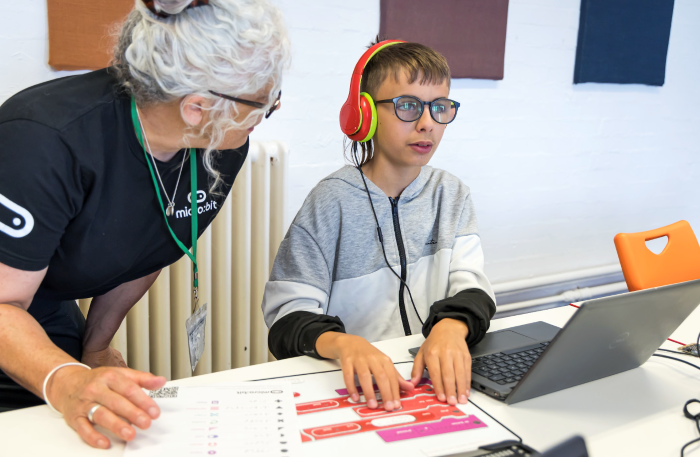 Zac Herbert, a 14-year-old pupil at New Worcester College in Worcester. Image Credit: Micro:bit Educational Foundation
New screen reader compatibility has launched today in Microsoft MakeCode, removing barriers that have long prevented many blind and low vision pupils from taking part in block-based coding alongside their classmates. Developed in partnership with Micro:bit Educational Foundation and the Blockly team at the Raspberry Pi Foundation, the new functionality is supported by classroom resources to help teachers bring coding to more children.
The technology was co-designed with children and young adults aged 8 to 18 who are blind or have low vision, alongside teachers who support them and experts in this field. Their feedback shaped every stage of development, helping create a solution that reflects the real barriers some young people face in the classroom. With input from people across the UK, Europe and the United States, the technology will make coding more accessible for future generations of learners around the world.
With the accessibility improvements being developed within Blockly, the technology behind many of the world's most widely used coding platforms, the impact could extend far beyond Microsoft MakeCode. It marks a major step towards making mainstream coding tools accessible to blind and visually impaired learners.
For Zac Herbert, a 14-year-old pupil at New Worcester College in Worcester, the impact has been life-changing. He said: “Up until Year 7, I wasn't actually in any computer science lessons.”
Before the new accessibility features were introduced, Zac often couldn’t take part in the same computing science lessons as his classmates because existing coding platforms weren’t accessible. Instead, he was taught separately or given alternative activities. He can now code independently alongside his peers using MakeCode and micro:bit.
He added: “It's great to have something that you've done. You haven't had to rely on another person to help you do it. You haven't had to rely on a sighted person to do it. It's your work. It's your masterpiece.”
Another student at the same school, Thomas Robb, age 12, said the technology has allowed him to move from contributing ideas to creating projects himself.
He said: “Before, me and my friends would use Scratch, but I never used to do the coding. I used to make the ideas and the sounds. If I didn't have the screen reader, I wouldn't be able to use micro:bit.”
Every child deserves the opportunity to create with technology, regardless of their ability. For too long, many blind and visually impaired young people have faced barriers to accessing the same coding experiences as their peers. By working directly with the young people most affected, we've helped remove some of those barriers and created a solution that gives many more children the opportunity to learn, create and build confidence through computing. We hope this is just the beginning of a much bigger shift towards making coding accessible for future generations of learners around the world.”
Lucy Gill, Head of Product, Micro:bit Educational Foundation
Jacqueline Russell, Product Manager at Microsoft, added: “This has really been a super collaborative project between the Micro:bit Educational Foundation, Blockly, and our team with user input and feedback driving our progress all along the way.I feel so proud of this milestone - taking what was a purely visual, mouse-heavy user interface and transforming it into a fully accessible tool for all students to learn computing.”
Used by more than 70 million children across 85 countries, the BBC micro:bit is one of the world's most widely adopted educational technologies. With the new screen reader developed in Blockly, this breakthrough will also be available for other coding platforms to adopt, extending its impact far beyond the micro:bit and helping even more children benefit from accessible coding.
This launch marks just one step in the Micro:bit Educational Foundation’s ambition to make technology accessible to every child. From expanding accessibility for children who are deaf or hard of hearing, have fine motor challenges or are neurodiverse, to developing new learning resources and working with local translators to increase global access, the Foundation continues to work with funding partners to remove barriers for the next generation of learners and creators.
 Hydroxyurea does not increase infection risk in children with sickle cell anemia