Sponsored Content by BenchlingReviewed by Ify IsiborJul 15 2026
R&D teams frequently ask why they need Benchling AI agents when they already have access to an enterprise AI assistant through their company agreement and can connect it to Benchling via MCP.
Enterprise AI assistants have broad context across biology, chemistry, and pharmaceutical discovery. This breadth is useful for general scientific questions, literature synthesis, and communication tasks. However, broad context is not the same as understanding an organization’s science.
What enterprise AI assistants cannot access is the scientific record that R&D organizations have built in Benchling: the experimental plan, what was actually accomplished, the outcome, and what the team decided to do next. That complete trace, from hypothesis to results, connected across sequences, batches, assay runs, notebook entries, and workflows, is what makes R&D data beneficial for an AI. It is stored in Benchling in a structured, connected format that cannot be preserved by a text export.
The problem: R&D knowledge is trapped
R&D organizations produce significant amounts of data. A single pharmaceutical program can generate thousands of experiments, hundreds of assay runs, and structured result tables that accumulate over years. This information holds substantial value, both as a record of what occurred and as context for future decisions.
The challenge is that most of that data is not quickly accessible. When researchers must answer a question such as "What is the best-performing construct from our Q3 CRISPR screen, and how does it compare to what we tried in 2022?" the process is often still manual. They search, scroll, ping a colleague, and export to Excel. While the answer usually lies there somewhere, finding it takes more time than it should.
The consequences compound: researchers re-run experiments that have already been performed, cross-experiment questions that should take one hour last a week, and institutional knowledge disappears when team members leave.
In addition to faster search, R&D teams need AI to synthesize findings across experiments, surface anomalies in assay data, support hypothesis generation, and minimize documentation burden without leaving the environment where their science already resides.
Three gaps that enterprise AI assistants cannot bridge
When R&D teams attempt to address these requirements with an enterprise AI assistant, they encounter the same three limitations:
Context: An enterprise AI assistant does not understand an organization's data model. It does not know that the "Result" field in Assay Schema X maps to a specific numeric threshold defined by the team, or that Batch ID 2047 is downstream of a registry entry carrying a known quality flag. Without that context, responses are generic at best and misleading at worst.
Connectivity: Enterprise AI assistants only work on what is given to them. They operate on snapshots of data that were copied, pasted, or exported, instead of on the live, structured environment in which research actually takes place. Although more in-depth integrations can be built, they require substantial effort to develop and maintain.
Credibility: Researchers must know the source of an answer, the specific records it is based on, and how to validate it. Enterprise AI assistants generate outputs without native links back to the source data. In a GxP environment, this issue can create both usability issues and compliance risks.
These gaps can only be addressed by developing AI that understands the data model from the outset.
What Benchling AI Agents are actually designed to do
Benchling AI is constructed on a purpose-built agent harness designed specifically for scientific workflows. As with other agents, it relies on LLMs to reason and produce answers. What matters is what surrounds it: a scientific context layer that understands Benchling's data model, tooling that knows how to query structured and unstructured R&D data, and an orchestration system that plans and analyzes multi-step tasks before returning a response.
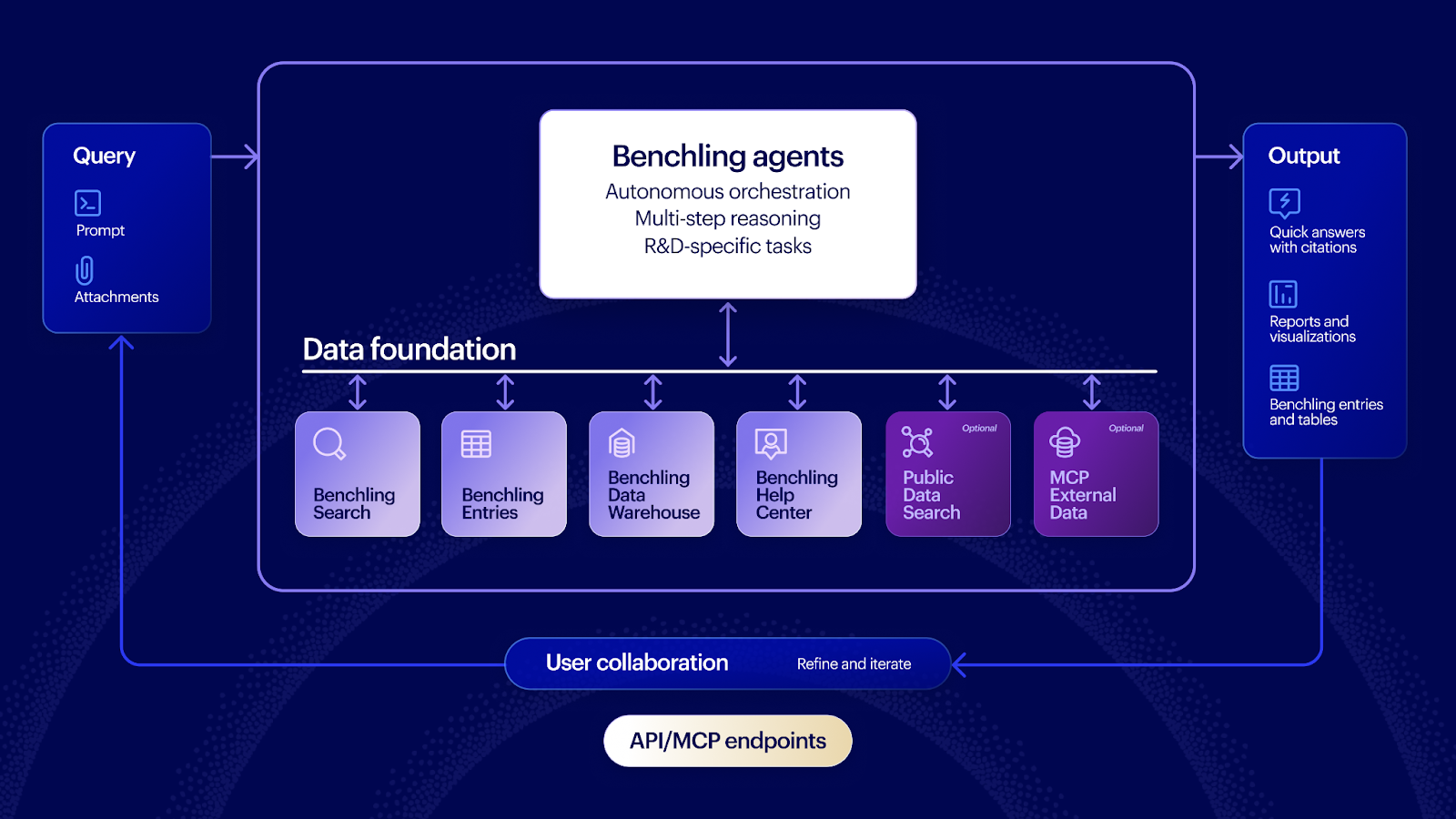
Image Credit: Benchling
Several factors differentiate Benchling agents in practice:
They reason across structured R&D data as well as documents. Both enterprise AI assistants and Benchling AI agents can read notebook entries and generate text summaries. In addition, Benchling agents can query the underlying structured data connected to those entries. When asked about an assay, a Benchling agent can read the notebook entry describing it, query the assay schema directly, filter by result threshold, join across batches, and surface the top candidates within a single response. An enterprise AI assistant working from an export can only perform the first part.
They are multi-model by design. Benchling does not utilize a single LLM for every task. Different models have different strengths, and those strengths are not evenly distributed. By choosing the best-performing model for each subtask based on internal assessments, Benchling agents can outperform what any single model could achieve on its own.
They return deep-linked results. When Ask or Deep Research returns a response, it includes direct links to the specific entities, entries, registry items, and findings it referenced. Researchers can click directly into any cited object to investigate and confirm the answer, right within the same panel of the Benchling interface. When researchers utilize an enterprise AI assistant instead, that proximity disappears, and the friction the AI was supposed to remove returns.
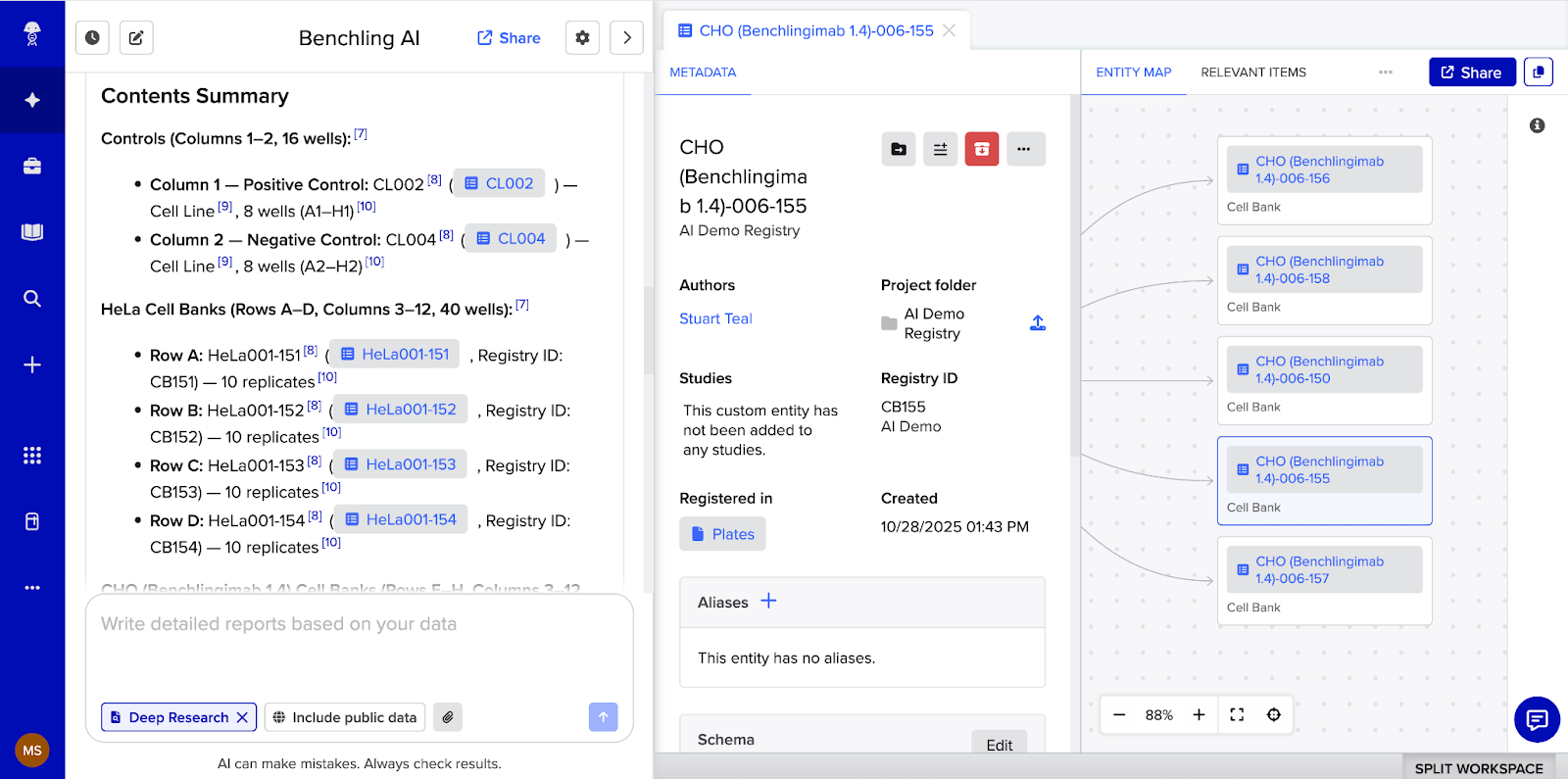
Image Credit: Benchling
Compose creates Benchling objects instead of text. When Compose produces an experiment plan or populates a data table, it does not generate text for researchers to copy and paste. It creates actual Benchling objects, notebook entries, templates, and structured tables that are populated directly within the platform with complete audit trails intact. Researchers review and verify the output before it becomes part of the organization's data environment.
What actually occurs when an enterprise AI assistant connects through MCP
When a client uses Benchling’s MCP server to connect an enterprise AI assistant to Benchling, it is not making raw API calls and passing outcomes to a general model. The company’s MCP Server calls its Deep Research and Ask agents behind the scenes, using the same dedicated prompts, the same agent harness, and the same scientific tuning.
Clients utilizing an enterprise AI assistant alongside Benchling's MCP Server are already using Benchling's agent intelligence. The key difference lies in whether those agents are used in-platform or called externally, where deep linking, navigation, and object creation are reduced.
In terms of cost, many teams assume the MCP path is more affordable than utilizing Benchling AI directly, even though it is not. Credit consumption is the same either way. The cost discussion should concentrate on the value and quality of the results, rather than on the assumption that using an external AI assistant is the less expensive option.
Open by design
If Benchling AI agents are purpose-built for the Benchling data model, does that mean clients are locked in? No.
Benchling's MCP Server allows any MCP-compatible AI instrument to query Benchling data as part of a broader workflow. The MCP Client works in the opposite direction, allowing researchers to bring data from external instruments directly into Deep Research without leaving Benchling. Open APIs across entities, assays, entries, inventory, and workflows allow data to be routed to any downstream system or AI tool as needed.
The bottom line
Enterprise AI assistants are well-suited for literature review, communication drafting, and broad scientific Q&A. However, their suitability decreases when researchers must query their data, synthesize results across experiments, and develop artifacts that become part of the scientific record.
Benchling agents are specifically designed for that navigation. They employ named entity recognition to understand scientific terminology in context, supervisor prompts tuned for R&D workflows, and clear citations tied back to the source records they queried. These mechanisms allow researchers to confirm an answer, trace it back to its origin, and apply it confidently in regulated settings.
About Benchling
Benchling makes biotech research and development faster and more collaborative. Biotechnology has the potential to solve humanity’s most pressing challenges, such as disease, renewable energy, clean water, and hunger. The brightest minds are working on these problems but they are equipped with archaic tools. We aspire to fix this and increase the rate of scientific output with a web-based platform that allows researchers to design and run experiments, analyze data, and share results.
Hundreds of thousands of scientists all around the world use Benchling to do research. Whether they are at the world’s largest companies, the top research universities, or working on a startup in a garage, scientists use Benchling for the same reason: to be empowered, not encumbered, by their tools.
Sponsored Content Policy: News-Medical.net publishes articles and related content that may be derived from sources where we have existing commercial relationships, provided such content adds value to the core editorial ethos of News-Medical.net, which is to educate and inform site visitors interested in medical research, science, medical devices and treatments.