Sponsored Content by BenchlingReviewed by Ify IsiborJul 16 2026
Since accuracy, precision, and reproducibility play essential roles in the life sciences sector, telling researchers to embrace imperfect data may seem counterintuitive.
However, the Benchling team has collaborated with more than a thousand life sciences companies, consulting on their data maturity and helping them enhance and even reconstruct their data approaches.
A common characteristic among successful teams is the understanding that achieving AI-ready data is a journey rather than an instant solution. They work with their current data while advancing toward data maturity goals. A popular belief in the life sciences industry is that only pristine “gold data” is valuable, particularly for AI. However, the reality is that waiting to reach perfect data is a trap.
Instead, teams should embrace “silver data” – structured, contextualized, and interoperable datasets that are sufficient to drive automation, analytics, and AI, without the unrealistic burden of perfection.
The following section details the framework Benchling utilizes to evaluate AI-ready data in life sciences and why silver data, though imperfect, is crucial to reaching data maturity objectives.
How to evaluate data maturity in life sciences
Before obtaining AI-driven insights or automated workflows, evaluating an organization’s data maturity level is the first step. Benchling’s maturity model is derived from Databricks’ medallion architecture for organizing lakehouse data and has been adapted specifically for the life sciences industry.
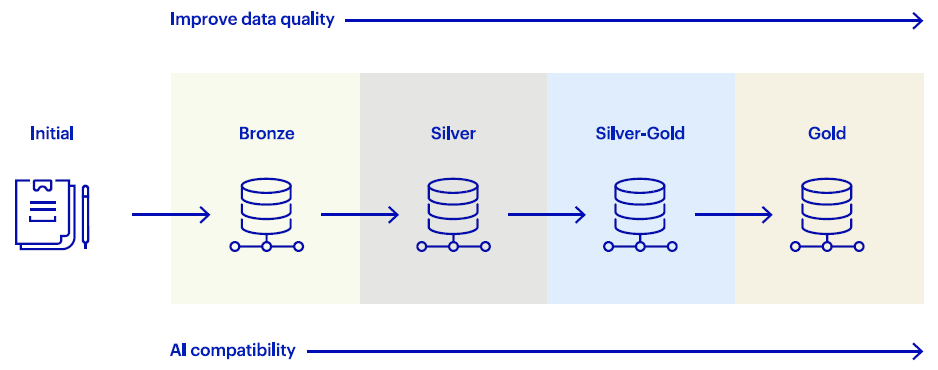
Image Credit: Benchling
Source: Benchling
| Data maturity |
Description |
Example |
AI data readiness |
| Initial |
- Data is recorded manually
with no standardization, stored using physical notebooks and local files
- No version control or traceability
|
Strain research labs using
paper notebooks or standalone
spreadsheets |
Not AI-compatible
Data is too unstructured and disconnected
|
| Foundational |
- Data is digitized but remains inconsistent and siloed
- Consists of uncleaned, unstructured, or semistructured data
- May include missing values, duplicates, or inconsistent formats
- While data becomes more accessible, the absence of standardization limits its findability, interoperability,
and reusability
|
Shared drives between cell therapy research and development teams, but lack of governance produces a content sprawl:
- Raw instrument outputs (e.g., sequencing files)
- Unstructured lab notes or text PDFs
- Sensor logs from bioreactors or Internet of Things devices
- Unannotated images (e.g., microscopy)
|
Bronze
Limited AI use, mostly for search, but not for analytics:
- Data extraction & parsing: Use natural language processing to extract structured info from lab notes or PDFs
- Image recognition: Preprocess and annotate raw images with AI (e.g., cell counting, segmentation)
- Anomaly detection: Identify outliers in raw logs or instrument readings.
- Data labeling tools: Assist human curators with semiautomated annotation (e.g., labeling samples)
|
| Effective |
- Teams adopt structured data practices within their own functions, but inconsistencies persist across departments
- Governance efforts begin, but integration between systems is still limited
- Data becomes more findable and reusable within departments; however, lack of organization-wide standards restricts full interoperability and broader reuse
|
Structured data across one team, like process development, but not standardized across the organization:
- Tabular datasets with harmonized formats
- Tagged metadata on experiments
- Structured assay data (e.g., IC50 values with conditions)
- Integrated data from multiple sources (LIMS, ELN, instruments)
|
Silver
Basic automation and analytics, but AI is not fully adopted:
- Exploratory data analysis: Clustering, dimensionality reduction (e.g., principle component analysis)
- Predictive modeling: Train basic models (e.g., for compound efficacy or toxicity)
- Pattern recognition: Discover relationships or correlations across experiments
- Metadata inference: Use AI to fill in gaps (e.g., infer cell line or condition from context)
|
| Leading |
- Organization-wide data standardization is in place,
with automated pipelines ensuring consistency and accessibility
- Data is findable, accessible, interoperable, and reusable across the organization
- Some manual processes persist, and full AI-readiness has not been achieved
|
Research and development departments have implemented end-to-end, structured data pipelines and partially automated regulatory workflows; AI-readiness is emerging but not yet fully realized:
- Assay results across multiple experiments or studies can be queried with a conversational user interface and return information that improves scientific decision-making
- Fully annotated omics datasets (e.g., gene expression with pathway links) are produced on demand
- All instrument data is automatically synced into LIMS system and transformed for downstream analytics; user engages with data to perform statistical analyzes
|
Silver-Gold
AI is used in specific areas but not for full-scale decision-making:
- Multimodal modeling: Combine structured + unstructured data (e.g., images + omics)
- Transfer learning: Fine-tune pretrained models on inhouse datasets
- Hypothesis generation: Suggest new targets, combinations, or biomarkers
- Early causal modeling: Explore drivers of outcomes beyond correlation
|
| Transformational |
- Data is fully standardized and centralized across all functions
- Highly curated, automated,
QA-checked, version-
controlled, and often governed for regulatory use
- True automation has been achieved across the entire organization, with minimal to no manual processes remaining
|
AI powers cross-functional data integration across R&D, clinical trials, regulatory compliance,
and manufacturing, enabling
real-time insights and predictive analytics across an entire organization:
- Validated datasets are automatically created and formatted for regulatory submission (e.g., clinical trial data)
- Creation of compound libraries with picklist of top candidates paired with predicted in silico performance ready for wet lab confirmation
- Continual simulation of “what-if” hypotheses using an established digital twin model
|
Gold
AI is embedded in every stage of data management for automation at scale:
- Advanced modeling & simulation: ML or deep learning for drug discovery
- Digital twins / virtual trials: Build simulations of patients, cell lines, or processes
- Virtual screening: Predict efficacy and safety profiles of top candidate drugs, ADMET, or synthetic feasibility
- Explainable AI: Use models that must provide interpretable results for regulatory environments
|
The advantages of balancing silver and gold data
Obtaining gold data – fully structured, high-quality, and AI-ready – is the goal of any data-driven organization. However, reaching this state requires overcoming structural and cultural hurdles that stall teams before they even begin.
Gold-level data involves schematization: structuring data into predefined schemas to ensure consistency, traceability, and interoperability. In the life sciences sector, this entails translating diverse experimental workflows and observational data into scalable, machine-readable formats.
However, gold data is not always the immediate or even the correct solution for every scientific workflow. For numerous organizations, silver data serves as a crucial bridge – enabling structure and automation to evolve naturally without disrupting the versatility required for early-stage research and dynamic workflows.
The most sophisticated organizations utilize both silver and gold data strategically: silver for agile workflows and gold for scalable processes.
Silver data
- Well suited for early-stage research, assay development, and exploratory experiments.
- A semi-structured framework introduces consistency without rigid constraints on evolving workflows.
Gold data
- Essential for regulated environments, large-scale aggregation, and AI-driven automation.
- A fully structured framework guarantees traceability, consistency, and interoperability at scale.
Three best practices to transition from bronze to silver data
For clients in the bronze stage who want to progress toward silver and gold data maturity, Benchling recommends starting with the following:
- Basic data organization:
-
- Establish consistent naming conventions.
- Adopt metadata standards.
- Utilize structural templates to ensure searchability and efficient evaluation.
- Avoid siloed storage formats characteristic of bronze-level data.
- Automation and analytics:
-
- Minimize manual entry barriers by introducing automated instruments such as Optical Character Recognition (OCR), Natural Language Processing (NLP), and machine learning pipelines.
- Implement instruments that extract, clean, categorize, and evaluate unstructured records with low effort, eliminating the need for manual input.
- Integration with critical systems:
-
- Ensure compatibility between tools such as electronic lab notebooks (ELNs), laboratory information management systems (LIMS), enterprise resource planning (ERP), and regulatory compliance platforms.
- Focus on seamless data flow to minimize fragmentation and duplication.
Jumping straight to full governance without first addressing naming conventions, data cleaning, and system interoperability results in chaos, frustration, and poor adoption. Implementing Benchling helps in all three areas!
Making the case for silver data implementation
Leadership may worry that focusing on silver-level data could discourage progress toward gold. However, experience demonstrates that silver is a key enabler of gold-level quality.
By incrementally introducing structure and standardization, teams develop the habits and infrastructure required for seamless implementation of gold-level systems. These concerns are common among leaders who are cautious – and Benchling’s responses are exactly what have been shown to be true from 1000+ implementations.
Source: Benchling
| Objection |
Response |
Won’t standardization
overwhelm our teams? |
Transitioning to silver-level data capture doesn’t mean burdening your teams. Tools like automated metadata tagging and schema generation from formalized semi-structured results capture minimizes manual input. Additionally, by embedding data standards into daily workflows, organizations can ease the load while building a foundation for future automation. |
What if we lack the
technical expertise? |
For organizations concerned about technical expertise, start with user-friendly tools that simplify the structuring process. Many platforms offer no-code interfaces or pre-built templates designed for scientists and researchers without programming backgrounds. Partnering with experienced vendors can further ease the transition. |
How do we measure
success at the
silver stage? |
Measuring the impact of silver data transformation involves tracking key metrics such as:
- Improved data consistency across teams
- Time saved in retrieving or cleaning data
- Higher adoption rates of standardized processes
These indicators demonstrate progress and build momentum for achieving gold-level quality. |
What about legacy
data? |
Legacy data often feels like an insurmountable challenge, but it doesn’t have to be tackled all at once. Start with the most relevant datasets and prioritize structure for ongoing projects. Tools like data wrangling pipelines and machine learning can help identify patterns, clean inconsistencies, and retroactively apply structure over time.
Progress is better than perfection; structured current data will create a roadmap for handling older files.
|
Is this investment
worth the cost? |
While implementing silver-level data practices involves upfront costs, the return on investment is substantial. Organizations adopting structured data systems report:
- Fewer duplicate experiments, reducing wasted resources
- Improved regulatory compliance, avoiding costly delays
- Faster decision-making, accelerating time-to-market
The cost of inaction (i.e., unstructured data leading to inefficiencies and errors) is often far greater. |
Will this disrupt
current operations? |
Transitioning to structured data doesn’t have to disrupt ongoing work. By adopting a phased approach that focuses on high-priority areas first, you can make improvements incrementally. Embed new processes into existing workflows to minimize friction and build momentum across teams. |
How do we ensure
adoption by all teams? |
Adoption hinges on involving end-users from the start. Engage scientists and researchers in cocreating workflows and processes that align with their needs. Provide clear training and celebrate early successes, such as faster data retrieval or streamlined reporting, to build momentum and enthusiasm across teams. |
Enhancing data maturity for AI readiness: A competitive necessity
The life sciences sector is long overdue for improved data practices. AI-driven insights and next-generation research abilities rely on high-quality data. While many companies remain stuck in the bronze stages of data maturity, using silver data and progressing toward gold is the optimal place to begin.
About Benchling
Benchling makes biotech research and development faster and more collaborative. Biotechnology has the potential to solve humanity’s most pressing challenges, such as disease, renewable energy, clean water, and hunger. The brightest minds are working on these problems but they are equipped with archaic tools. We aspire to fix this and increase the rate of scientific output with a web-based platform that allows researchers to design and run experiments, analyze data, and share results.
Hundreds of thousands of scientists all around the world use Benchling to do research. Whether they are at the world’s largest companies, the top research universities, or working on a startup in a garage, scientists use Benchling for the same reason: to be empowered, not encumbered, by their tools.
Sponsored Content Policy: News-Medical.net publishes articles and related content that may be derived from sources where we have existing commercial relationships, provided such content adds value to the core editorial ethos of News-Medical.net, which is to educate and inform site visitors interested in medical research, science, medical devices and treatments.