Fractyl Health, Inc. (Fractyl), a clinical-stage metabolic therapeutics company focused on pioneering novel approaches to treat obesity and type 2 diabetes (T2D), today announced positive one-year results from its REMAIN-1 Midpoint Cohort (“Midpoint Cohort”). The new results reinforce the potential of the Revita DMR System (Revita) to be the first durable procedural therapy for post-GLP-1 weight maintenance.
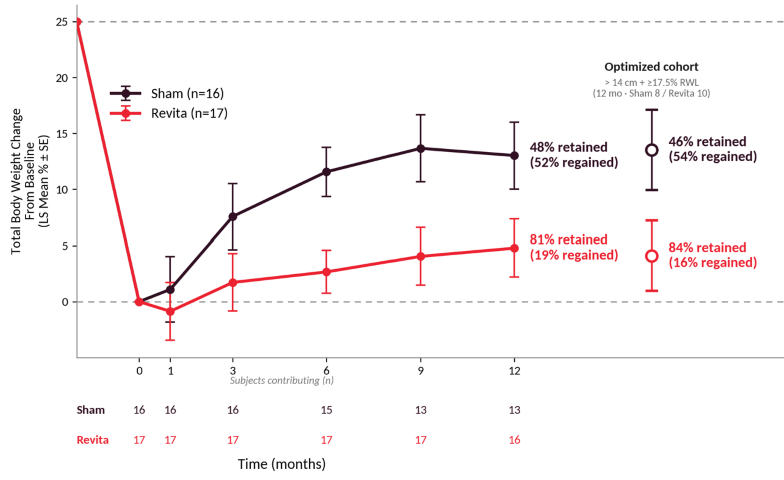 Change in body weight in (i) Complete Ablation population: > 14 cm duodenal ablation, no run-in weight loss restriction (Sham n=16, Revita n=17) and (ii) Optimized population: complete ablation (> 14 cm) and run-in weight loss ≥ 17.5% (Sham n=8, Revita n=10). Y-axis: LS-mean % total body-weight change from baseline; MMRM, compound-symmetry covariance, estimated at 20% run-in weight loss; error bars ± SE; n contributing shown per visit below axis. Retention = % of run-in weight loss maintained at 12 months. Exploratory REMAIN-1 Midpoint Cohort subgroup; not powered for formal inference. Abbreviations: MMRM, mixed-model repeated measures; LS-mean, least-squares mean; SE, standard error. Image Credit: Fractyl Health, Inc.
Key findings:
- Dose-dependent durability confirmed at one year: In the full modified intention-to-treat (mITT) population (N=45), a single Revita procedure reduced weight regain by approximately 40% versus sham at one year (least-squares mean weight regain of 7.8% versus 13.0% of body weight; n=29 versus 16 for Revita versus sham). Participants who received complete duodenal ablation (> 14 cm) maintained approximately 81% of GLP-1-induced weight loss at one year, compared with 48% in sham participants (least-squares mean weight regain of 4.8% versus 13.0% of body weight; n=17 versus 16 for Revita versus sham), reflecting a reduction in weight regain of over 60% versus sham. This is consistent with earlier findings that more complete duodenal ablation drives greater treatment effect.
- Greatest benefit in patients with greatest need: In an optimized population of participants who received complete duodenal ablation (> 14 cm) and had higher GLP-1 run-in weight loss (≥ 17.5%), Revita maintained approximately 84% of GLP-1-induced weight loss at one year versus 46% with sham (least-squares mean weight regain of 4.1% versus 13.5% of body weight; n=10 versus 8 for Revita versus sham). These results are consistent with the view that patients at greatest need may derive the greatest benefit from Revita due to their higher propensity for weight regain after GLP-1 discontinuation.
- Weight-maintenance responder rate: The second co-primary endpoint of the Pivotal Cohort, assessed against a U.S. Food and Drug Administration (FDA) mandated pre-specified performance goal of > 50%, measures the proportion of Revita patients maintaining at least 5% total body weight loss relative to their pre-tirzepatide weight at one year. As a reference point for the Pivotal Cohort, this responder rate was 73% in the Midpoint Cohort mITT population, rising to 91% in those with complete duodenal ablation (> 14 cm).
- Excellent tolerability: No device- or procedure-related serious adverse events occurred. No new device-related treatment-emergent adverse events (TEAEs) were observed between six and 12 months. Overall TEAE rates were comparable between arms through one year (24% Revita versus 25% sham), reflecting a generally mild peri-procedural adverse event profile that supports potentially broad outpatient use for Revita. One new diagnosis of type 2 diabetes occurred in the sham arm versus none with Revita.
The success of GLP-1 medicines has created a new unsolved problem: what happens when patients stop. Most do stop eventually, whether because of cost, side effects, or simply not wanting to inject a drug for the rest of their lives. When they stop, the weight most often comes back.
Today's results are the first randomized, sham-controlled evidence that a single Revita procedure can keep most of the weight off for a full year after GLP-1 is stopped, without the need for ongoing medication. We eagerly anticipate an early Q4 2026 topline readout from the REMAIN-1 Pivotal Cohort with deep conviction that Revita may represent the first procedural entrant into the post-GLP-1 weight maintenance category.”
Harith Rajagopalan, M.D., Ph.D., Co-Founder and Chief Executive Officer, Fractyl
Webcast
Fractyl Health will host a webcast today, July 15, 2026, at 8:00 a.m. Eastern Time. The live webcast can be accessed by clicking this link. This webcast can also be found in the “Events” section of Fractyl’s website at ir.fractyl.com. The webcast will be archived and available for replay for at least 30 days after the event.
About REMAIN-1 weight maintenance program
REMAIN-1 is Fractyl Health’s pivotal program evaluating Revita for weight maintenance in adults with obesity following discontinuation of GLP-1 therapy. The Midpoint Cohort (N=45) is a randomized, double-blind, sham-controlled study in adults who achieved at least 15% total body weight loss on tirzepatide; after discontinuing the drug, participants were randomized 2:1 to a single Revita procedure or a sham endoscopic procedure and followed for one year. The Midpoint Cohort is not powered for formal statistical significance; results are descriptive and are intended to characterize the treatment effect and inform the Pivotal Cohort design and execution. Results in the Midpoint Cohort at one year are evaluated per the pre-specified statistical analysis plan defined for the pivotal study, with GLP-1 weight loss fitted as a covariate on treatment effects, calculated as least-square means at the 20% reference. Both a Complete Ablation cohort (defined as > 14 cm of duodenal ablation) and an Optimized responder population (with > 14 cm duodenal ablation and ≥ 17.5% run-in weight loss) are pre-specified key secondary endpoints in the pivotal study. The Pivotal Cohort is fully randomized and well powered at the expected effect size to clear both co-primary endpoints in the modified intention-to-treat (mITT) population: (i) weight regain at six months (Revita versus sham) and (ii) a responder rate defined as the proportion of participants maintaining at least 5% total body weight loss relative to their pre-tirzepatide weight at one year. Topline six-month randomized data from the Pivotal Cohort are anticipated in early Q4 2026.
 Excess adiposity may alter the immune environment of airways to promote lung cancer