A new meta-analysis finds that “laughing gas” can lift depressive symptoms within hours, highlighting a fast-acting antidepressant approach that may work best when carefully repeated rather than given just once.

Study: Nitrous oxide for the treatment of depression: a systematic review and meta-analysis. Image Credit: mazur serhiy UA / Shutterstock
In a recent review published in the journal eBioMedicine, researchers synthesized data from protocol papers, clinical trials, and exploratory studies to assess evidence regarding the effectiveness of nitrous oxide for treating depression.
They concluded that within hours of administration, nitrous oxide can produce a rapid antidepressant effect with generally transient, dose-dependent side effects. However, further research is needed to confirm these findings.
Rising Interest in Fast-Acting Depression Therapies
Depression affects more than 300 million people worldwide. Its causes include complex interactions among environmental, biological, and psychological systems that disrupt stress-regulation pathways and neural circuits.
Standard antidepressants remain inadequate for many patients. This has intensified research focus on faster-acting therapies that can support people with depression, particularly for those who experience treatment-resistant depression.
Nitrous Oxide’s Mechanistic Rationale as an Antidepressant
Growing research has shifted toward the glutamatergic system, motivated in part by ketamine’s fast-acting antidepressant effects. Nitrous oxide, a N-methyl-D-aspartate (NMDA) receptor antagonist widely used as an anesthetic, has shown similar fast-acting benefits, accompanied by short-lived, dose-dependent adverse effects.
Its actions include modulating glutamate signaling, altering activity within the default mode network, and influencing dopamine and opioid systems. These mechanisms have positioned nitrous oxide as a promising candidate for further investigation as a novel antidepressant.
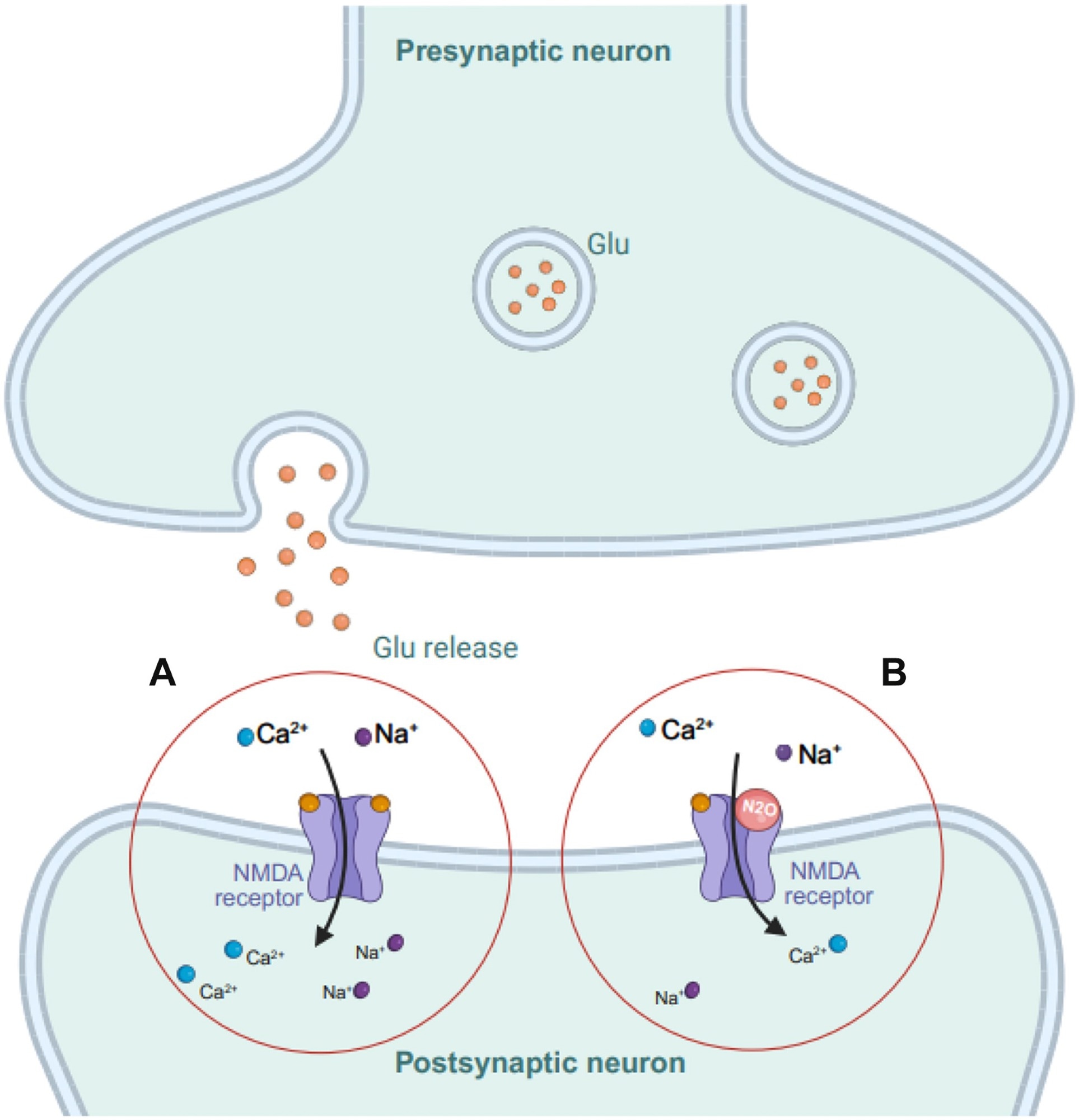
Mechanism of action of nitrous oxide (N2O) in modulating NMDA receptor activity. In the normal state (A), glutamate (glu) binds to NMDA receptors on the postsynaptic neuron, causing calcium (Ca2+) and sodium (Na+) ion influx, triggering excitatory signalling. In B) N2O partially blocks NMDA receptors, inhibiting glutamate binding and preventing Na+ and Ca2+ influx, thereby reducing excitatory signalling. This modulation of ions affects the excitatory and inhibitory balance in the central nervous system and is implicated in depression. Figure created with BioRender. Gill, K. (2025) https://BioRender.com/a87q343.
Clinical Evidence Base for Nitrous Oxide
The review identified eleven eligible studies, including seven completed clinical trials, most of which were randomized controlled trials, and four published protocol papers. These studies represented early-phase research conducted in Australia, Brazil, China, and the United States.
Across the completed trials, a total of 247 participants were enrolled, comprising individuals with major depressive disorder, treatment-resistant depression, or bipolar depression. Nitrous oxide was typically administered at concentrations of either 25% or 50%. It was delivered through controlled inhalation for periods ranging from 20 to 60 minutes, either as a single treatment session or as repeated sessions scheduled weekly or twice weekly, with most pooled efficacy estimates driven primarily by single-session 50% protocols.
Rapid Antidepressant Effects From Single Doses
Overall, the studies showed that one session of nitrous oxide could quickly reduce symptoms of depression, with detectable improvements within two hours after its administration.
In one of the earliest trials, scientists found that a 60-minute session of 50% nitrous oxide led to noticeably lower depression scores compared with a placebo at both two and 24 hours. People receiving the treatment were also more likely to show a meaningful improvement (20% vs 5%), and some even reached remission within a day.
Another study reported similar results in people with treatment-resistant depression: symptoms improved within hours. However, the effect faded by one week. A third study found that nearly half of participants still showed improvement a week after a single treatment, especially those who responded strongly at the start.
Results for bipolar depression were less consistent. In one study, both nitrous oxide and the comparison drug midazolam reduced symptoms; however, nitrous oxide helped more people improve within the first two hours. The study also suggested that people with certain patterns of brain blood flow might be more likely to benefit, hinting at a possible biological marker for predicting treatment response.
Enhanced and Sustained Benefits With Repeated Dosing
Studies involving multiple treatment sessions demonstrated more substantial and more sustained improvements in depressive symptoms. Across all repeated-dose studies, the greatest improvements usually appeared within 24 to 48 hours after each treatment and accumulated over time.
For example, eight sessions over four weeks led to very high improvement and remission rates compared to a placebo.
Another study found that both low-dose (25%) and high-dose (50%) nitrous oxide reduced symptoms over two weeks, though the higher dose was more effective. The lower dose, however, caused fewer adverse events such as nausea and dizziness, suggesting it might be a good compromise between effectiveness and tolerability.
The most extensive study to date found that weekly sessions over four weeks led to steady, cumulative improvement. People receiving nitrous oxide were more likely to reach remission in the first week than those on placebo, and the 50% dose again produced the strongest results.
Pooled Findings From Meta-Analytic Synthesis
When data from several trials were combined, nitrous oxide showed clear antidepressant effects at both two hours and 24 hours after treatment. These early improvements were consistent across studies, with very low statistical heterogeneity.
However, the combined data did not show lasting benefits at one week, suggesting the main effects are short-term unless treatments are repeated. Because only a small number of trials contributed to the pooled estimates, some asymmetry in the funnel plots suggests that publication bias cannot be excluded, and blinding may have been imperfect in some trials, raising the possibility of expectancy effects.
Overall Conclusions and Research Gaps
Researchers found that across a small number of early-phase trials, nitrous oxide produces rapid, short-term antidepressant effects, with repeated dosing extending both the magnitude and duration of benefits.
However, most studies were small, early-phase trials with heterogeneous designs, limited long-term follow-up, and insufficient power to compare doses or identify predictors fully. Differences in delivery systems, comparators, and outcome measures also constrain comparability. Safety data, though generally reassuring, remain incomplete for long-term or repeated use.
Overall, the evidence suggests that nitrous oxide is a fast-acting antidepressant candidate that is generally well tolerated, with higher rates of mild, transient side effects than placebo, but that larger, longer, and mechanistically informed trials are needed.
Journal reference:
- Gill, K., de Cates, A.N., Wiseman, C., Murphy, S.E., Williams, E., Harmer, C.J., Morales-Muñoz, I., Marwaha, S. (2025). Nitrous oxide for the treatment of depression: a systematic review and meta-analysis. eBioMedicine. DOI: 10.1016/j.ebiom.2025.106023, https://www.thelancet.com/journals/ebiom/article/PIIS2352-3964(25)00467-0/f
 Maternal depressive symptoms linked to higher infant mortality risk