A small Japanese study suggests that a low-salt, oat-based granola breakfast may improve blood pressure, lipid risk markers, and gut health indicators in people with moderate chronic kidney disease, while highlighting the need for larger controlled trials.
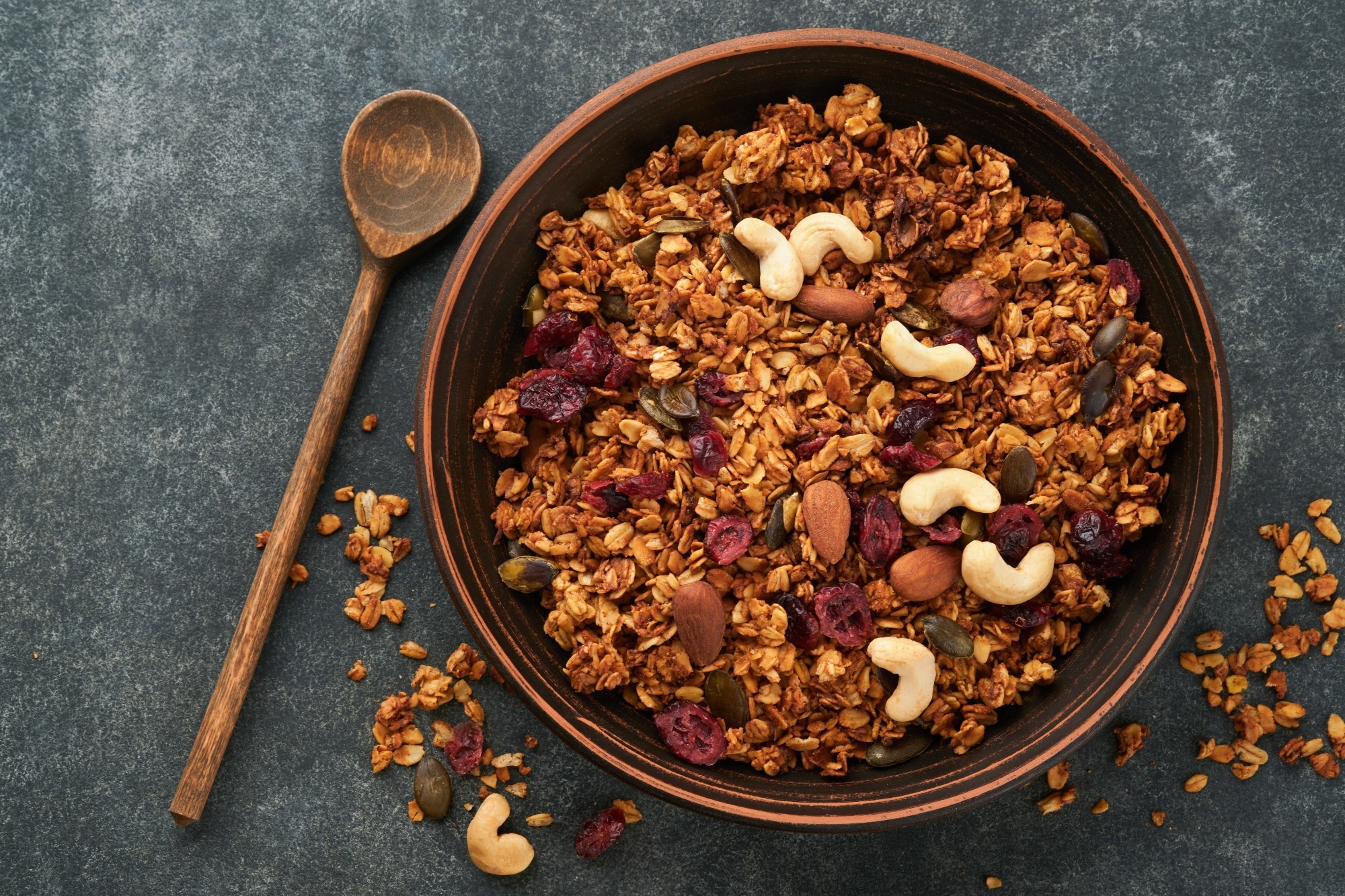
Study: Fruits Granola Consumption May Contribute to a Reduced Risk of Cardiovascular Disease in Patients with Stage G2–4 Chronic Kidney Disease. Image Credit: Katarzyna Hurova / Shutterstock
In a recent study published in Foods, researchers investigated the effects of fruit granola (FGR) intake on patients with CKD.
Chronic Kidney Disease and Cardiovascular Risk
CKD is a substantial global health concern, affecting around 843.6 million people worldwide, and is associated with increasing mortality rates. By 2040, it is projected to be the fifth leading cause of years of life lost worldwide. Lifestyle-related conditions, including diabetes, obesity, and hypertension, are major risk factors for CKD. CVD also worsens life prognosis, similar to CKD, and the two conditions often coexist.
The incidence of CVD increases with CKD progression, with cardiovascular disease being the leading cause of mortality among CKD patients. Dietary interventions, including Mediterranean, whole-grain, and low-protein diets, have been reported to reduce the risk of CKD. Fruit granola is a cereal food primarily made from oats and contains approximately 0.24 g of salt per 50 g serving, making it a low-sodium option compared with typical Western or Japanese meals.
Nutritional Properties of Oats and Granola
The main ingredient in granola, oats, contains beta-glucan, a water-soluble dietary fiber reported to reduce low-density lipoprotein cholesterol (LDL-C) and blood glucose levels. Previously, the authors noted that FGR intake reduced salt intake and blood pressure (BP) and improved the intestinal environment in hemodialysis patients in an observational before-and-after study. They hypothesized that FGR intake could yield similar improvements in patients with CKD.
Study Design and Participant Selection
In the present study, researchers investigated the efficacy and safety of FGR consumption among patients with moderate CKD. Patients aged 20 years or older with stable disease status and an estimated glomerular filtration rate of 15–89 mL/min were recruited at a university hospital in Japan. Individuals with active inflammation, reduced nutritional status, malignancy, or steroid therapy were excluded.
Measurements, Intervention, and Data Collection
Blood and urine samples were collected during outpatient visits. Clinical chemistry tests and complete blood counts were performed. Blood pressure was measured non-invasively, and the average home BP over the previous week was calculated. Urine tests were conducted using automated analyzers, and nutritional status was assessed using the Geriatric Nutritional Risk Index. Patients also completed questionnaires regarding bowel movements.
Changes in stool form and frequency were evaluated using the Bristol Stool Form Scale. The intervention replaced participants’ usual breakfast with 50 g of FGR at least five days per week for two months. Tanaka’s formula was used to estimate daily salt intake from spot urine samples. Laboratory tests, questionnaires, and BP measurements were repeated after the intervention.
Clinical and Biochemical Outcomes
The study enrolled 25 individuals, of whom 24 were included in the final analysis. Participants had a mean age of 66.8 years, were predominantly male (83 percent), and mainly had CKD stages G3a to G3b, with stage G3 accounting for approximately 71 percent. Diabetic nephropathy was present in 87 percent of patients.
Systolic BP decreased significantly from 128.9 mmHg at baseline to 124.3 mmHg after the intervention, while diastolic BP showed a non-significant reduction. No adverse events were reported.
No changes were observed in liver, renal, or hematopoietic function, including serum creatinine and estimated glomerular filtration rate. LDL-C and the LDL-C to high-density lipoprotein cholesterol (HDL-C) ratio decreased significantly, while HDL-C and triglycerides remained unchanged. Glycated hemoglobin, glucose metabolism, and electrolyte levels were also unchanged. Ferritin levels declined significantly, though the clinical relevance remains unclear.
Urinary albumin, sodium, chloride, potassium, and the albumin-to-creatinine ratio showed no significant changes. Estimated daily salt intake increased from 8.4 g/day to 9.2 g/day, a finding that the authors note may reflect limitations of spot urine-based estimation. Urinary N-acetyl-beta-D-glucosaminidase, a marker of renal tubular damage, decreased significantly. Improvements in bowel movement frequency and stool quality were also observed.
Interpretation, Limitations, and Implications
Overall, two months of fruit granola consumption was associated with reductions in urinary markers of tubular damage, lower systolic BP, and improvements in lipid-related and intestinal health markers in patients with moderate CKD. These findings suggest potential cardiovascular and renal benefits, but should be regarded as hypothesis-generating.
Key limitations include the single-arm, open-label design, the absence of a control group, a small sample size, a short intervention duration, and the lack of dietary records. The exclusive recruitment of Japanese participants and the involvement of a food manufacturer in the research program may further limit generalizability. Larger, longer-term studies in diverse populations are needed.
Journal reference:
- Okuma, T., Nagasawa, H., Otsuka, T., et al. (2025). Fruits granola consumption may contribute to a reduced risk of cardiovascular disease in patients with stage G2–4 chronic kidney disease. Foods, 14(24), 4346. DOI: 10.3390/foods14244346, https://www.mdpi.com/2304-8158/14/24/4346
 What helped families stay with WIC? Remote access may be key