From alpha brain waves to amygdala activity, scientists map how forests, wetlands, and even immersive virtual nature can recalibrate the brain, revealing why stepping outside may be one of the most powerful tools for mental resilience.
 Study: Your brain on nature: A scoping review of the neuroscience of nature exposure. Image credit: PeopleImages/Shutterstock.com
A recent review in Neuroscience & Biobehavioral Reviews examined how nature exposure affects the brain, identified gaps in current research methods, and suggested areas for future study.
Theoretical Foundations of Nature's Benefits
Several studies have shown that exposure to nature enhances both psychological and physiological well-being. Neuroscience approaches, such as the Exposome, map the combined effects of environmental exposures and biological factors on brain health, but can be enriched by examining specific cognitive and emotional processes involved in well-being.
Spending time in nature improves attention, reduces stress, and increases positive mood. Researchers have proposed three main ecopsychology theories to explain these effects. The Attention Restoration Theory (ART) suggests that nature helps restore attentional focus, while the Stress Recovery Theory (SRT) proposes that natural environments rapidly reduce stress and promote recovery. The third Biophilia Hypothesis argues that humans have an innate drive to connect with nature, which may underlie these restorative effects.
Assessing Neural Mechanisms of Nature Exposure
Theoretical frameworks do not account for the neural mechanisms through which nature influences cognition and emotion. Even though systematic reviews and meta-analyses confirm that contact with green spaces is linked to better physical and mental health, most research fails to examine the neural mechanisms underlying this association.
The present study assesses neuroimaging studies examining how natural stimuli influence brain function and cognitive-affective processing across real-world environments and controlled laboratory settings. It evaluated 108 peer-reviewed studies examining the neurobiological impact of nature exposure with techniques such as electroencephalogram (EEG), Magnetic resonance imaging (MRI), functional magnetic resonance imaging (fMRI), and functional near-infrared spectroscopy (fNIRS).
The current study examined factors such as stimulus complexity, environmental type, and study design to clarify the neural mechanisms linking nature exposure to cognition and emotion, highlight existing gaps, and suggest future research directions.
The majority of EEG studies focused on pictorial, video, and virtual environment (VE) paradigms, while fMRI and fNIRS studies included both lab and field exposures. MRI studies leveraged database analyses and post-exposure assessments. This diversity highlights a robust body of neuroimaging evidence on nature exposure, although protocols varied substantially in stimulus type, duration, and outcome measures, limiting direct comparability across studies.
The current review featured diverse participants, with most EEG, fMRI, and fNIRS samples consisting of young to middle-aged adults (ages 18–55) and a balanced gender distribution.
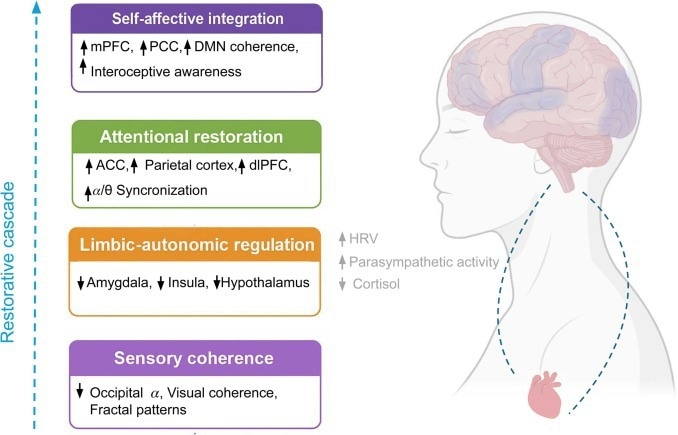 A proposed neurobiological “restorative cascade” showing how exposure to natural environments progresses from sensory coherence and reduced limbic stress responses to attentional restoration and enhanced self-affective brain network integration.
Determinants and Durability of Nature’s Neurobiological Effects
Nature exposure yielded quantifiable benefits across neural, emotional, and physiological domains. EEG and event-related potential (ERP) research consistently demonstrates that nature exposure increases alpha power, indicative of enhanced relaxation and inward-focused attention, and promotes greater neural connectivity. In contrast, urban settings were associated with elevated beta and gamma activity, markers of increased arousal and stress.
Green environments enhanced both emotional and cognitive indicators of well-being, with prolonged or immersive exposures amplifying these effects relative to brief or simulated experiences. Field and laboratory investigations further established that blue spaces, such as wetlands, conferred the most rapid and pronounced stress recovery, followed by open and closed green spaces. In contrast, grey spaces, typically urban or built environments, were repeatedly shown to be the least effective in facilitating recovery.
The magnitude of these benefits depended on several factors. An exposure duration of at least 15 minutes and high environmental quality, characterized by visual richness, cleanliness, and perceived safety, further amplified positive outcomes. Engagement in horticultural activities or relaxation in authentic green or blue spaces resulted in significant improvements in neural relaxation (e.g., increased alpha power), mood, and stress reduction.
Although immersive virtual environments also demonstrated measurable benefits, real-world exposure often produced stronger or more consistent restorative effects, while simulated environments or indoor rest typically failed to elicit comparable restorative responses.
Key environmental features, including greenness, openness, presence of natural water bodies, and minimal visual clutter, were shown to optimize the restorative potential of outdoor spaces. Furthermore, sitting and walking generally produced stronger restorative EEG signatures than talking or cognitively demanding activities during exposure.
Visual exposure to nature, relative to auditory stimuli alone, produced stronger and more rapid well-being gains, with measurable benefits apparent after approximately 8–9 minutes of exposure.
To integrate findings across imaging modalities, the authors propose a multilevel neurobiological cascade linking perceptual, autonomic, cognitive, and affective systems. In this model, natural scenes are processed efficiently by early visual regions, reducing perceptual load; limbic and autonomic circuits then downregulate stress responses; alpha–theta synchronization supports attentional restoration; and increased connectivity within default mode network regions may promote emotional coherence and a sense of connectedness.
Critically, repeated engagement with restorative environments over extended periods may induce enduring changes in brain structure and function, though much of the structural MRI evidence remains correlational and based on long-term associations with residential greenspace, thereby supporting neurobiological resilience and providing a mechanistic link between acute restorative effects and long-term improvements in mental and physical health.
Conclusion
Neuroimaging research provides compelling evidence that exposure to natural environments confers diverse neural, cognitive, and emotional benefits. However, most of the reviewed studies were conducted in healthy adult populations and relied on heterogeneous, often correlational designs, meaning the findings should not be interpreted as definitive causal proof or generalized to clinical groups. The authors also note the possibility of publication bias and call for more preregistered, longitudinal, and mechanistic trials.
Future studies should leverage longitudinal designs, incorporate ecological momentary assessment, and explore underlying neurobiological mechanisms in more diverse and clinical cohorts. Expanding interdisciplinary approaches can inform the integration of nature-based interventions into urban design, public health policy, and personalized mental health care, maximizing restorative outcomes for society at large.
Download your PDF copy by clicking here.
 Psilocybin reshapes brain connections through distinct cellular pathways