Scientists argue that fine particle pollution may be harming brain health and lowering cognitive potential worldwide, with modelling suggesting massive cumulative IQ losses and disproportionate impacts in poorer regions.
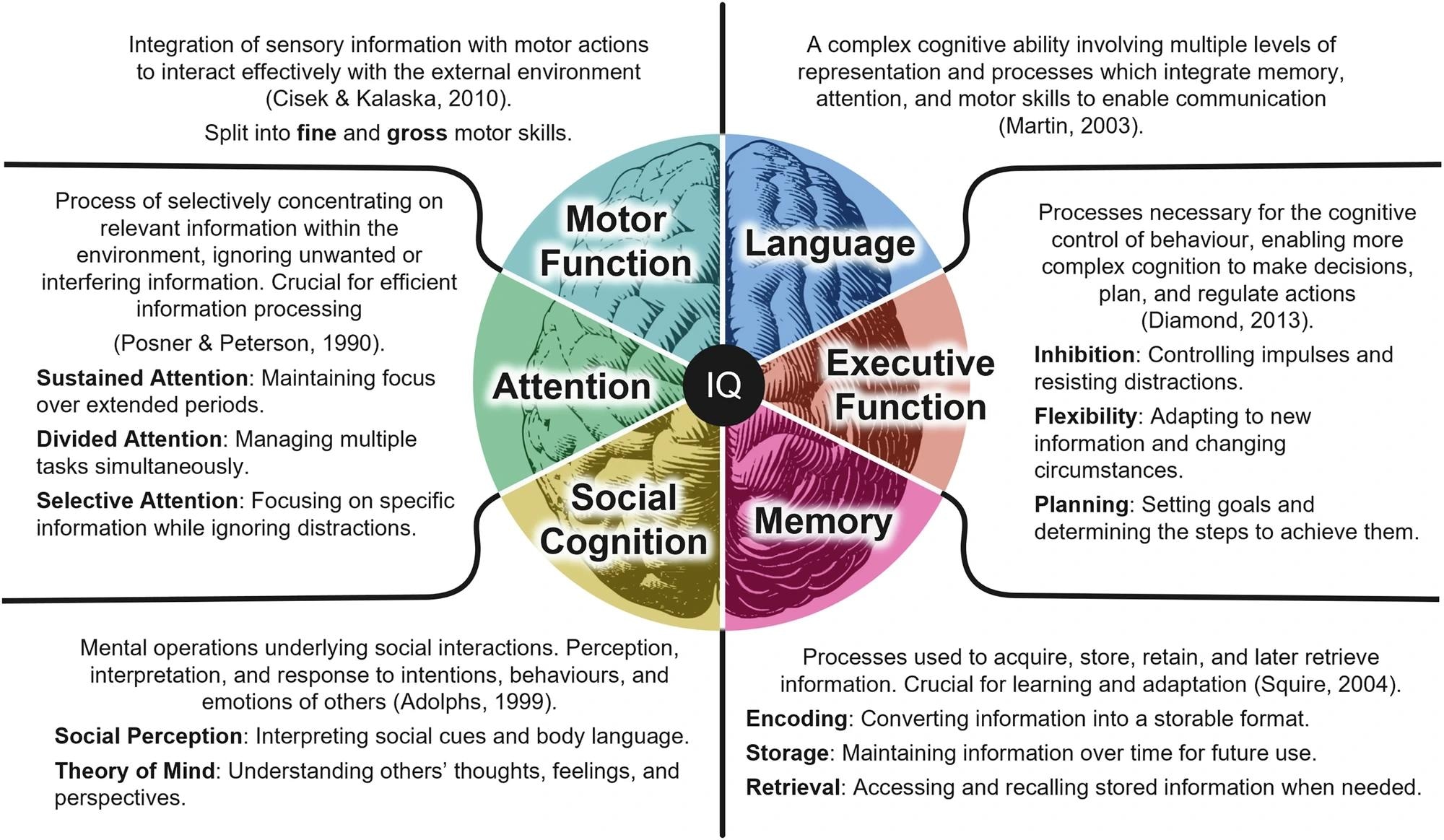
Diagram summarising the key domains within human cognition.
In a recent perspective article published in npj Clean Air, a group of authors examined how exposure to fine particulate matter (PM2.5) may influence cognitive health, intelligence quotient (IQ), and potentially broader global socioeconomic outcomes.
Background
Imagine losing a few points of intelligence quotient simply by breathing the air around you. The consequences of air pollution on the brain are less widely discussed, though the damage to the lungs and heart has historically received greater attention in public health research. PM2.5 particles may penetrate deeply into the body and potentially reach the brain via the circulation or the olfactory pathway, where they could affect neurological processes involved in cognition. A growing body of epidemiological and experimental research suggests that exposure to pollution may be associated with a long-term decrease in learning, performance, and productivity.
Since humans are exposed to contaminated air daily, even small cognitive effects might have substantial population-level consequences. Further research is needed to better understand this emerging neurological risk.
Air pollution as a threat to cognitive health
The World Health Organization (WHO) recognizes air pollution as the leading environmental risk factor for global human health. Polluted air causes millions of premature deaths and is linked to heart, lung, and cancer risks. Increasing evidence suggests that it may also affect brain health and cognitive performance.
Some sources of PM2.5 include vehicle emissions, industrial processes, power generation, and natural sources such as dust. When inhaled, PM2.5 may then reach the brain via the circulation, disruption of the blood-brain barrier, or other biological pathways proposed by researchers. Studies have linked exposure to such particles with brain damage and impaired mental function.
Dementia may reduce productivity and earning potential while increasing healthcare costs. Globally, dementia already costs more than one trillion US dollars annually, illustrating how neurological disorders can impose major economic burdens on societies and why protecting cognitive health is important for economic systems and social welfare.
Evidence linking air pollution to intelligence and learning
Numerous studies have established a connection between long-term exposure to PM2.5 and reduced cognitive performance and intelligence quotient scores. Intelligence quotient (IQ) is widely considered a proxy indicator of cognitive ability, encompassing functions such as working memory, processing, reasoning, and problem solving, which represent key domains of cognition.
These cognitive domains are measured using standardized assessments, including the Wechsler Adult Intelligence Scale, the Stanford-Binet Intelligence Test, and the Universal Nonverbal Intelligence Test.
In a meta-analysis of international studies examining PM2.5 effects on children, researchers concluded that an increase of one microgram per cubic meter (µg/m³) of PM2.5 is associated with a small but consistent loss in intelligence quotient. While this effect may appear modest for an individual, its impact becomes enormous when applied to entire populations.
Using global exposure data, the authors applied a log-linear modelling framework based on previously published exposure and response estimates to estimate pollution-related cognitive effects. Their analysis suggested that this could result in approximately 16 billion intelligence quotient points lost among children worldwide. When projected across the entire global population, the estimated loss could reach about 65 billion intelligence quotient points.
The authors note that much of the available evidence linking PM2.5 to IQ comes from studies of children; therefore, global estimates should be interpreted cautiously when extrapolated to adult populations.
Global inequality in cognitive impacts
Air pollution does not affect everyone equally, but approximately 9 out of 10 people worldwide inhale air with levels of pollutants above the WHO-recommended limits. However, exposure levels vary greatly between countries and regions.
The authors estimated country-level losses in intelligence quotient by analyzing population-weighted PM2.5 concentrations from global datasets. The findings indicated that the average loss in intelligence quotient attributable to pollution ranged from about 0.41 to 19.08 points, depending on location. Lower-income countries were estimated to experience significantly greater cognitive losses than wealthier nations.
Statistical analysis confirmed a strong relationship between national income classification and pollution-related cognitive impact. Lower-income and lower-middle-income countries showed the largest estimated losses in intelligence quotient, while high-income countries generally experienced smaller impacts. This disparity highlights how environmental risks can amplify existing social inequalities.
Biological mechanisms behind cognitive damage
Scientists believe that several biological processes may help explain how pollution affects the brain. One key mechanism involves inflammation and oxidative stress. When particulate matter enters the body, it can trigger immune responses that may damage brain cells and interfere with normal neurological development.
Tiny particles may also cross protective barriers in the body and accumulate in brain tissues. This can alter brain structure and, over time, potentially impair cognitive performance. Such effects may appear during early childhood development but may also contribute to cognitive decline in later life.
Metals like lead, cadmium, chromium, manganese, arsenic, nickel, and mercury have been associated with lower intelligence quotient, behavioral changes, developmental disability, and, in some cases, with neurodegenerative diseases such as Parkinson’s disease and Alzheimer’s disease. These findings suggest that polluted environments may influence brain health throughout the entire lifespan.
Policy responses and research priorities
Addressing the cognitive impacts of air pollution requires stronger policies and public awareness. Governments could reduce exposure by regulating vehicle, industrial, and power plant emissions. Urban planning strategies can also play an important role by limiting pollution near schools and residential areas where children are most vulnerable.
Regulatory agencies may need to reconsider current air quality guidelines. Existing limits were largely designed to prevent respiratory and cardiovascular diseases, but they may not adequately protect neurological health. Future standards should consider particle composition, chemical toxicity, and exposure pathways rather than focusing only on particle size.
The authors also emphasize that pollution control strategies should address the toxicity and chemical composition of particles, as well as their sources of emission, and may require coordinated action across environmental, health, and urban policy sectors.
Conclusion
Air pollution represents not only an environmental hazard but also a potential threat to global cognitive health. Exposure to PM2.5 has been associated with lower intelligence quotient, reduced learning performance, and greater risks of neurological disorders. These effects are particularly concerning given the widespread global exposure to polluted air and the possible societal implications of small cognitive changes occurring across large populations.
These findings suggest the need to implement stricter environmental regulations and improve public awareness. Protecting air quality could therefore safeguard human intellectual potential, reduce health inequalities, and support economic productivity across societies worldwide.
Journal reference:
- Faherty, T., Ellis-Bradford, L.-J. A., Onyeaka, H., Harrison, R. M., & Pope, F. D. (2026). Reframing air pollution as a cognitive and socioeconomic risk. npj Clean Air. DOI: 10.1038/s44407-026-00059-4, https://www.nature.com/articles/s44407-026-00059-4
 Bacterial strains determine pneumonia and meningitis risk from air pollution