Could your shoelaces be holding you back? Researchers find smarter lacing design enhances comfort and control during long runs without disrupting natural movement.
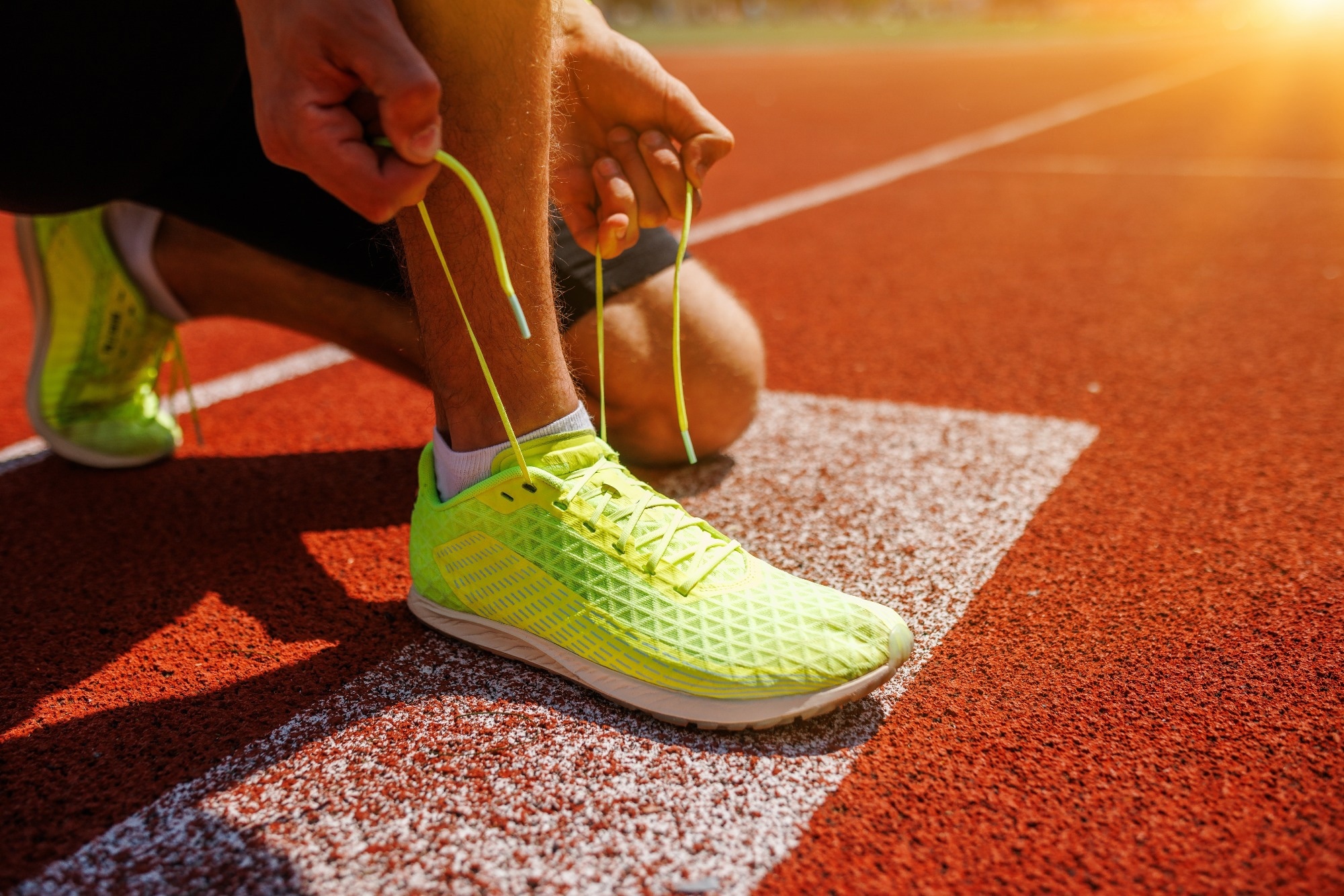 Study: Effects of a wrapping closure lacing system on wearing comfort, lock-in stability, and lower-limb muscle demand during prolonged running. Image credit: sergey kolesnikov/Shutterstock.com
A study published in Frontiers in Sports and Active Living found that a novel footwear lacing system based on wrapping closure improved comfort while maintaining running kinematics unchanged compared with conventional laces.
How lacing systems shape foot–shoe biomechanics
Running is widely practiced because it requires little specialized gear and is accessible to almost anyone at almost any age. However, footwear design and manufacture play complementary roles in ensuring good performance while reducing the risk of injury.
The area of contact between the foot and the shoe upper determines the fit, stability, and pressure distribution across the shoe. Fitting is primarily regulated by the lacing or closure system, which controls how tightly the upper is held to the foot, how well the foot is contained, and how well the foot is coupled with the shoe, thereby affecting biomechanics.
Wrapping closure systems are alternative designs for footwear lacing, to hold the shoe firmly and reliably to the foot during active movement. Despite this, little is known about how they affect muscle activation and how they perform during prolonged running, compared with short tasks. With longer sessions, repetitive movements within a confined environment may amplify the runners’ responses.
The current study sought to fill this gap by comparing conventional laces (CL) with a dial-based lacing system (DLS), a wrapping closure system.
Marathon runners tested dial versus traditional laces
The researchers compared CL (polyester laces provided with the shoes) with DLS in 20 trained marathoners during two 50-minute treadmill running sessions. These were separated by 48 hours.
The researchers assessed metrics like:
• Wearing comfort – time to don or doff the footwear, visual analog scale rating
• Lock-in stability – per-cycle variability in pressure on the top of the foot, shoe-throat width, rate of lace loosening
• Running kinematics – joint motion capture at the knee and ankle, quantifying joint motion and stride characteristics via musculoskeletal modeling
• Lower-limb muscle activation – electromyography from the surface of four lower-leg muscles
Dial system improves comfort without altering running mechanics
The researchers found that runners took less time to put on or take off their footwear, with an average of 13.3 seconds for DLS versus 37 seconds for CL. Lace loosening was not observed with DLS, but it occurred in 10 % of CL. The researchers note that this may be the first time this metric has been reported in a running study. They conclude that, despite the lack of statistical significance, this is a potentially meaningful difference that may have contributed to the perception of greater stability. However, this requires more research.
Discomfort increased over time with both lacing systems. However, DLS was rated as causing less discomfort than CL on the VAS during the latter half of the running session. Runners mostly chose foot containment and stability as the chief contributors to comfort during running.
Gait analysis showed that dorsal foot pressure peaked at mid-stance, and both peak and trough foot pressures increased steadily across the running session, irrespective of lacing system. Even so, DLS was associated with less pressure fluctuation at the top of the foot. DLS was also associated with lower peak tibialis anterior activation at multiple time points during each session, compared to CL. However, participant height was identified as a confounding factor influencing this result. Other aspects were found to be similar in either system.
These findings are consistent with previous research, with runners reporting greater confidence and a perception of more even pressure distribution throughout the session.
This study demonstrates that the peak pressure exerted on the top of the foot during a normal running cycle is far lower than the discomfort threshold (1.8 kPa versus 134 kPa, respectively, based on additional measurements under controlled tightening conditions). The authors speculate that this was not the main contributor to feelings of discomfort. Rather, the perception of stability and comfort may be related to the fluctuations in pressure over each gait cycle.
The EMG measures may indirectly reflect reduced foot movement inside the shoe during running. Direct measures of such displacement are required to confirm it, however. The lack of widespread changes in activation patterns of other muscles supports the suggestion that lacing modifications chiefly affect local foot mechanics and leave lower limb kinematics intact.
The authors also reference prior research suggesting that tight lacing prevents energy loss from efforts to stabilize the foot-shoe coupling. It also prevents heel slippage, thereby reducing injury risk from repetitive micro-adjustments and abnormal lower limb loading. Future research is required to compare metabolic costs and injury risk across DLS and CL.
The authors point out certain DLS features that may contribute to reduced discomfort. For instance, the DLS nylon-coated wire has lower friction and is thinner, so it slides more smoothly through the eyelets. This allows more efficient adjustment of lacing tension across the shoe tongue, improving pressure distribution over the top of the foot.
Study limitations
The study had several limitations that could weaken its conclusions. It was conducted in a controlled environment, which may reduce the extent to which biomechanical differences between lacing systems are observed in real-world conditions. The participant group was restricted to a specific age range, limiting the generalizability of the findings to other populations. Although the sample size was based on pilot data, it may still have been insufficient to detect small or rare effects.
In addition, the study measured only total pressure rather than detailed pressure distribution, which could have provided a more comprehensive assessment of lacing system performance. The use of sensors and attachment aids may also have influenced participant comfort compared to natural running conditions. Furthermore, the absence of blinding introduces the possibility of bias in subjective measures such as comfort ratings. Finally, the study assessed only immediate effects, leaving the longer-term impacts of different lacing systems unknown.
Novel lacing design shows promise for endurance running
DLS appeared to offer greater wearing comfort, reduced differences in peak and trough pressure on the foot dorsum, and reduced local muscle activation while maintaining intact running kinematics.
According to the authors, this “indicates the potential advantage of DLS in maintaining foot–shoe coupling during endurance running.”
Download your PDF copy by clicking here.
 Spermidine boosts key cellular processes linked to aging in early research