By combining multiple measures of biosynthetic similarity, DiscERN uncovered a silent gene cluster that produces discomycin A, offering a more targeted route from microbial genomes to antibiotic candidates.
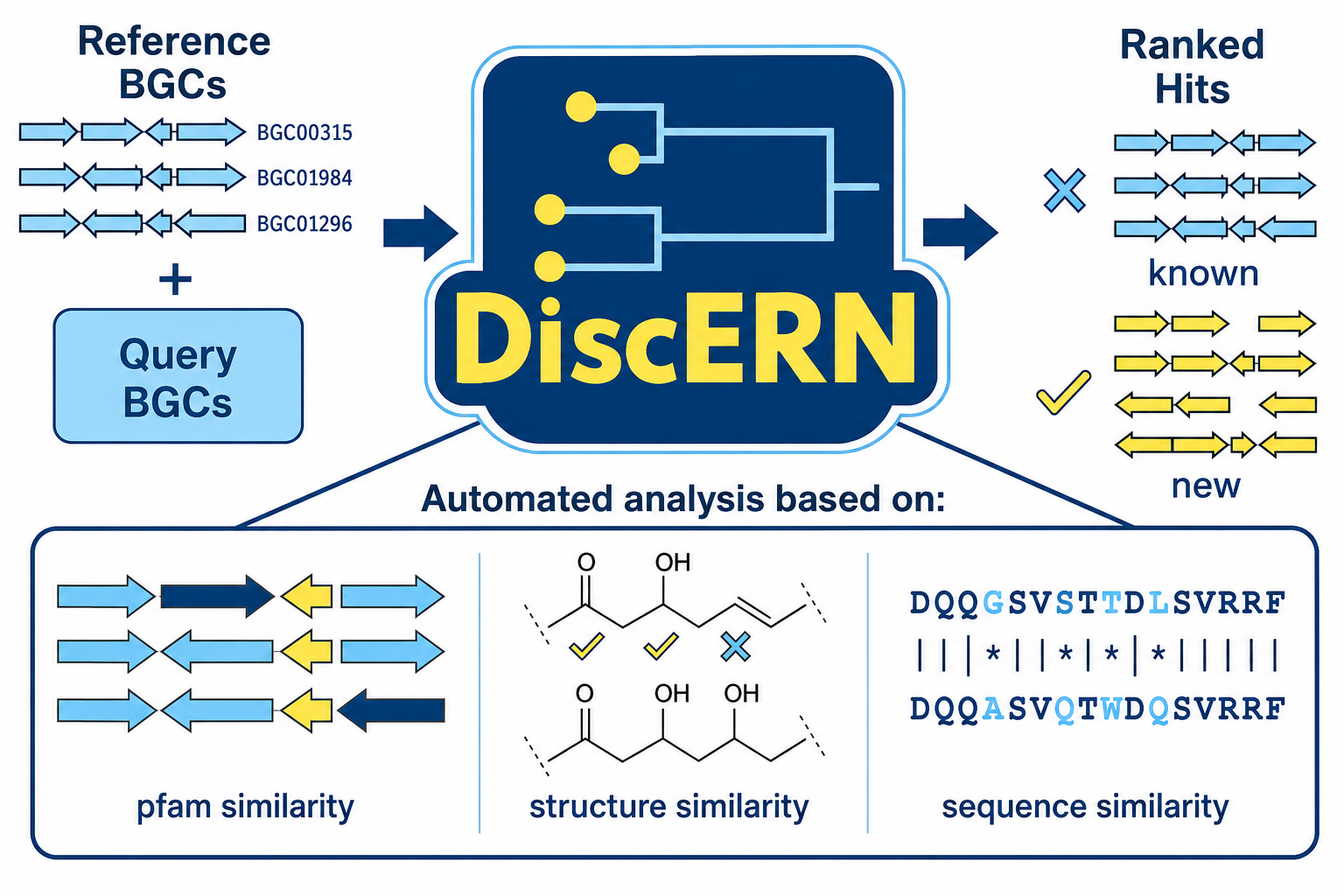
Schematic overview of DiscERN workflow: A user-defined family of BGCs specified using MIBiG numbers and a directory containing antiSMASH outputs for genomes to be analyzed is provided as input. DiscERN then applies and integrates an ensemble of algorithmic approaches to identify new family members and provides Intuitive outputs to facilitate prioritization for downstream functional analysis. Paper: DiscERN: an automated genome mining tool for the discovery of evolutionarily related natural products
In a recent 'Article in Press' in the journal Nature Communications, researchers developed a genome mining tool called the Discoverer of Evolutionarily Related Natural Products (DiscERN).
The rise of antimicrobial resistance (AMR) is a significant global health crisis, prompting renewed efforts to discover novel antibacterial chemical scaffolds. Bacterial natural products have historically been the major source of antibiotics. Genomic data indicate that the capacity for natural product synthesis is encoded within biosynthetic gene clusters (BGCs), which are discrete, co-located gene sets.
BGCs function as molecular assembly lines and harbor the enzymatic blueprints for the production of specific natural products. Studies have consistently reported that the number of BGCs exceeds the number of compounds isolated from the same organisms. As such, these cryptic or silent BGCs represent an opportunity to identify novel bioactive molecules. While tools for de novo BGC identification, single-reference searches, and large-scale clustering exist, dedicated methods optimized for the targeted, multi-reference expansion of user-defined BGC families remain limited.
The Study and Findings
In the present study, researchers developed DiscERN, an automated genome mining tool for the discovery of natural products. They leveraged four complementary algorithms to capture the distinct aspects of evolutionary relatedness: Pfam Vector, Basic Local Alignment Search Tool (BLAST) Vector, BLAST Rank, and Structural K-mer Intersection. These algorithms classify BGCs based on Pfam domain content and protein sequence similarity, with predicted product structure also used for compatible non-ribosomal peptide synthetase and polyketide synthase families.
The four algorithms were integrated into the DiscERN ensemble, which was applied to a dataset of 3,561 Actinomycete genomes to evaluate its performance in a realistic discovery task. The dataset was constructed by querying the National Center for Biotechnology Information (NCBI) Assembly Database for genomes of the class Actinomycetes. Only reference and representative genomes were included.
The genomes were processed with the Antibiotics and Secondary Metabolite Analysis Shell (antiSMASH) to generate 59,236 BGCs. Next, DiscERN parsed antiSMASH outputs using four antibiotic families as references: 16-membered macrolides, rifamycin-like polyketides, calcium-dependent lipopeptides, and glycopeptides. This yielded 688 putative hits, with up to 20 manually curated per family and confidence tier when the number of candidates was large. The examined clusters were classified as true positives, false positives, or undetermined when fragmentation prevented confident assignment.
Manual analysis of false negatives was not feasible due to the vast number of BGCs in the dataset. As such, leave-one-out (LOO) analysis was used to estimate recall for the four benchmark BGC families. DiscERN classified the held-out BGC for each LOO fold, and the number of algorithms that provided support (k) was recorded, with k indicating how many of the four methods independently identified the cluster. Subsequently, cumulative recall was computed for each confidence threshold, and F1 scores were estimated for each threshold.
In the authors’ combined performance analysis, a confidence threshold of k ≥ 2, indicating support from at least two algorithms, produced the highest estimated F1 score of 0.89, balancing an estimated recall of 0.95 with a precision of 0.84. A higher threshold (k ≥ 3, requiring agreement from at least 3 algorithms) increased estimated precision to 0.98, with virtually all classifiable predicted hits being true positives. Among BGCs identified as potentially encoding new natural products, a putative hit in the calcium-dependent antibiotic (CDA) family from Streptomyces kanamyceticus was selected for further analysis.
This BGC, named discomycin (dsc), was selected because it was present in a commercially available strain with no reports of CDA activity and because it contained a Streptomyces antibiotic regulatory protein (SARP) gene, suggesting a means of activation. The researchers integrated an additional copy of the SARP gene into the S. kanamyceticus chromosome under a strong constitutive promoter to activate the silent dsc BGC. They then cloned the complete dsc cluster and expressed it in the genome-minimized host Streptomyces albus Del14, confirming that discomycin A was the direct product of the dsc BGC.
Next, the team evaluated the biological activity of purified discomycin A against bacteria using microdilution assays. Discomycin A showed no activity against the Gram-negative bacteria examined. However, it exhibited potent calcium-dependent antibacterial activity against several Gram-positive bacteria, including Staphylococcus aureus, methicillin-resistant S. aureus USA300, and Bacillus subtilis. Cytotoxicity assessment against HCT-116 human colon carcinoma cells revealed no discernible cytotoxicity of discomycin A under the assay conditions.
Treating S. aureus with sub-inhibitory levels of discomycin A led to the accumulation of N-acetylmuramic acid (NAM) pentapeptide, consistent with inhibition of cell wall biosynthesis. Finally, the team benchmarked DiscERN against two genome-mining platforms, Genomic Assessment Tool for Orthologous Regions and Gene Clusters (GATOR-GC) and Biosynthetic Gene Similarity Clustering and Prospecting Engine (BiG-SCAPE).
Benchmarking involved targeted expansion of the calcium-dependent antibiotic family across 573 Streptomyces genomes. In this specific benchmark, DiscERN outperformed both comparators, yielding more true positives and a higher proportion of putatively novel peptide backbones than either platform. Notably, BiG-SCAPE did not identify the dsc BGC, whereas GATOR-GC did. GATOR-GC also returned another hit that neither BiG-SCAPE nor DiscERN identified.
Conclusions
In sum, DiscERN is a multimodal tool for targeted, hypothesis-driven expansion of user-defined BGC families. The study validated this pipeline through comprehensive benchmarking and identified discomycin A, a novel antibiotic from a silent BGC. The findings indicate that DiscERN provides an accessible, robust platform that streamlines the path from genomic data to a prioritized list of candidate BGCs for experimental validation, bridging the gap between in silico prediction and the discovery of bioactive compounds. However, further research will be needed to evaluate discomycin A in animal models and characterize its pharmacokinetics and broader mammalian safety.
Journal reference:
- Owen JG, Woolly EF, Lai HE, Woolner VH, Little RF (2026). DiscERN: an automated genome mining tool for the discovery of evolutionarily related natural products. Nature Communications. DOI: 10.1038/s41467-026-75491-x, https://www.nature.com/articles/s41467-026-75491-x
 Universal germline genetic testing catches missed cancer risks in older patients