By pairing students’ digital histories with years of standardized test data, researchers traced when performance gaps emerged and examined pervasive smartphone habits as one possible explanation.

Study: Longitudinal effect of early social media use on standardized learning outcomes during school career. Image Credit: Arsenii Palivoda / Shutterstock
In a recent study published in the journal Nature Human Behaviour, Italian researchers estimated the effects of early social media exposure on children's academic performance.
Children’s early use of digital devices is debated in the media and among scholars, leaving educators and parents uncertain amid conflicting recommendations. Most young people create their first social media accounts at ages often below the platforms' or countries' minimum age requirements. Many studies suggest an association between intensive social media use and adverse well-being outcomes, such as lower concentration, poorer sleep quality, and reduced in-person interactions.
About the study
In the present study, researchers used longitudinal academic records to examine the effects of early social media use on students' learning outcomes in Italy. The study leveraged data from two sources: the Italian National Institute for the Evaluation of the Education and Training System (INVALSI) and the Early Exposure to Screens and Unequal Performance (EYES UP) project. A web survey was administered as part of the EYES UP project to students enrolled in grades 10 and 11 in northern Italy during 2023–24.
The survey collected retrospective data on students' academic trajectories, the timing of their acquisition and use of digital devices, parental control of devices, satisfaction across life domains, and subjective well-being.
INVALSI collects standardized data on student achievement using competence tests in English, Italian, and math in different grades. EYES UP survey data were merged with INVALSI test records. Learning outcomes were INVALSI scores in Italian, English, and math tests.
In addition, longitudinal data on math and Italian marks were obtained from INVALSI for grades 2, 5, 8, and 10. Students were classified by the self-reported grade at which they first created a personal social media account. Early adopters (or users) were those who created a social media account in grade 6, 7, or 8, and late adopters were those who created it in grade 9 or later.
The principal longitudinal analysis included 4,545 students who opened an account after grade 5 and after acquiring a personal smartphone, meaning the effects of social media and smartphone ownership could not be fully separated.
The team applied a difference-in-differences strategy combined with statistical matching to estimate the effects of early social media use, comparing changes in academic performance over time between matched early and late adopters.
Findings
The study included 5,227 grade 10 and 11 students whose linked academic records spanned grades 2–10, approximately ages 7–16. The median grade for the first use of video game consoles was grade 4. About 47% of students received a smartphone in grade 6, and 98% owned a smartphone by the end of grade 8.
Further, 11.2% of students first joined social media in primary school, 29.5% in grade 6, 25% in grade 7, and 18% in grade 8. Notably, only 16.3% joined social media in grade 9 or later (which generally corresponds to Italy’s legal minimum age of 14 for autonomous access).
The number of years of social media exposure was negatively associated with learning outcomes in math and Italian. Before statistical matching, students with earlier exposure to social media came from less educated families. Moreover, these students had lower scores on the competence test.
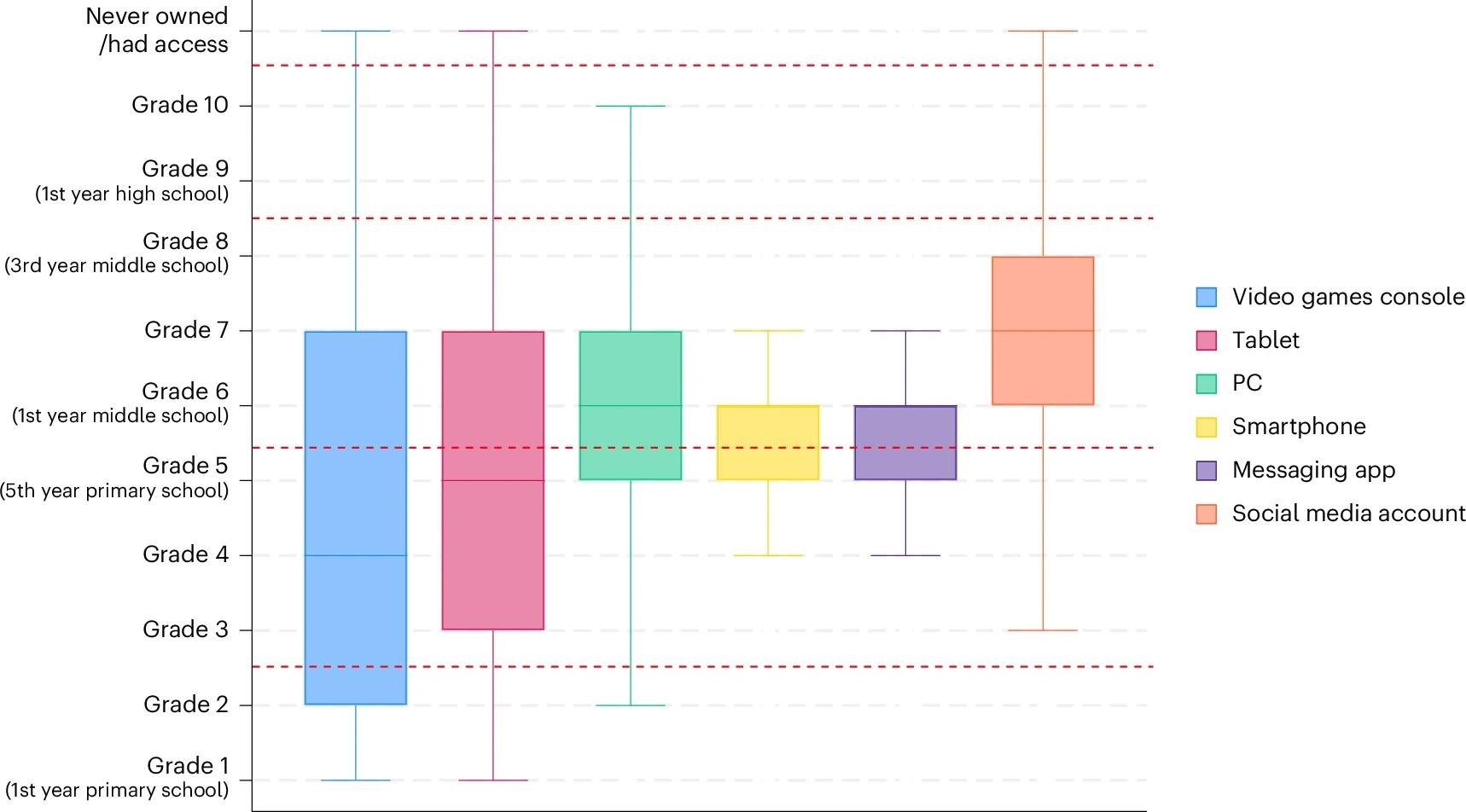
Exposure to technology during primary, lower- and upper-secondary school, box plot. Notes: N (students) = 5,227. The center line indicates the median; box bounds indicate the 25th and 75th percentiles; whiskers extend to the lower and upper adjacent values, defined as the most extreme observations within 1.5 times the interquartile range from the lower and upper quartiles, respectively. The horizontal red dashed line represents the timing of the INVALSI competence tests, which take place at the end of grades 2, 5, 8, and 10. The original questions were worded differently according to each device or account type. Students were asked to indicate the grade in which they first had (i) their own internet-connected smartphone, (ii) access to video game consoles, (iii) independent access to tablet and computer, and (iv) a personal profile for messaging apps and social media accounts.
The adjusted models estimated that students who created social media accounts in grade 6 had 0.22 standard deviations (SD) lower scores in Italian at grades 8 and 10 and 0.18 SD lower scores in math at grade 8 (and 0.27 SD lower at grade 10) than late adopters.
Students who first opened an account in grade 7 showed smaller but still meaningful estimated score deficits. Notably, the researchers found no statistically significant evidence that early social media adoption affected English competence; the authors offered the purely hypothetical explanation that much of the online content is in English. Furthermore, students who first opened accounts in grades 6 or 7 were more likely to repeat a grade in upper-secondary school than late adopters. Early adopters were also less likely to achieve excellent marks at the end of grade 8.
Finally, the team explored potential mediators (e.g., smartphone pervasiveness, parental control, life satisfaction, and parental access to online activities) of the negative association between social media access and academic performance.
Higher smartphone pervasiveness was associated with lower Italian and math scores by grade 10. Adding smartphone pervasiveness to the exploratory models reduced the estimated association by about 15%–34% for Italian test scores and 33%–47% for math test scores. Because data on the potential mediators were not longitudinal, the authors described this evidence as exploratory and purely correlational.
Conclusions
Collectively, the findings indicate that early social media use was negatively associated with academic performance compared with later adoption. Students who first opened social media accounts in grades 6 or 7 consistently showed worse outcomes in nearly all school-related dimensions. The estimated academic disadvantages were generally greater with earlier adoption and persisted or intensified through grade 10.
Because this was a non-experimental study, its causal interpretation depends on the parallel-trends assumption and the absence of unmeasured time-varying confounders. The timing of social media adoption was also reported retrospectively.
The study did not directly measure social media screen time or the content students consumed. Estimates for grade 8 adoption, particularly for mathematics, were less resistant to violations of the parallel-trends assumption.
Generalizability is limited by the northern Italian sample and the exclusion of dropouts, students in short vocational programs, and many students who repeated multiple grades. Further research is needed to investigate whether early exposure to social media affects social relationships and psychological well-being.
Journal reference:
- Gui M, Respi C, Abbiati G, et al. (2026). Longitudinal effect of early social media use on standardized learning outcomes during school career. Nature Human Behaviour. DOI: 10.1038/s41562-026-02522-4, https://www.nature.com/articles/s41562-026-02522-4
 Hemp brands exploit social media to market intoxicating products to youth