A Finnish birth cohort study probes how everyday coffee habits relate to body composition, amino acids, insulin markers, and sex hormones, revealing striking differences between men and women.

Study: Associations of habitual coffee intake with testosterone and cardiometabolic markers: the Northern Finland birth cohort 1966 study. Image Credit: bazilpp / Shutterstock
In a recent study published in the European Journal of Nutrition, researchers examined associations of habitual coffee intake with circulating metabolites, cardiometabolic markers, and sex-specific hormonal profiles.
Background
What might a routine cup of coffee reveal about metabolic and hormonal health? Coffee is an integral part of everyday life, and Finland has the highest coffee consumption in the world, at roughly 11.8 kg per person per year. Coffee contains over 1,000 bioactive substances, including caffeine, trigonelline, cafestol, kahweol, and chlorogenic acids.
Previous evidence has linked coffee intake with several cardiometabolic outcomes, but findings on testosterone and other hormonal pathways have been limited and inconsistent. These uncertainties prompted the researchers to examine habitual coffee intake in relation to metabolic, cardiometabolic, and hormonal markers.
About the study
Data were obtained from the 46-year follow-up in 2012 of the Northern Finland Birth Cohort 1966 (NFBC1966), a population-based cohort established in Oulu and Lapland, Finland. At age 46, 10,331 eligible cohort members were invited, and 5,832 attended clinical examinations.
All participants were instructed to fast for 12 hours and to abstain from smoking and coffee before their clinical examination. Individuals with missing coffee or tea intake were excluded, as were tea consumers; the final sample included 2,264 participants, comprising 2,194 coffee consumers and 70 non-consumers.
Clinical and laboratory measures were collected from participants during assessment. The coffee intake measure was based on participants' self-reported average number of cups consumed per day. Groups were created based on the extent of coffee consumption and categorized as 0, 1-2, 3-4, and ≥5 cups per day.
Measures included body mass index (BMI), waist-to-hip ratio, body fat percentage and mass, visceral fat area, and skeletal muscle mass. Hormonal analysis included total, free, and bioavailable testosterone, sex hormone-binding globulin (SHBG), and the free androgen index (FAI). Fasting serum underwent proton nuclear magnetic resonance (NMR) metabolomics, quantifying 164 lipid and metabolite measures.
Sex-stratified Spearman correlations were used to examine metabolomic and cardiometabolic markers, while multivariable linear regression of hormonal markers was adjusted for BMI, education, smoking, physical activity, and alcohol consumption. Female hormonal analyses excluded women with polycystic ovary syndrome (PCOS) or missing PCOS status.
Study results
In total, there were 2,264 participants in the final analysis, of which 47% were men. Among coffee drinkers, 296 were low consumers, 822 were moderate consumers, and 1,076 were high consumers. The proportion of men increased from 35% among low consumers to 55% among high consumers. In contrast, BMI, waist circumference, hip circumference, and waist-to-hip ratio were similar across coffee categories.
Body composition differed significantly across coffee consumption groups. Higher coffee intake groups had lower body fat percentage and mass, lower visceral fat area, and greater skeletal muscle mass. These observations were consistent even after the participants with extreme BMI values were excluded from the analysis.
Metabolomic analyses identified sex-specific correlation patterns, although the correlations were generally small. In men, higher coffee intake was inversely correlated with several amino acids, including the branched-chain amino acids (BCAAs) isoleucine, leucine, and valine, and the amino acid alanine, as well as omega-3 fatty acids.
Positive correlations were observed with several low-density lipoprotein (LDL)- and intermediate-density lipoprotein (IDL)-related cholesterol measures and with the proportion of saturated fatty acids.
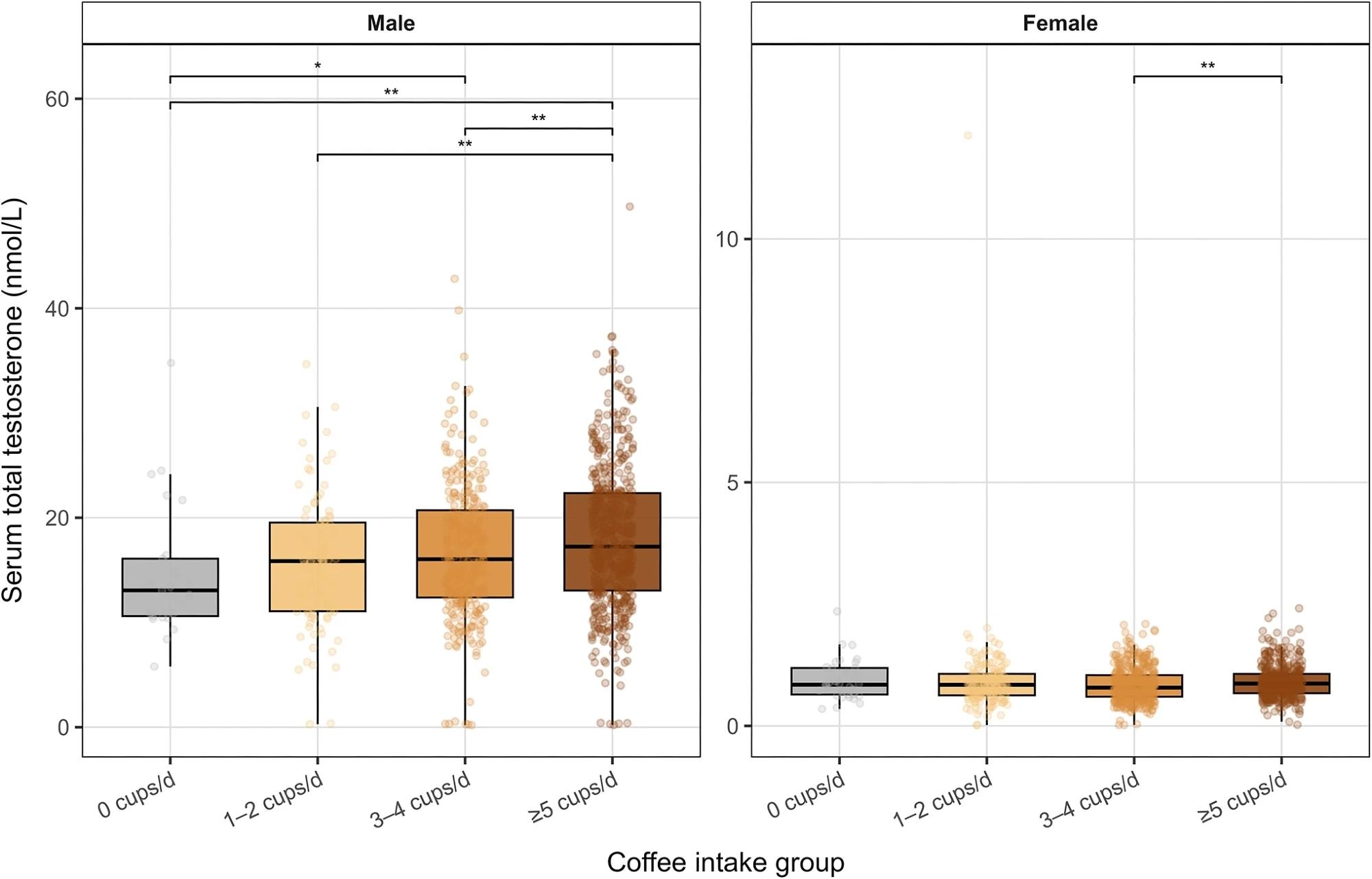
Serum total testosterone by coffee intake group, stratified by sex
In women, the correlation pattern was narrower, with inverse associations involving glycerol, citrate, leucine, and omega-3 fatty acids and a positive association with glycine.
Cardiometabolic correlations were more pronounced in men, although most were small. Higher coffee intake was inversely correlated with fasting insulin, insulin responses at 60 and 120 minutes during the oral glucose tolerance test (OGTT), and Homeostatic Model Assessment 2 (HOMA2)-derived measures of insulin resistance and beta-cell function.
Positive correlations were observed with HOMA2-derived insulin sensitivity, SHBG, total testosterone, bioavailable testosterone, and the FINRISK cardiovascular risk score. In comparison, associations in women were much fewer and weaker, with inverse correlations involving waist-to-hip ratio, high-sensitivity C-reactive protein (CRP), and fasting insulin, and positive correlations with QUICKI-derived insulin sensitivity and the FINRISK score.
The authors noted that the FINRISK associations may reflect correlated lifestyle factors rather than a direct adverse effect of coffee.
Hormonal findings were especially sex-specific. In men, serum total testosterone was generally higher with greater coffee intake. Moderate and high consumers had significantly higher testosterone concentrations than non-consumers, and high consumers also had higher concentrations than low and moderate consumers. Fully adjusted regression models showed that each additional cup of coffee per day was associated with higher total testosterone (β = +0.29 nmol/L), bioavailable testosterone (β = +0.08 nmol/L), and SHBG (β = +0.57 nmol/L), but lower FAI (β = −0.36) and free testosterone (β = −0.01 nmol/L), after full adjustment.
In women without PCOS, coffee intake was positively associated with SHBG (β = +1.27 nmol/L per cup/day) and inversely associated with FAI (β = −0.32) and free testosterone (β = −0.01 nmol/L per cup/day). No significant associations were observed with total or bioavailable testosterone.
The authors cautioned that these findings reflect population-level endocrine patterns rather than evidence that additional coffee intake produces clinically meaningful hormonal changes in individuals.
Conclusions
Higher coffee intake groups had lower body fat and visceral fat and greater skeletal muscle mass despite similar BMI across intake groups. Coffee intake was inversely correlated with circulating BCAAs in both sexes.
The strongest hormonal associations were sex-specific: in men, higher intake was associated with higher total and bioavailable testosterone and SHBG but lower free testosterone and FAI; in women, associations centered on higher SHBG and lower free testosterone and FAI. Because the study was cross-sectional, the findings represent population-level associations rather than causal effects, and reverse causation and residual confounding cannot be excluded.
Coffee intake was also self-reported; the non-consumer group was small, and the homogeneous Finnish population may limit generalizability. Longitudinal and interventional studies are needed to establish causality and identify coffee-derived bioactive compounds.
Journal reference:
- Verroest, L., Jokelainen, J., Choudhary, S., Walkowiak, J., Karhu, T., Palaniswamy, S., Auvinen, J., Järvelin, M.-R., Herzig, K.-H., & Raza, G. S. (2026). Associations of habitual coffee intake with testosterone and cardiometabolic markers: The Northern Finland Birth Cohort 1966 study. European Journal of Nutrition. 65. DOI: 10.1007/s00394-026-04038-z, https://link.springer.com/article/10.1007/s00394-026-04038-z
 Too little or too much testosterone may matter for heart rhythm