A nationwide analysis of hospital technology adoption reveals striking differences in who lives near AI-enabled care, while also examining whether specific digital tools are associated with better outcomes in time-sensitive treatment.

Study: Hospital AI and robotics adoption and access inequality in the United States. Image Credit: tete_escape / Shutterstock
In a recent study published in the journal Scientific Reports, researchers at Drexel University, USA, conducted a national observational analysis of 3,143 counties to investigate associations between hospital artificial intelligence (AI) and robotic systems and clinical outcomes, as well as geographic access disparities across the United States (US).
The primary analyses focused on 2023 data and included technology adoption records from the American Hospital Association (AHA; 6,166 hospitals), clinical care metrics from the Centers for Medicare & Medicaid Services (CMS), and mortality data from the Centers for Disease Control and Prevention (CDC).
Study findings revealed that specific workflow AI capabilities were associated with statistically significant differences in hospital-level time-sensitive care outcomes (e.g., 5.4% relative decline in 30-day pneumonia mortality). The study also demonstrated that physical access to these technologies remains sharply unequal, estimating that approximately 114.6 million people in the access-analysis population lived more than a 30-minute drive from an AI-enabled hospital.
Background
Persistent staffing strain and workforce burnout can contribute to coordination failures during time-sensitive clinical care in hospitals across the United States (US).
As hospital adoption of artificial intelligence (AI) and robotic systems grows, these technologies may help address operational pressures, but technology diffusion in healthcare remains uneven: large, digitally mature health systems tend to adopt these technologies first, while many rural communities remain farther from AI- and robotics-enabled care.
National evidence evaluating the clinical associations and potential access inequities of hospital AI and robotics remains limited in the US.
About the study
The present study aimed to address this knowledge gap and inform future digital technology deployment policy by examining whether hospital AI and robotics were associated with clinical rescue outcomes and population health, and by mapping travel barriers that prevent AI-enhanced hospital accessibility across the contiguous US.
The study’s analytic sample included data from the American Hospital Association's (AHA) 6,166-strong hospital dataset (2023; for 3,143 counties), along with mortality data from the Centers for Disease Control and Prevention (CDC), hospital outcome data from the Centers for Medicare & Medicaid Services (CMS), and socioeconomic measures from County Health Rankings.
To account for wealth-proxy bias (where technology adoption may reflect pre-existing hospital resources and organizational capacity), augmented inverse probability weighting (AIPW) models were adjusted for 2019 baseline performance, as well as hospital and county covariates, when estimating 2023 associations.
Statistical evaluations first assessed hospital-level clinical care processes with a specific focus on: 1. Severe sepsis and septic shock early management bundle (SEP-1) compliance, and 2. 30-day risk-standardized pneumonia mortality.
The models then evaluated separate county-level premature mortality measures, including 2023 hospital-setting deaths among residents under age 75 and years of potential life lost (YPLL). Finally, the study estimated geographic accessibility by analyzing population-weighted drive times across ~240,000 US Census block groups.
Study findings
The study’s hospital-level analyses found that specific AI workflow capabilities were associated with better outcomes in certain time-sensitive rescue pathways. For example, adoption of staff-scheduling AI was associated with an adjusted 2.24-percentage-point increase in SEP-1 sepsis bundle completion (3.9% relative improvement, P < 0.05), and routine task automation AI was associated with a 0.87-percentage-point reduction in 30-day pneumonia mortality (5.4% lower mortality, P < 0.05). Hospitals that later adopted routine-task automation AI already had modestly lower pneumonia mortality before adoption, making this association more vulnerable to residual confounding.
In exploratory analyses, in-hospital robotics adoption was associated with an adjusted 0.03-point improvement in Patient Safety Indicator 15 (PSI-15), a metric for accidental puncture and laceration events.
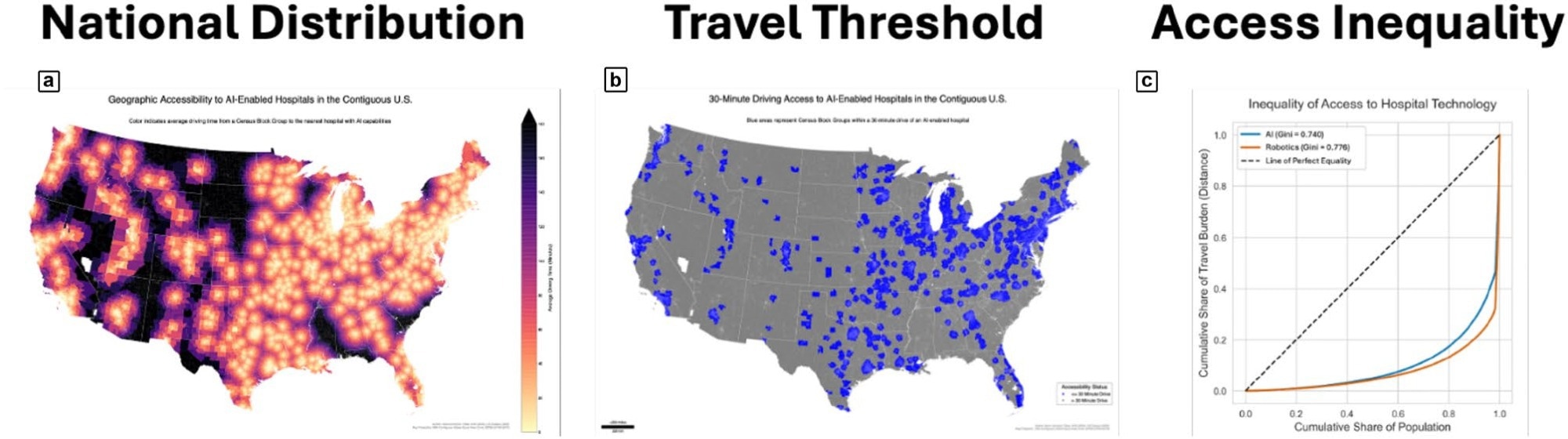
National geographic access and inequality in AI- and robotics-enabled hospital access (2023). (a) Continuous access map using Census block-group proxy drive time to the nearest AI-enabled hospital in the contiguous U.S., where AI-enabled status is defined using the workflow AI routine-task automation measure (AHA item MO14, AI for automating routine tasks) aligned with the primary county mortality models. (b) Binary policy-threshold map indicating block groups within a 30-min drive of an AI-enabled hospital; in 2023, 65.8% of the access-analysis population was within 30 minutes, and approximately 114.6 million remained outside this access threshold. (c) Lorenz curves for population-weighted travel burden to AI- and robotics-enabled hospitals, showing high but differential inequality (AI Gini = 0.740; Robotics Gini = 0.776). Together, the three panels visualize national technology access gaps and their distributional consequences.
At the county level, access to routine-task automation AI was associated with 25.5 fewer hospital deaths per 100,000 residents under age 75 (a 9.9% reduction, P < 0.001). This estimate was sensitive to model choice and attenuated to near zero after an added adjustment for organizational capacity, so the authors treated it cautiously. The historical YPLL benchmark also showed lower premature mortality in counties with AI access and was more consistent across alternative statistical models.
The study found that while 79.5% of the access-analysis population (266.0 million individuals) lived within a 30-minute drive of surgical robotics, only 65.8% (220.1 million) lived within a 30-minute drive of AI-enabled hospitals, leaving 114.6 million people outside this threshold, indicating marked geospatial inequality within the country. The access measure reflected geographic proximity rather than actual service use, hospital capacity, or the depth of AI implementation.
Geographic accessibility models found that the 90th percentile (P90) drive distance to an AI-enabled hospital was 61.3 miles, compared with 1.9 miles at the 10th percentile (P10), yielding a P90/P10 access gap ratio of 32.3.
From 2022 to 2024, the number of AI-enabled hospitals increased by an estimated 56%, while population coverage rose from 66.2% to 75.2%. Yet the Gini coefficient increased slightly from 0.739 to 0.767, indicating that distributional inequality did not improve. The P90/P10 gap narrowed by 33%, suggesting some improvement among the most poorly served populations. This multi-year comparison used a broader definition of AI-enabled hospitals than the primary 2023 analysis.
Conclusions
The present study found that specific hospital AI capabilities were associated with better outcomes in several time-sensitive care measures, while robotics showed narrower procedural associations. These associations occurred alongside deep geographic inequalities in access across the US, with AI adoption clustered in urban areas and many rural communities farther from hospitals that adopted it.
Because the study was observational, the results do not establish that AI or robotics caused better outcomes, and residual differences in hospital resources and organizational capacity may partly explain the associations.
 What a 38-year study suggests about red meat, white meat, and mortality