Can ice massage, massage guns, or a combination help runners recover after strenuous exercise? A randomized trial tracked muscle soreness, jumping performance, and calf and Achilles tendon stiffness over 72 hours to compare four recovery approaches.
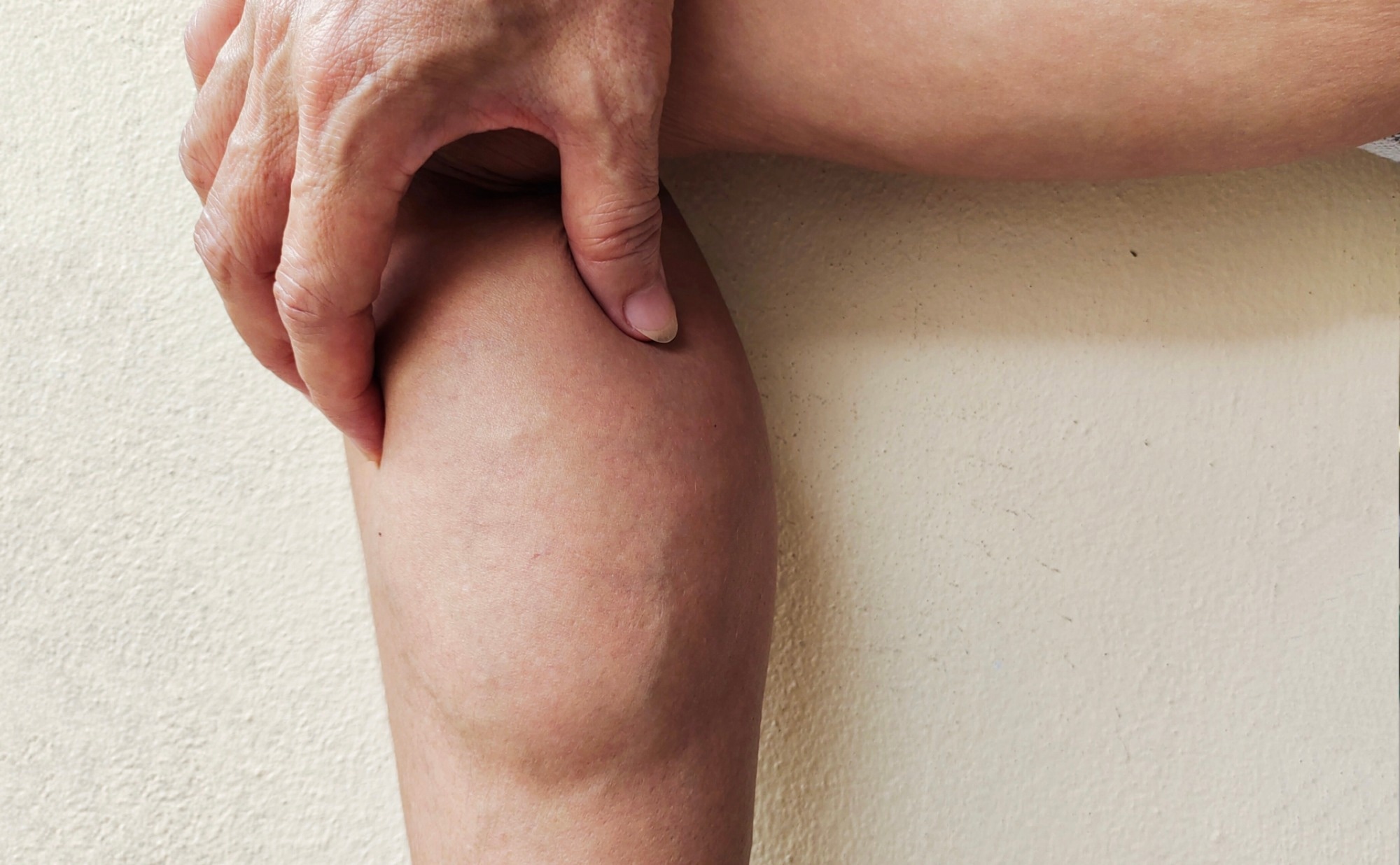
Study: Effects of repeated ice massage, percussive massage, and combined recovery on 72-h calf muscle–tendon recovery after eccentric exercise in recreational runners: a randomized controlled trial. Image Credit: Rungkh / Shutterstock
In a recent study published in the journal Scientific Reports, the researchers compared the effects of repeated ice massage, percussive massage, combined recovery, and passive rest on calf muscle–tendon recovery over 72 hours after exercise involving controlled, resistance-loaded calf muscle lengthening in recreational runners.
Scientists from the Medical University of Silesia, Jan Dlugosz University, Katowice Business University, and Provita Medical Center in Poland conducted the research in collaboration with the University of Montenegro and the Montenegrin Sports Academy.
Background
How quickly can a runner’s calves recover after exercise? Running offers health benefits, but repetitive lower-limb loading exposes recreational runners to musculoskeletal injuries, particularly involving the calf and Achilles tendon. Intensive or unfamiliar eccentric exercise can temporarily reduce muscle function, increase soreness, alter tissue stiffness, and affect biochemical markers. These responses may recover at different rates, so no single measure is sufficient to describe recovery. Ice massage and percussive massage are used after exercise, but evidence for their effects on performance and muscle-tendon properties remains mixed. Further randomized research using multiple recovery measures and repeated assessments is needed to clarify their short-term effects.
About the study
In this single-center, four-arm randomized controlled trial, 80 recreational runners aged 18–40 years were allocated equally to ice massage, percussive massage, combined recovery, or passive recovery. Participants had at least 3 years of running experience, completed at least three weekly running sessions, and covered at least 60 km monthly. They performed five sets of 15 bilateral Smith-machine calf raises, using an individualized load of approximately 70% of body mass and a controlled 3- to 4-second eccentric lowering phase. Active treatments began immediately and were repeated twice daily for 72 hours, for a total of seven sessions. Ice massage involved three 3-minute applications with 1-minute rests during a 12-minute session per calf; percussive massage was delivered for 10 minutes within a 12-minute per-calf protocol that included manual massage before and after treatment; combined treatment alternated 2 minutes of each modality three times per calf.
Assessments occurred before and immediately after exercise and at 24, 48, and 72 hours. Outcomes included Reactive Strength Index (RSI), a measure of how quickly someone can transition from landing to jumping, tissue stiffness measured using shear wave elastography (SWE), an ultrasound technique applied to the gastrocnemius and Achilles tendon, soreness on the Numerical Rating Scale (NRS), serum lactate dehydrogenase (LDH), Borg perceived-exertion scores, and Total Quality Recovery (TQR). Allocation was concealed in sealed opaque envelopes, and outcome assessors and the laboratory diagnostician were masked to group assignment. Participants and treating physiotherapists were not blinded, and the study included no sham or attention-matched treatments. Participants avoided running, strenuous lower-limb activity, and other recovery methods during follow-up.
Study results
All 80 participants completed follow-up, with 20 in each group and no missing outcome data. Baseline demographic and running characteristics were similar across the randomized groups. The eccentric protocol produced changes across measured domains: reactive strength and perceived recovery declined, while soreness, perceived exertion, LDH activity, and stiffness in both heads of the gastrocnemius muscle and the Achilles tendon increased. Recovery trajectories differed significantly among groups for all eight outcome or anatomical-site models.
RSI improved in every group over 72 hours, with the greatest increase after combined recovery (+0.62 m/s), followed by ice massage (+0.52 m/s), percussive massage (+0.49 m/s), and passive recovery (+0.38 m/s). Compared with passive recovery, the improvement was 0.24 m/s greater after combined treatment, 0.14 m/s greater after ice massage, and 0.11 m/s greater after percussive massage. Exploratory comparisons also favored combined treatment over ice massage and percussive massage; these comparisons were not the primary treatment contrasts. The study did not establish whether these improvements were clinically meaningful or translated into better subsequent running performance.
Stiffness declined more with each active intervention than with passive recovery. At 72 hours, the additional reduction relative to passive recovery ranged from roughly 1.5 to 2.3 kilopascals (kPa) in the medial and lateral gastrocnemius heads and 23 to 39 kPa in the Achilles tendon. Lower stiffness does not necessarily indicate tissue healing or better athletic performance.
Soreness also decreased more with active recovery: the reductions exceeded passive recovery by 1.20 points with ice massage, 1.30 points with percussive massage, and 1.35 points with combined treatment. At 72 hours, soreness scores were 0.5, 0.3, and 0.1 after ice, percussive, and combined recovery, respectively, compared with 1.5 after passive recovery.
LDH activity, a nonspecific indicator of exercise-related cellular stress, declined in all four groups, but none of the active interventions differed significantly from passive recovery at 72 hours after adjustment. Perceived exertion decreased more with active recovery than with passive recovery. TQR improved more after ice massage (+2.95 points), combined recovery (+2.35 points), and percussive massage (+0.95 points) than after passive recovery. Ice massage showed the largest improvement in perceived recovery, while combined recovery produced the greatest improvement in RSI. Differences in therapist contact and participant expectations may have contributed to improvements in reported soreness and perceived recovery.
Conclusions
Repeated ice massage, percussive massage, and combined recovery were associated with more favorable 72-hour changes in reactive strength, muscle-tendon stiffness, soreness, and perceived recovery than passive rest in recreational runners after eccentric calf loading. The combined treatment showed the largest reactive-strength improvement, but its advantage over the isolated treatments was based on exploratory comparisons. LDH differences were not sustained at 72 hours.
The findings apply to this protocol and population; they do not establish tissue repair, injury prevention, or superiority of combined treatment. The experiment used controlled calf raises rather than running, so its relevance to recovery after normal training or competition remains uncertain. Larger, longer-term studies with sham-controlled comparisons are needed, while treatment choice should reflect the recovery outcome being prioritized and the athlete’s tolerance.
Source:
Journal reference:
- Ryszkiel, I., Pilis, K., Stanek, A., Olchowy, C., Bjelica, D., & Trybulski, R. (2026). Effects of repeated ice massage, percussive massage, and combined recovery on 72-h calf muscle–tendon recovery after eccentric exercise in recreational runners: A randomized controlled trial. Scientific Reports. DOI: 10.1038/s41598-026-80302-w, https://www.nature.com/articles/s41598-026-80302-w
 Graded physical activity prescriptions improve functional outcomes in psychiatry