Can artificial intelligence learn what makes a burger irresistible while improving its nutritional value and environmental footprint? Researchers put five AI-designed recipes to the taste test against one of the world's most recognizable burgers.
Research: Generative artificial intelligence creates delicious, sustainable, and nutritious burgers. Image Credit: Naja_WoW / Shutterstock
In a recent study published in the journal npj Science of Food, researchers at Stanford University and Stanford University School of Medicine, California, USA, evaluated whether generative artificial intelligence (AI) can learn patterns in human food preferences from existing recipes and developed burgers designed separately for taste, nutritional quality, and environmental sustainability.
Background
Can a burger be both delicious and environmentally sustainable while offering better nutritional value?
Food choices affect human and planetary health, as food production contributes to climate change, biodiversity loss, and freshwater depletion. Inadequate dietary patterns result in malnutrition and chronic diseases.
Sustainable, nutritious alternative foods may offer many benefits, but the main constraint is consumer acceptance. This acceptance depends heavily on taste, texture, and cultural familiarity.
Conventional food development relies heavily on culinary expertise and repeated testing, which can slow the search for new formulations. Generative AI can rapidly examine ingredient combinations while accounting for established preferences and nutritional goals.
About the study
The researchers implemented a two-stage generative AI model to create burger recipes. The model was trained on 2,216 human-written burger recipes curated from a collection of over half a million recipes on Food.com. The dataset covered 146 ingredients, and the model learned which ingredients commonly appeared together and in what quantities.
The model created one million burger recipes and assessed them for novelty, predicted palatability, environmental impact, and nutritional quality. The researchers selected promising candidates according to these measures.
Recipe similarity was measured using the substantial difference score (SDS). Recipe popularity was used to estimate how appealing each combination might be, rather than as a direct measure of taste. Environmental sustainability was assessed using an aggregated score incorporating land use, freshwater eutrophication potential, scarcity-weighted water use, and greenhouse gas emissions. Nutritional evaluation used the Healthy Eating Index (HEI), which assesses how closely food composition follows dietary recommendations.
Five AI-generated burgers representing different design objectives were selected, along with the Big Mac as a reference. An executive chef translated the ingredient lists into standardized cooking and assembly instructions for other chefs to follow.
A blinded sensory evaluation involving 101 volunteers was conducted at a restaurant in San Francisco, California. Each participant tasted all six burgers and rated overall liking, flavor, and texture on a seven-point scale.
The researchers also collected descriptive impressions, including whether the burgers tasted meaty, smoky, earthy, or bland.
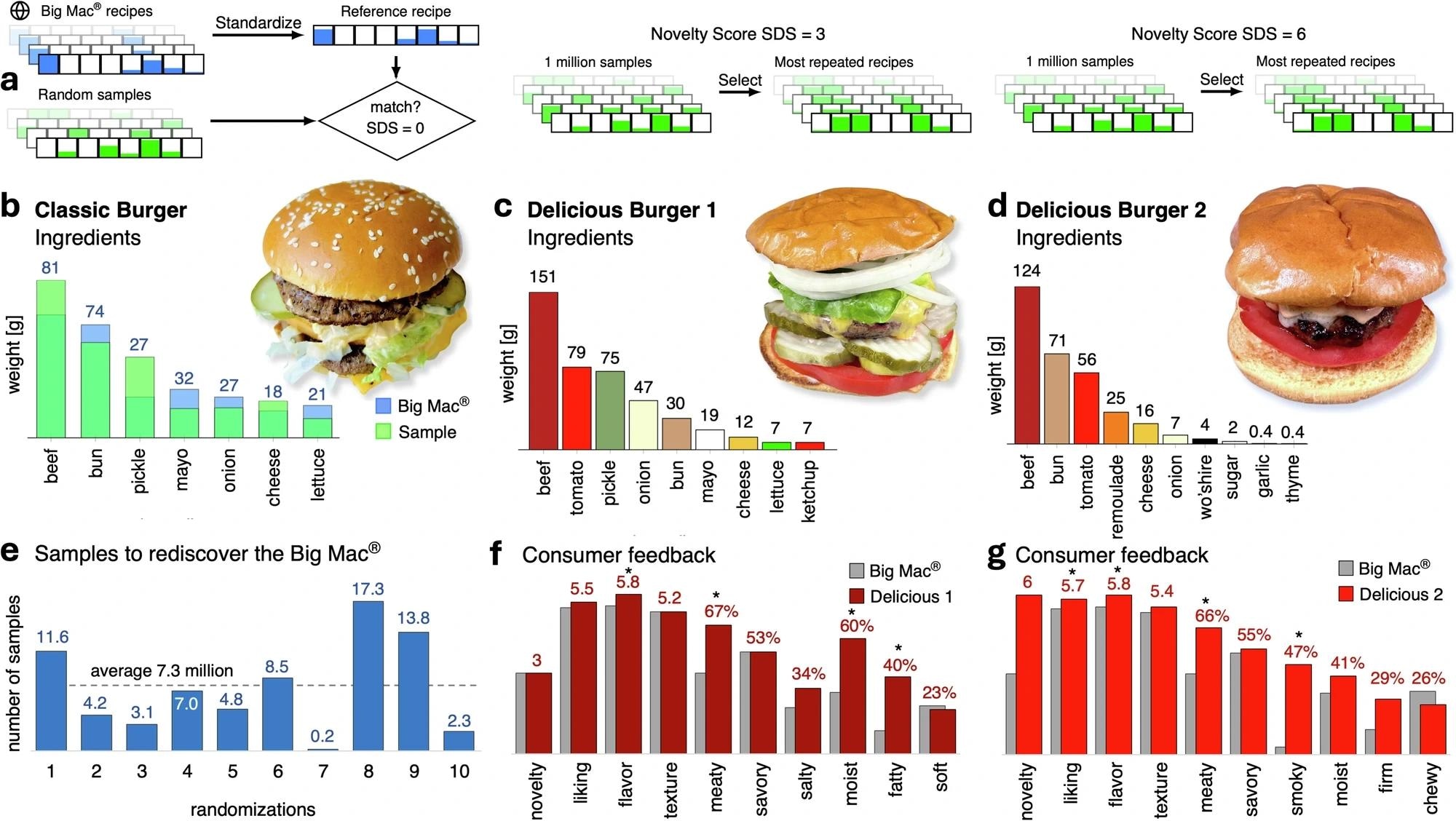
The generative AI rediscovers classic burgers and discovers novel burgers from random AI generated samples, where a substantial difference score of zero, SDS = 0, defines a match between a classic recipe and the sample, and a substantial difference score larger than zero, SDS > 0, defines the novelty score of the sample (a); rediscovered recipe of the Big Mac® as representative Classic Burger (b); discovered recipes of Delicious Burger 1 with SDS > 3 and Delicious Burger 2 with SDS > 6 (c, d); number of samples needed to rediscover the Big Mac® for n = 10 randomizations (e); consumer feedback for Delicious Burger 1 and Delicious Burger 2 compared to the Big Mac® (f, g); * indicates statistical significance (p < 0.05).
Study results
The generated samples closely matched the original dataset in ingredient popularity, ingredient correlations, and recipe length, though ingredient-quantity estimates were less precise. Popular ingredient combinations generally occupied regions associated with higher predicted palatability but lower nutritional scores.
In a separate experiment, the model generated a recipe matching a reconstructed Big Mac reference under the study's similarity criteria, without being trained on that reference. The researchers assembled the reference from four publicly available recreations because the official formula is proprietary.
Across ten independent runs, finding a match required an average of 7.3 million generated recipes. The match allowed some variation in ingredient quantities and did not establish that the model had reproduced the exact commercial formula.
In the tasting, Delicious Burger 1 had slightly higher flavor ratings than the Big Mac. Delicious Burger 2 also had slightly higher overall liking and flavor ratings. These differences were statistically significant but modest, while texture scores were similar. Participants more often described Delicious Burger 1 as meaty, moist, and fatty, whereas Delicious Burger 2 was more often described as meaty and smoky.
The researchers also selected two mushroom-containing burgers to examine environmental performance. Sustainable Burger 1, a mushroom-based formulation, achieved an environmental impact score of 0.06, around 94% lower than the Big Mac score of 0.93.
Sustainable Burger 2, with beef and mushrooms, had an environmental impact score of 1.02, slightly higher than the Big Mac's. Sensory evaluation of Sustainable Burger 1 showed that the mushroom-based patty received significantly lower ratings for liking, flavor, and texture compared to the Big Mac. Sustainable Burger 2 received similar ratings, with no statistically significant differences detected.
The model also produced a Nutritious Burger with an HEI score of 63.12, nearly twice the Big Mac's score of 33.71. Its estimated environmental impact score was about one-sixth of the Big Mac's. The formulation included more vegetables, whole grains, and plant protein, and less refined grains, sodium, and saturated fat.
These nutritional improvements were calculated from ingredient data, rather than demonstrated through clinical health outcomes. The burger scored significantly lower on overall liking, flavor, and texture during tasting than the conventional burger. Participants described it as earthy, bland, dry, soft, and grainy.
The model also generated personalized burgers based on age, sex, body composition, and physical activity. Examples included recipes for an active 15-year-old male and a moderately active 70-year-old female, showing how ingredient selection and quantities could be adjusted to individual nutritional needs.
These examples were computational and were not included in the restaurant tasting. Comparisons across all six burgers highlighted distinct trade-offs between novelty, ingredient diversity, sensory acceptance, nutrition, and environmental impact.
The two delicious burgers earned the strongest sensory ratings but had higher estimated environmental impacts than the Big Mac. The mushroom-based and bean-based versions offered greater environmental or nutritional improvements, accompanied by lower sensory ratings.
Conclusions
The results show how generative AI can use publicly available recipes and learn statistical patterns associated with human food preferences to create burgers selected for different goals. The model matched a reconstructed Big Mac reference within defined similarity limits, developed other burger alternatives with comparable sensory acceptance, identified one mushroom-based formulation with substantially lower estimated environmental impact, and developed a bean-based burger with improved nutritional quality.
The findings also show that no single tested burger achieved the highest scores for taste, nutrition, and sustainability at once. The model primarily reflects Western-style burger traditions, considers ingredient identities and quantities rather than cooking processes, and relies on aggregated environmental and nutritional databases. Broader sensory evaluations and more comprehensive food-design models are needed to establish its wider applicability.
Source:
Journal reference:
- Tac, V., Gardner, C. D., & Kuhl, E. (2026). Generative artificial intelligence creates delicious, sustainable, and nutritious burgers. npj Science of Food, 10, 199. DOI: 10.1038/s41538-026-00953-x, https://www.nature.com/articles/s41538-026-00953-x
 Advancing Neuroscience Research Through Collaboration and Patient-Centered Innovation