A study of nearly 7,000 British adults challenges how obesity is classified, examining whether body weight alone can distinguish those with obesity-related health complications from those without them.

Study: Rethinking obesity: comparison of the new clinical obesity framework with traditional BMI-based classifications in midlife UK adults. Image Credit: New Africa / Shutterstock
In a recent study published in the International Journal of Obesity, researchers compared a new clinical obesity classification system with conventional body mass index (BMI) categories.
Scientists from University College London (UCL), the UCLH NIHR Biomedical Research Center, and Barts Health NHS Trust in London, United Kingdom, conducted the research.
BMI is a widely used tool to identify obesity in research and clinical settings. Still, it remains heavily criticized for failing to capture fat distribution, distinguish fat from muscle mass, and account for sex, age, and ethnic differences. A recent clinical definition commissioned by the Lancet aimed to move beyond BMI alone and introduce objective diagnostic criteria for obesity.
The new clinical obesity classification uses three components to differentiate preclinical, clinical, and no-obesity states: excess adiposity, organ dysfunction, and functional limitations. Population-level evidence remains limited, prompting comparisons with standard BMI definitions.
About the study
In the present study, the researchers investigated the prevalence of clinical and preclinical obesity in midlife and the discordance with BMI-based definitions. They used participant data from a follow-up wave conducted at age 46 years from a nationally representative birth cohort, the 1970 British Cohort Study. This wave comprised biomedical assessments, questionnaires, and interviews.
The new clinical obesity criteria were applied to data from the age 46 follow-up wave. Accordingly, individuals with no excess adiposity were defined as having no obesity, while those with excess adiposity but no related functional limitations or organ dysfunction were categorized as having preclinical obesity. People with excess adiposity and either functional limitations or obesity-related organ dysfunction, or both, were classified as having clinical obesity. The researchers used available body composition, waist measurements, health reports, and functional assessments to approximate the diagnostic criteria.
Subjects were also categorized using standard World Health Organization (WHO) BMI thresholds into underweight (BMI < 18.5 kg/m²), healthy (BMI: 18.5 to < 25 kg/m²), overweight (BMI: 25 to < 30 kg/m²), and obesity (BMI ≥ 30 kg/m²) classes. The researchers assessed agreement between BMI and clinical obesity definitions.
Characteristics of BMI and clinical obesity categories were reported across demographic, behavioral, and health indicators; differences in these characteristics were compared across groups. Logistic regression examined associations between obesity status and five-year mortality.
Findings
Of the 8,581 subjects from the age 46 wave, 81.3% had data for both classifications. Among the 6,978 included subjects, 52.5% and 17.7% met the criteria for preclinical and clinical obesity, respectively, while 29.8% had no obesity. Under BMI-based classification, 0.7% were underweight, 29.1% were healthy, 37.8% were overweight, and 32.4% had obesity.
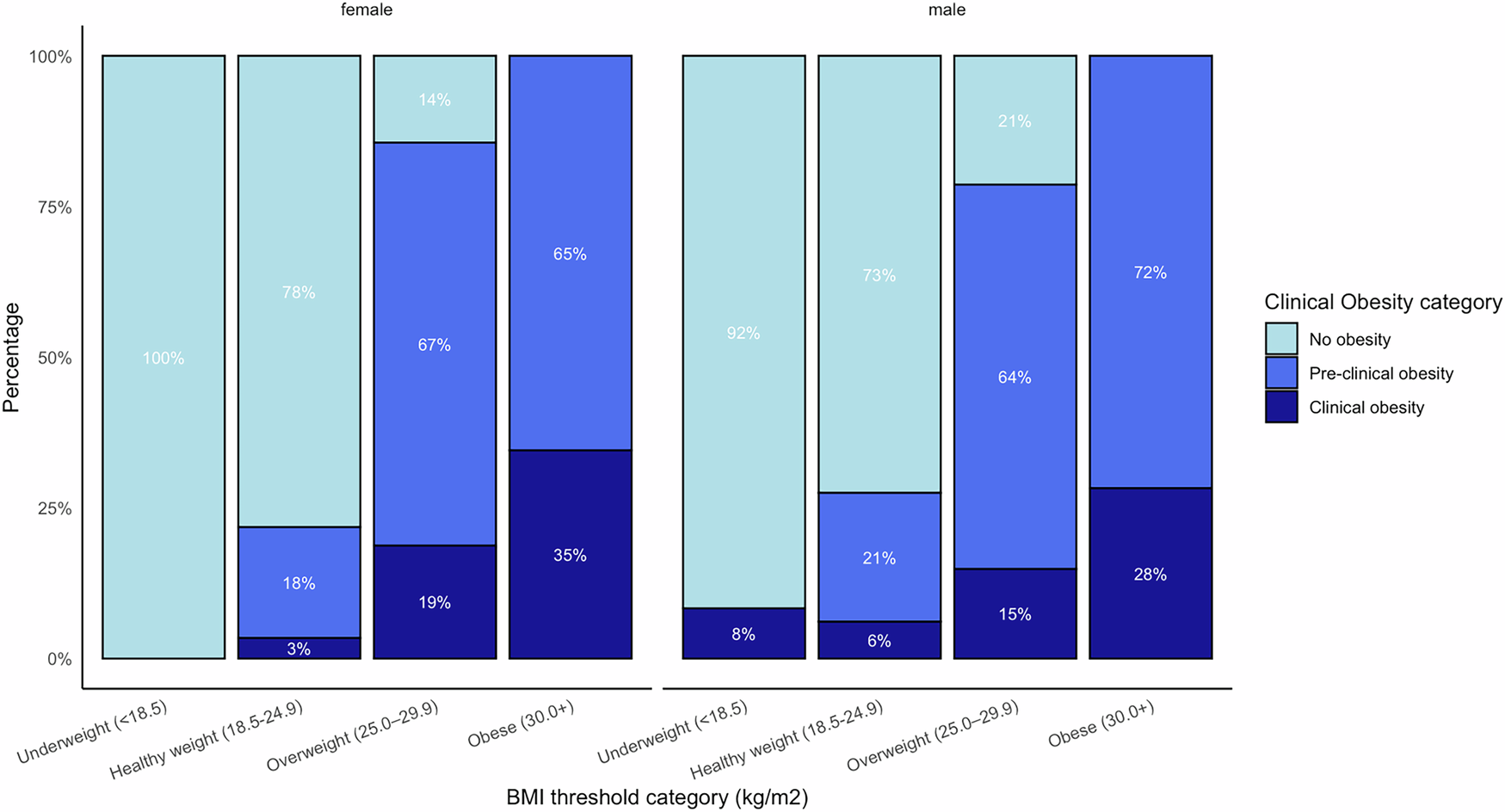
Comparison of clinical obesity and BMI category classifications in the overall sample (n = 6978), females (n = 3635) and males (n = 3343).
Among subjects with obesity defined based on BMI, only 31.4% met the criteria for clinical obesity, with the remainder having preclinical obesity. Among individuals with a BMI in the overweight range, 65% had preclinical obesity, 16.6% met the criteria for clinical obesity, and 18% had no obesity under the new classification.
Among underweight individuals, 98% were also categorized as having no obesity, and only one underweight subject met clinical obesity criteria. Characteristic differences were broadly similar across both definitions. Individuals in the highest classification (BMI-defined or clinical obesity) were more likely to be female, to abstain from alcohol, to have lower educational attainment, and to work in manual occupations. Agreement between classifications was stronger among women than men.
Those with clinical or BMI-defined obesity also had poorer health, spent more time sedentary, slept less, and engaged in less physical activity. Overall, 27 individuals died by age 51 years. Clinical obesity was associated with higher five-year mortality odds than no obesity; the increase observed for preclinical obesity was statistically inconclusive. Being overweight or having obesity based on BMI showed no statistically significant association with mortality relative to a healthy BMI.
Conclusions
Overall, the results indicate that the new clinical obesity classification may be more meaningful than using conventional BMI definitions. Around 69% of individuals with BMI-defined obesity were classified as having preclinical obesity rather than clinical obesity, indicating considerable heterogeneity in this BMI category.
Clinical obesity was associated with higher five-year mortality odds, suggesting the new criteria may identify health risks not fully reflected by BMI, but the small number of deaths limits the strength of this evidence.
The new classification approach could also inform clinical care stratification and research. Additional studies are required to validate the criteria across age groups, sexes, ethnicities, and settings. Clinical obesity prevalence may also have been underestimated because participants missing adiposity assessments had higher average BMIs.
Further research must establish whether the criteria improve long-term risk prediction before they are used in individual clinical decisions.
 Obesity impairs key immune cells but bariatric surgery reverses damage