From what’s on the plate to how it’s served, this new research reveals how everyday parenting choices can shape children’s lifelong attitudes toward fruits and vegetables, and offers a practical way to measure it.
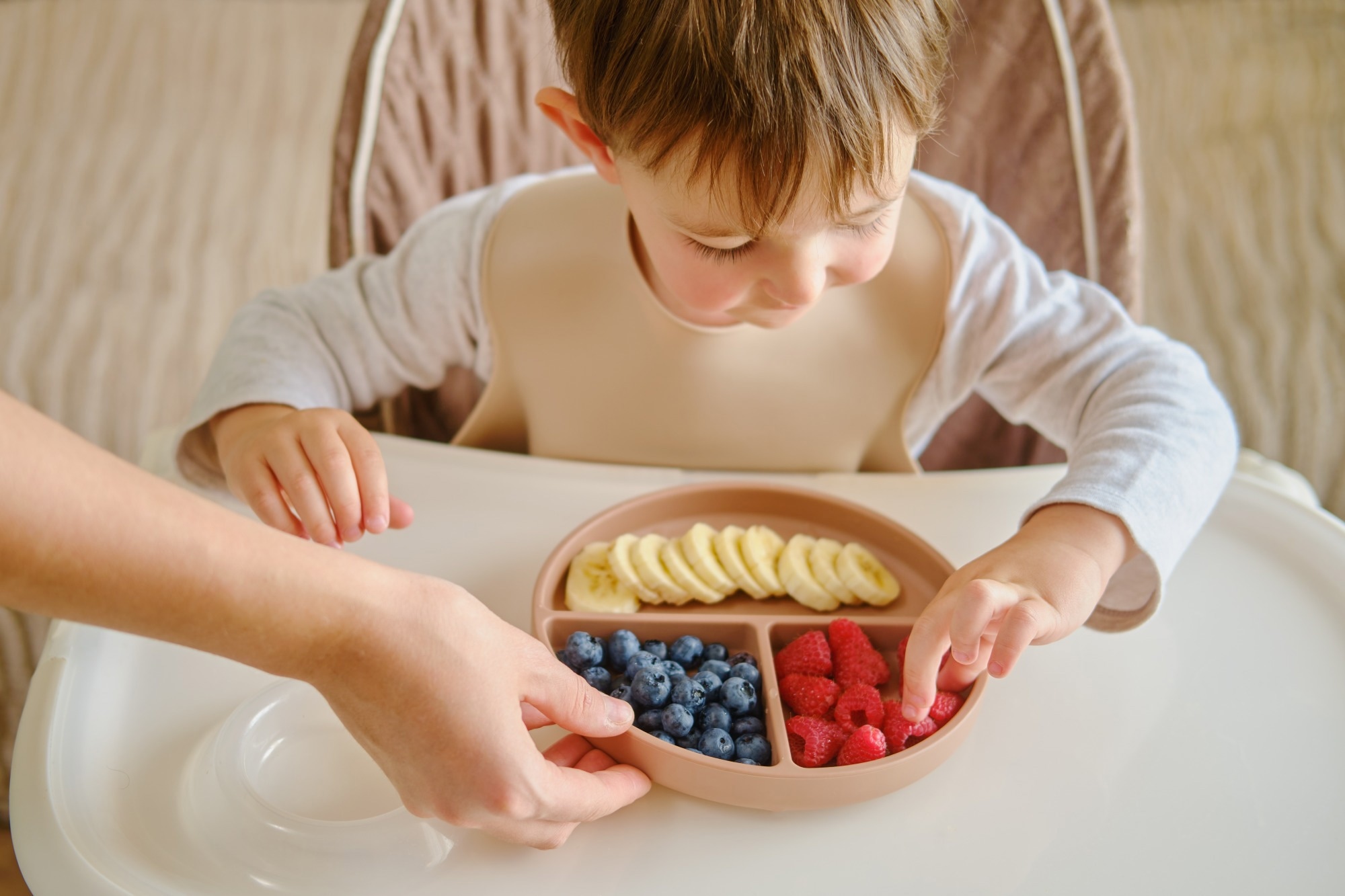 Study: Fruit and Vegetable Parenting Practices in Preschoolers: Initial Examination and Cultural Equivalency of a New Measure. Image credit: Zhuravlev Andrey/Shutterstock.com
Parenting practices may shape lifelong food habits, including fruit and vegetable consumption. Yet there are few validated tools to evaluate such practices. A study in Nutrients reports the development of a parenting practices questionnaire specifically focused on fruit and vegetable intake, designed to be culturally inclusive and potentially applicable across diverse low-income populations and settings.
Parenting behaviours shape early taste preferences and habits
Despite the undisputed value of fruit and vegetable (FV) intake to health, most American children eat too little of these items. For instance, only ~7 % of adolescents meet recommended fruit intake, and only ~2 % meet vegetable recommendations, compared to daily fruit and vegetable consumption by ~68 % and ~51 % of young children, respectively. FV eating habits affect long-term health and food waste, with FV being the largest component of food left on school trays in the US.
Parental roles include ensuring FV is available and encouraging its consumption. Young children typically are slow to accept new foods, especially when, like many vegetables, they are non-sweet and have a variety of textures. Culture plays a major role in vegetable preparation and presentation, and shaping children’s expectations.
Parental approaches include eating and enjoying vegetables themselves, presenting them attractively, and repeatedly exposing young children to these tastes (often at least 8–10 times for vegetables).
The relative efficacy of such strategies needs to be assessed and compared, yet there are few validated tools to measure FV-promoting parental practices in early childhood, as distinct from overall food intake. Existing tools often focus solely on vegetables or rely on unvalidated concepts. They often fail to gauge the cultural relevance of such concepts in diverse groups.
The current study sought to fill this gap by developing and testing a new measure of FV parenting practices in a racially/ethnically diverse, low-income sample of preschool children enrolled in Head Start programs.
Three-phase design builds and refines questionnaire tool
The researchers used data from a large study of parental FV practices. The original study comprised three phases, the third being the focus of the current paper:
- Phase 1: Preliminary identification of important areas in parental practices from a review of existing measures. This led to the generation of a 107-item questionnaire covering eleven key areas
- Phase 2: Further analysis and revision of this list by adding more data. This was compiled from discussions on FV strategies, held within 18 diverse focus groups consisting of 62 parents (primarily mothers) of preschoolers enrolled in Head Start programs
- Phase 3: The questionnaire was reduced to 21 items across four subscales. The final questionnaire was administered to 281 newly recruited parents of 3–5-year-old children
Four key parenting behaviours linked to fruit and veg intake
The phase 3 participants included mostly mothers, with a mean age of 31.9 years. Approximately 38 % and 36 % were Black or Hispanic White, respectively, with 27 % White. When stratified by body mass index, 24 % were at a healthy weight, 29 % were overweight, and 43 % were obese. The average age of the children participating in this phase was ~4.35 years, with about 38 % classified as obese and 9 % overweight.
The questionnaire was reduced using a series of methods, including principal component analysis (PCA) and confirmatory factor analysis, to identify common patterns and refine the measure.
In addition, the researchers chose items asking specifically about fruit or vegetables rather than both together. This allowed the questionnaire to be reduced to 21 items across four subscales: availability, modeling, child-focused, and pressure.
The items in each subscale demonstrated internal consistency, indicating that they all measured the same concept and strengthening the subscale's reliability.
Across cultural and racial-ethnic groups, the subscales measured the same factors similarly (meaning the questionnaire captured the same underlying behaviors across groups), indicating configural invariance. Moreover, metric equivalence was observed (indicating similar relationships between questions and underlying constructs across groups). Scalar equivalence also held in three of the subscales (suggesting comparable scoring across groups).
The exception was the child-focused subscale, where Hispanic parents differed from White parents in three of five items. Hispanic parents focused more on having prepared FV readily available and within reach, while White parents focused more on including the child in preparation.
These subscales correlated with other validated measures of parental feeding practices, such as the Child Feeding Questionnaire and the Caregivers’ Feeding Style Questionnaire. Criterion validity was supported by associations with children’s fruit and vegetable intake over the previous week, though these correlations were modest in strength. The scores were not associated with the child’s BMI, parental education, income, or age, indicating their applicability to diverse samples.
Similarly, the questionnaire was correlated with parents’ preferences for fruits and vegetables, and children’s preferences for vegetables. These indicate the initial validity of this new measure to some extent and support the importance of parental behavior in determining FV availability and presentation.
The questionnaire was relatively brief and straightforward to administer, indicating its value for research and for evaluating interventions. The use of separate subscales rather than collapsing them into a single area of “responsiveness” permits a more detailed study of FV preferences and consumption, as well as health outcomes among young children. Importantly, this allowed the authors to capture “both responsive strategies and also some of the most commonly utilized non-responsive parenting practices that constitute pressure.”
Another advantage of this study was the separate exploration of parental practices for feeding vegetables compared with those for feeding fruits.
Strengths and limitations
The study has several strengths, including the development of a brief, easily administered questionnaire suitable for diverse populations. It employed a rigorous multi-phase approach that integrated existing measures with new qualitative and quantitative data and drew on a racially and socioeconomically diverse sample of parents, thereby enhancing the relevance of its findings.
However, the study also has some limitations. Using a convenience sample rather than a random sample introduces the possibility of selection bias. Additionally, the inclusion of only Hispanic, White, and Black participants limits the generalizability of the findings to other groups. The questionnaire was not assessed for temporal (test–retest) reliability, and overall validation was limited, as the cross-sectional design precluded any conclusions about causality.
New tool offers a practical way to assess fruit and veg consumption
The researchers conducted initial validation analyses of a new questionnaire that could be easily used to assess parental behaviors related to children’s FV consumption. Initial validation and measurement equivalence were established across three ethnic-racial groups. Future research is required to assess parenting practices for FV intake in larger samples and to confirm reliability and longitudinal associations.
Download your PDF copy by clicking here.
Journal reference:
-
Shriver, L. H., and Buehler, C. (2026). Fruit and Vegetable Parenting Practices in Preschoolers: Initial Examination and Cultural Equivalency of a New Measure. Nutrients. DOI: https://www.mdpi.com/2072-6643/18/6/974. https://www.mdpi.com/2072-6643/18/6/974
 Transposable elements cause majority of lethal mutations in fruit flies