Eye-tracking experiments reveal a curious contradiction: people tend to avoid looking at spiders when other creatures are present, yet striking features such as large eyes, bright colors, and webs still draw their gaze back.
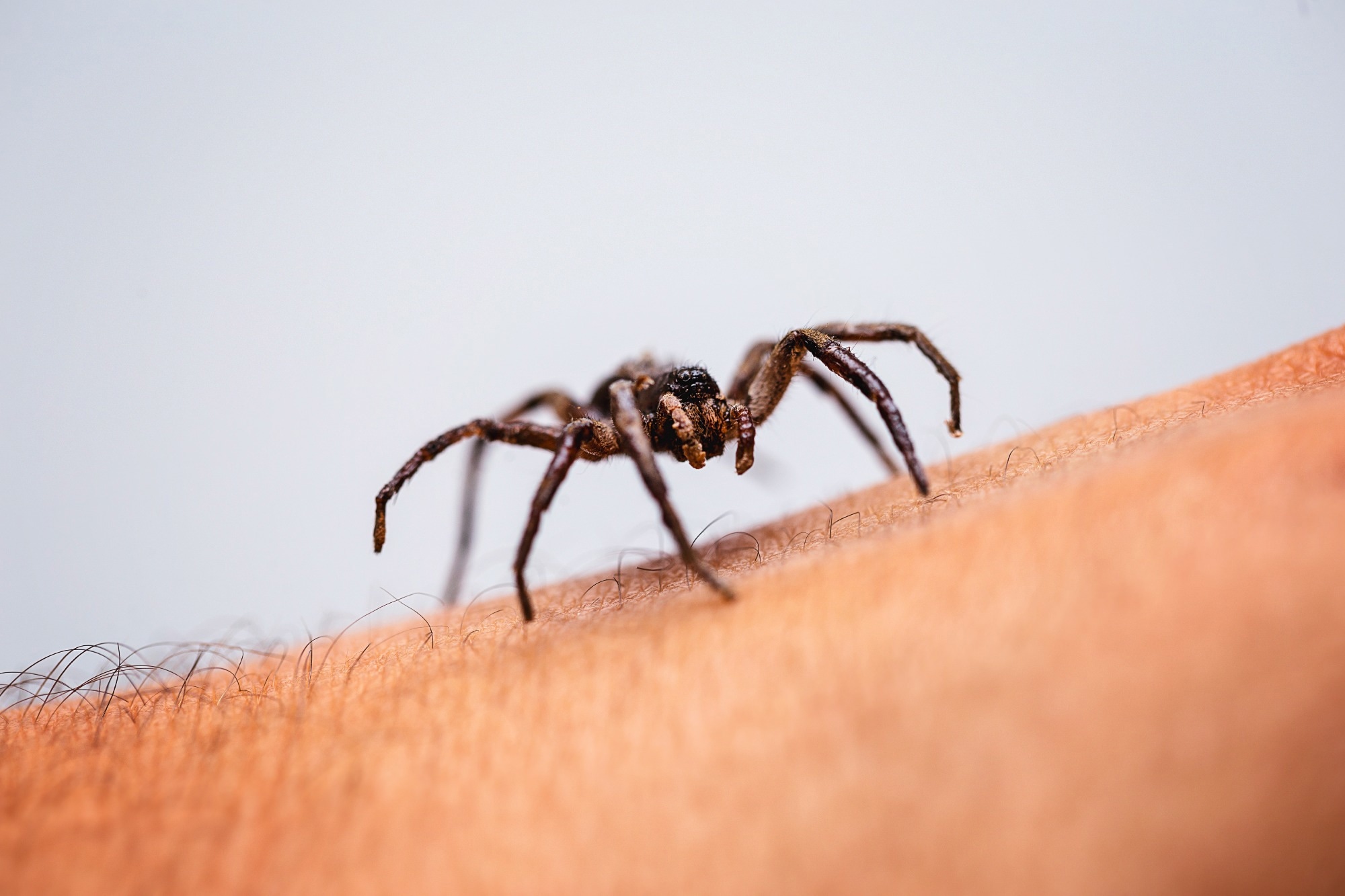 Study: Human eyetracking reveals a general avoidance of spider images but a bias toward spider-specific features. Image credit: RHJPhtotos/Shutterstock.com
Spiders are often regarded with fear and disgust. But what drives this reaction? A recent study published in the journal Frontiers in Arachnid Science examined the visual features that influence how people view spider images.
Why spiders trigger fear, disgust, and visual attention
Intensely negative feelings about spiders not only inhibit human-nature interactions but may hamper spider conservation initiatives. One way to evaluate a phobia is through attentional bias, the way a given stimulus attracts and holds attention.
A phobia is an anxiety disorder. According to the vigilance-avoidance hypothesis, anxious people often reflexively pay attention to a visually threatening image but subsequently avoid paying attention to it using conscious effort. Another view is that more anxious people pay selective attention to threatening stimuli and tend to return to them more often because of difficulty with disengagement from perceived threat. Eye-tracking methods could help test these hypotheses by offering a direct evaluation of visual attention.
The order, number, duration, and timing of gaze fixation on a single location (visual fixation), as well as the length of saccades (eye movements between fixation points), are strongly associated with visual attention and emotional states. When emotionally aroused, such changes in eye movements can occur, including looking more frequently, sometimes for shorter periods, and more frequent involuntary gaze switching.
Therefore, this study used visual attentional details to monitor attention patterns in young adults viewing images of spiders and other insects.
Prior research has shown that several spider features elicit fear and disgust, including: chelicerae; hairiness; fast, jerky, and unpredictable movement; dark coloration; fangs; and the ability to bite. Interestingly, both entomologists who dislike spiders and spider-phobic individuals at large share the same dislikes, apparently insurmountable even with habitual contact and learning about them.
Earlier studies have suggested that people with spider phobia fixate on spider images more quickly but do not easily disengage from them. The current study used a free-view framework to assess how much attention participants paid to spiders relative to other arthropods and which visual features of spiders drew the most attention.
Eye-tracking experiment compared spiders with other arthropods
The study involved 118 undergraduates who saw single and paired images of spiders and other arthropods (invertebrates with jointed legs) against a natural background. Their eye movements were monitored during the viewing.
They also provided data via a survey on spider phobia and attitudes towards spiders. Markers of increased tendency to pay attention included:
- Total dwell time – how much time was spent in total on each type of image – a measure of attentional bias
- First run dwell time – how much time was spent on an area of interest during the first visit
- First fixation time – how much time elapsed from the beginning till the first image is fixed on by the eye
- Run count – how many times the participant returns to the same image – associated with attentional bias
Study findings
Spiders versus other arthropods
When participants were shown paired images of spiders and butterflies, they initially spent similar time examining both images, spent similar total time on both, and made similar repeated looks at both images. However, the time to first look at the spider image was longer compared to the other.
When spider images were paired with images of insects other than butterflies, arachnids other than spiders, or myriapods like millipedes or centipedes, participants showed, in several comparisons, faster initial fixation on and longer viewing of other arthropods than spiders. They repeatedly viewed other images (except for other arachnids) more often than spiders.
Initial engagement with scorpion images was briefer than with spider images, with other features being similar.
While women looked longer at butterfly images than at spider images, the converse was true for males. Men also looked longer at non-spider arachnids than women, though the study reported complex interactions between sex, image type, and phobia level in some comparisons.
For all measures, people tended to take longer to initially fix on a spider image, to dwell on such images for shorter overall periods, and to repeat their gaze fewer times. Jumping spiders and insects were viewed much longer and received attention much sooner than other spiders.
The findings suggest that humans generally avoid looking at spider images relative to other arthropod images, preferring to look at pictures of other arthropods. Participants still looked at spiders during trials, but they were less likely to fixate on them first. They also showed limited evidence of avoiding scorpion images when paired with other arachnids, indicating a possible aversion to both spiders and scorpions, although the study did not directly compare spiders and scorpions.
Paired spider images
When both images in the presented pair depicted different types of spiders, the viewer paid more attention to spider-specific features. These included coloration, larger eyes in jumping spiders, spiders on a web or with eggs, prominent fangs, and spiders that were less hairy rather than more hairy
This was an interesting observation, as these features might be expected to intensify negative reactions to the spider images rather than draw attention.
The authors suggest that this may simply be due to the image's greater attention-drawing capacity. Alternatively, some of these features (web or egg) suggested a stationary spider (and therefore a lesser threat) rather than one that might move unpredictably at any moment. The authors also suggest that cues associated with predictable behavior, such as spiders guarding eggs or sitting on webs, may feel less threatening than spiders on the ground that could move unpredictably.
Non-spider insects with two prominent eyes showed increased attentional bias similar to that of jumping spiders. The authors hypothesize that this may be because they have a face-like appearance, which is a powerful attention cue. The researchers note that these features may trigger anthropomorphism, in which animals with forward-facing or prominent eyes resemble human facial cues and thereby attract attention.
Unlike earlier studies, participants rapidly discriminated between spiders and non-spider arachnids, as they did between other arthropods, suggesting that they were not influenced by any “spider-like” category. On the other hand, knowing which features of spiders arouse positive attention and curiosity rather than avoidance could help convince people that spiders are not just nasty, dangerous bugs but necessary participants in the environment.
Understanding spider perception could improve conservation messaging
The study suggests a complex pattern of visual attention: people avoid looking at spiders when alternative arthropod images are available, but notice certain aspects once they do look at them.
This study contributes to our foundational understanding of how threat, curiosity, anthropomorphism, and predictability interact to guide visual attention to spiders.
These findings might help uncover which visual components contribute to spider phobia and, thus, how it can be countered more effectively.
Download your PDF copy by clicking here.
 Stronger connection found between cannabis use and mental illness